3D Printed Jigs and Fixtures Can Help Boost your Productivity



Liuzhou JingDa Automotive Brake Tube Manufacturing Co., is a leading supplier for SAIC Motor for break tubes for both Micro and Passenger cars. Mr. Bian, the technical director of JingDa, says that 3D printing is certainly having a tangible impact on how break tube engineers create solutions that improve the effectiveness of production lines while enhancing the effectiveness of the tubes.
Everything JingDa does with 3D printing revolves around aiding in one or more of three benefits: quality, productivity, and increased effectiveness. In fact, those pillars are arguably at the core of any factory around the world.
Here’s a look at JingDa Automotive’s brake tubes. There are 6 sorts of brake tubes, at least, required on every single vehicle, some require 8 kinds or more. Each and every tube needs test fixtures to measure them to see if they’re in spec.
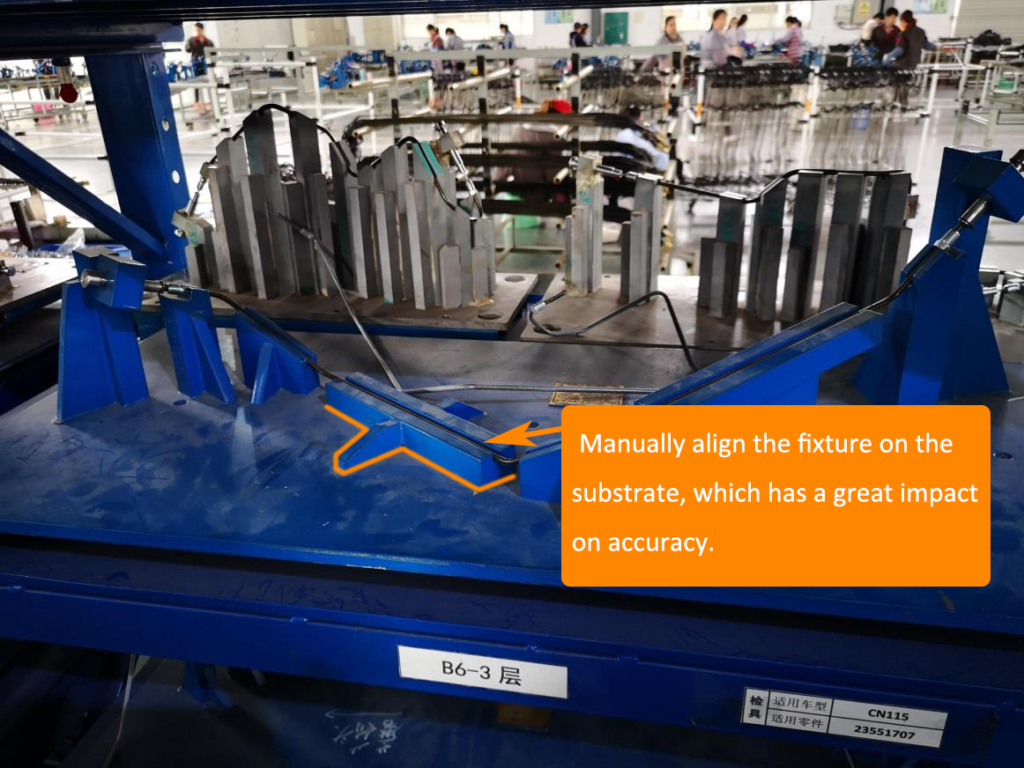
Traditional brake tube fixture
Traditional fixtures can’t test these tubes quickly enough. They also can’t test them accurately according to the key position and the tortuosity of the brake tubes. The quality and the precision that FDM 3D printing brings to the table can satisfy the conditions required.

Traditional brake tube fixture
In order to complete a whole project in one week, the company will need 2 sets of 3 meter long fixtures to inspect a fixture line. To complete this task Jingda reached out to Deed 3d printing company. With more than 40 Stratasys Fortus printers, Deed3D have very short turnover time. Indeed the delivery of the fixtures was completed within 5 days.
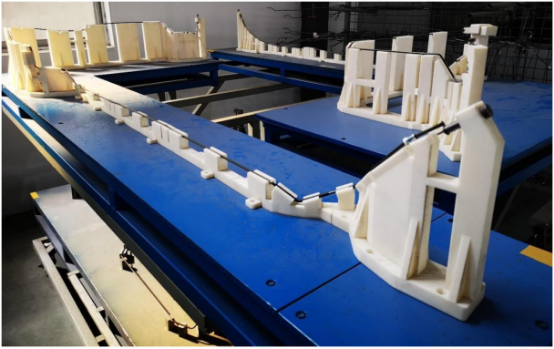
ABS-M30 material printed on Stratasys 900MC printers, 500mm to 800mm length model.
Comparison between CNC and 3d printing fixtures
|
mode of production |
Original CNC Production |
Stratasys FDM 3D Printing |
|
Production Method |
After each independent inspection fixture is completed, all inspection fixtures are fixed on the substrate by means of bonding. |
Print in one piece, or print in sections, and then fix it on the substrate. |
|
Cost |
The cost of the two methods of production is not very different |
|
|
Time |
The production time is long, it is difficult to control the delivery period, and it will affect the project progress. |
The turnaround time is short and controllable. It can be controlled according to its own production schedule without affecting the project schedule. |
|
Production difficulty |
The more curved detection parts will make the production of the inspection fixture difficult and the accuracy difficult to control. |
The degree of bending of the product has nothing to do with manufacturing difficulty, and the accuracy is easy to control. |
|
Accuracy |
Low accuracy caused by splicing fixture |
Accuracy is much higher than the customer requirement |
|
Data requirements |
2D projection + height marking |
3D data, need to redraw |
|
Convenience |
Heavyweight solid material, inconvenient to use |
Sparse printing, lightweight, easy to use |
Subscribe to Our Email Newsletter
Stay up-to-date on all the latest news from the 3D printing industry and receive information and offers from third party vendors.
Print Services
Upload your 3D Models and get them printed quickly and efficiently.













You May Also Like
AM Investment Strategies 2026 Sets the Stage for AMS 2027
AM Investment Strategies 2026 Nov. 5 · 12 p.m. ET · Free online event RESERVE YOUR SPOT ↗ A one-hour online discussion featuring some of the biggest names in 3D...
With Its Latest $200M Round, ICON May Be Running Away With the 3D Printed Construction Market
I used to view ICON, the Austin-based additive construction (AC) firm, as one of a handful of companies that could realistically consider itself the leader of the 3D printed construction...
How Should Businesses Build New Business? Dirk Simon Weighs In — Part 1
Dirk Simon had deep experience in materials and chemistry before joining the 3D printing industry. Instrumental in BASF and Farsoon’s market introduction, Dirk has spent a lot of time thinking...
3D Printing Services Near $2.5B as AM Market Shifts Beyond Hardware
The additive manufacturing market may be growing again, but one of the more interesting numbers behind that recovery has little to do with selling 3D printers. AM services generated nearly...