Metal Powder Supplier Elementum 3D Added to $46B Air Force Contract


Elementum 3D, a Colorado-based developer and supplier of metal powders used in additive manufacturing (AM), announced that the company has been added to the vendors list in the fourth on-ramp of the US Air Force’s $46 billion Enterprise-Wide Agile Acquisition Contract (EWAAC). In September, 2021, the Air Force Life Cycle Management Center at Florida’s Eglin Air Force Base (AFB) named the first 55 awardees to the EWAAC vendors list, in an Indefinite Delivery, Indefinite Quantity (IDIQ) contract anticipated to last through 2031.
As the name implies, IDIQ contracts are used by the federal government in circumstances where the exact parameters of its needs for certain goods and/or services — in terms of both amounts and delivery deadlines — aren’t yet known. The specific purpose of the EWAAC is to accelerate the processes by which the Air Force acquires “innovative weapons systems”.
In particular, the EWAAC initiative is focused on implementing digital acquisition processes. Including Elementum 3D, 122 vendors were added to the EWAAC portal in this latest on-ramp, with the vendors list now totaling almost 300 names.
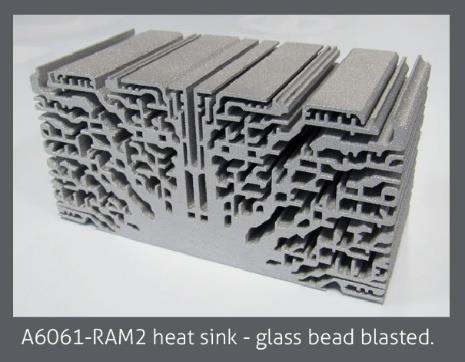
Heat sink.
In a press release about Elementum 3D’s addition to the vendors list for the Air Force’s EWAAC contract, the CEO and founder of Elementum 3D, Dr. Jacob Nuechterlein, said, “The Elementum 3D team is ready to develop innovative capabilities that align with the nation’s defense needs. Our history runs deep with the US Air Force, and we are honored to be part of this contract in support of the US armed forces.”
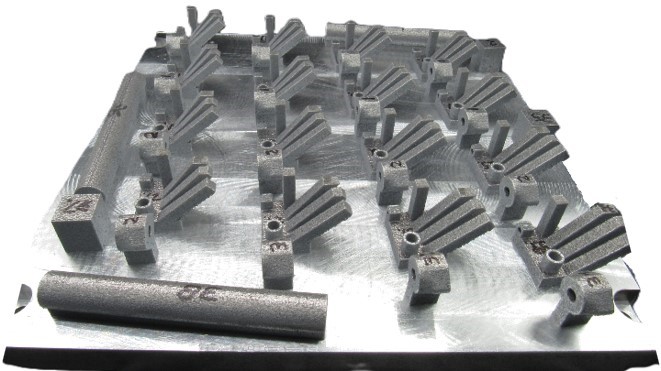
Application testing of A6061-RAM2 for PBF-LB AM.
Some of Elementum 3D’s most recent work with the US Air Force includes a material characterization agreement surrounding specialized aluminum alloys for powder bed fusion (PBF), as well as an SBIR Phase I contract from Air Force innovation accelerator AFWERX for R&D into “permeable AM”. Elementum’s patented Reactive AM (RAM) process utilizes sub-micron ceramic reinforcements to enable the creation of printed components with properties that closely resemble conventionally manufactured counterparts.
From any angle, Elementum 3D’s addition to the EWAAC vendors list is impressive, but it is especially impressive insofar as, currently, the company appears to be the only metal powders specialist on the list. But there are many other familiar names to the AM world found amongst the 297 in the EWAAC portal, including Ursa Major, Firestorm Labs, and Divergent.
The addition of a metal powder supplier would seem to suggest that the Air Force is anticipating increased demand for powder-based AM parts. If we can draw assumptions from the AM-relevant names on the EWAAC list — along with what the Air Force and DoD have been signaling, more broadly — propulsion solutions and drones are the most likely drivers for such increased demand.
With all that in mind, as big as it is, in-and-of-itself, the EWAAC contract should have long-term implications far beyond its own boundaries. Given how quickly the DoD’s procurement needs are changing nowadays, IDIQ could ultimately become the routine way the agency does business, and that is a state-of-affairs that would require a digital acquisition ecosystem to be the foundation around which the rest of the future defense industrial base is built. 3D printed drones and rocket engines are an ideal starting point for testing the validity of that concept. Eventually, the EWAAC can serve as a mechanism to gradually incorporate the concept into the workings of the DoD at large.
Images courtesy of Elementum 3D
Subscribe to Our Email Newsletter
Stay up-to-date on all the latest news from the 3D printing industry and receive information and offers from third party vendors.
Print Services
Upload your 3D Models and get them printed quickly and efficiently.













You May Also Like
The Two Paths to AM Print Services Market Growth
AM Research New market research: AM Research is building its new Additive Manufacturing Services Market 2.0 model. Learn more about the report and preorder here → Things continue to heat...
Additive Manufacturing Has a Major Growth Opportunity; Trust Will Decide Who Captures It
After years of overpromising, the next phase of AM growth will be won by companies that consistently deliver what they say. When I entered additive manufacturing in 2014, after 15...
10 Years of Multi Jet Fusion: Onsite at HP’s Vancouver, Washington Facility
At this year’s RAPID event in Boston, HP Additive Manufacturing Solutions celebrated ten years in the additive manufacturing (AM) market. The company ushered in the milestone with several innovations, including...
ADDMAN to Buy Up to $10.8M in Nickel 718 Powder from 6K Additive Over 30 Months
After years of buildup, we’re finally starting to see what the US metal additive manufacturing (AM) market could look like at scale. To be sure, it’s still not quite there,...