Arburg Owners Purchase German RepRap


Among the first fused filament fabrication (FFF) startups to industrialize its technology, German RepRap has held a unique position in the additive manufacturing (AM) space. Now, the company may see that position grow even larger, as German RepRap has been sold to the owners of Arburg, a substantial machine manufacturer specializing in injection molding.
Born out of the open source RepRap movement, German RepRap was founded in 2010. Unlike other firms that were attempting to compete with MakerBot by introducing low-cost, desktop systems, German RepRap aimed at the industrial market, focusing on high-quality components and architecture.
The company launched the x400, one of the earliest large-scale FFF 3D printers, which featured a build volume of 400 x 400 x 350 mm. In 2014, this was overshadowed by the even larger x1000, which had a build volume of 1000 x 800 x 600 mm. By 2016, it had introduced a new technology it called liquid additive manufacturing (LAM), capable of depositing materials such as liquid silicon rubber. Throughout this time, German RepRap took on such large customers as Airbus and partners as Dow Chemical.

German RepRap L320 3D printer [Image: German RepRap]
In 2013, the company launched the Freeformer 3D printer. The Freeformer relies on a proprietary method that processes standard injection molding pellets using a piezoelectric screw and deposits individual droplets at a rate of up to 200 droplets per second with a diameter of 0.2 and 0.4mm, depending on the nozzle size. By using pellets, the technology is open to a much broader range of less expensive materials.
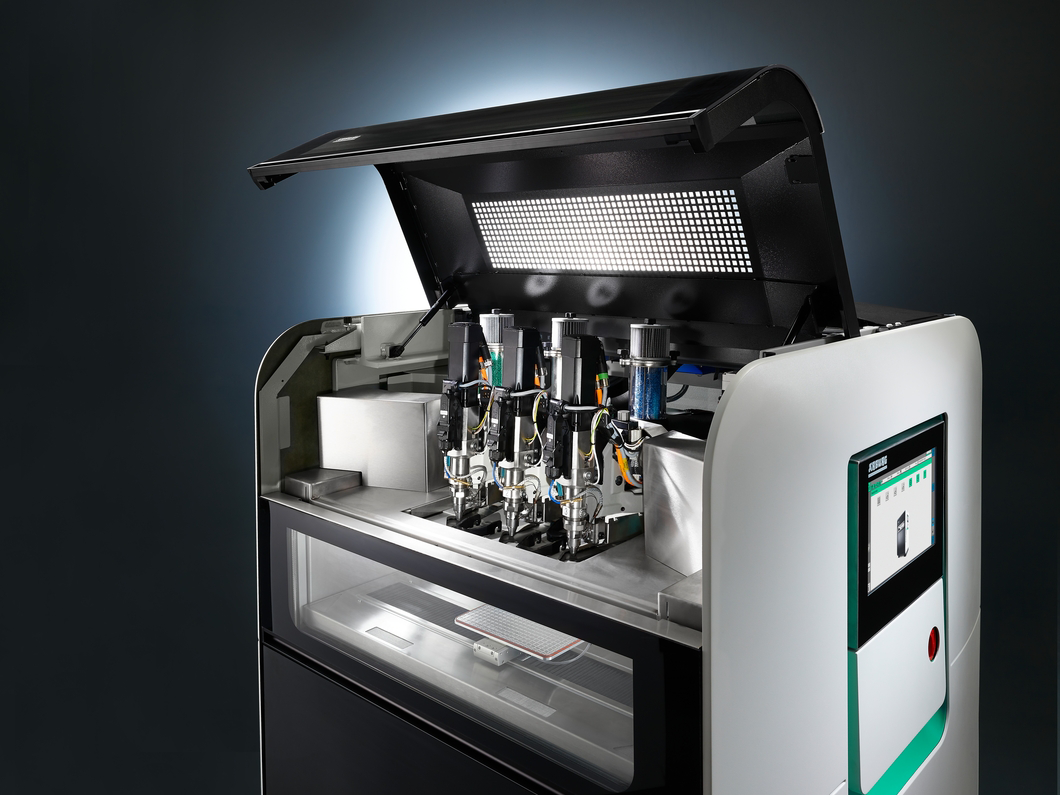
The Arburg Freeformer. Image courtesy of Arburg.
Materials listed on the Arburg site range from ULTEM 9085 (approved for and widely used in aerospace 3D printing applications) to wide varieties of ABS, TPU, and carbon fiber (all shown printed in a single part). There’s even a cellulose-based soluble polymer printed as a medication tablet, demonstrating the possibility of 3D printing medicines.
Initial exploratory conversations between German RepRap and Arburg led to an acquisition deal. While the 3D printing startup will now be owned by the larger manufacturer, it will operate as a separate company, maintaining existing staff and leadership.
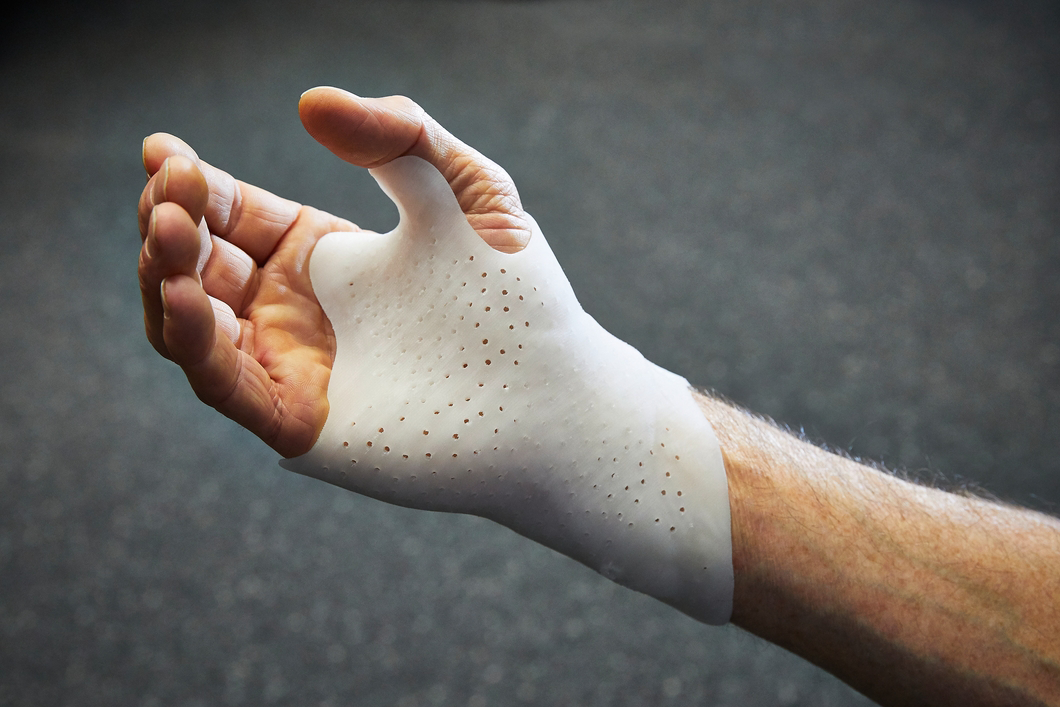
The medical material TPE Medalist MD 12130H (hardness 32 Shore A) is suitable, for example, for producing flexible, customised hand orthoses.
The two companies should obviously complement one another. Arburg will now be able to offer a broad range of AM equipment alongside its Freeformer system. This means, for instance, that Freeformer customers who need to print with silicone can turn to the L320 LAM 3D printer from German RepRap. The x400 could be sold as an introductory machine before turning to the Freeformer.
Via Arburg, German RepRap now has substantial financial resources from its parent company, as well as broad industrial experience. Perhaps more importantly, it has access to Arburg’s customer base, which spans the world of manufacturing. Given Arburg’s long-standing legacy, it would be surprising for the acquisition not to benefit both companies but gauging the success of Arburg in the AM market so far is difficult to do. Despite the Freeformer’s unique technology, it has not quite made the impact that was anticipated when it was first released. In 2017, however, Arburg added to its additive team and improved the technology, so all of that may be ready to change with the purchase of German RepRap.
Subscribe to Our Email Newsletter
Stay up-to-date on all the latest news from the 3D printing industry and receive information and offers from third party vendors.
Print Services
Upload your 3D Models and get them printed quickly and efficiently.












You May Also Like
Bambu Lab 3D Printers Bring a 166-Million-Year-Old Dinosaur Back to Life
Fourteen desktop 3D printers spent seven weeks producing the bones of a dinosaur that lived roughly 166 million years ago. The result is now on display at Blenheim Palace in...
3D Printing Financials: Creality Warns of H1 Loss Ahead of Earnings Report
Creality (HKG: 3388) is expecting to report a loss for the first half of 2026, just months after the 3D printer maker went public in Hong Kong. In a profit...
Kupros Launches Cu29 V2, Announces Process for Embedded Electronics from Desktop FFF & FDM
In addition to its more traditional uses, the centrality of copper to an unusually large number of high-growth industries has led more than a few observers to argue that it...
Bambu Lab and Insta360 Invite Makers to Build Custom Camera Gear
Bambu Lab is expanding the role of MakerWorld, its community platform for 3D printable models. The company has partnered with camera maker Insta360 to launch the Luna Ultra Design Challenge,...