3D Print Mass Customized Grippers Thanks to trinckle

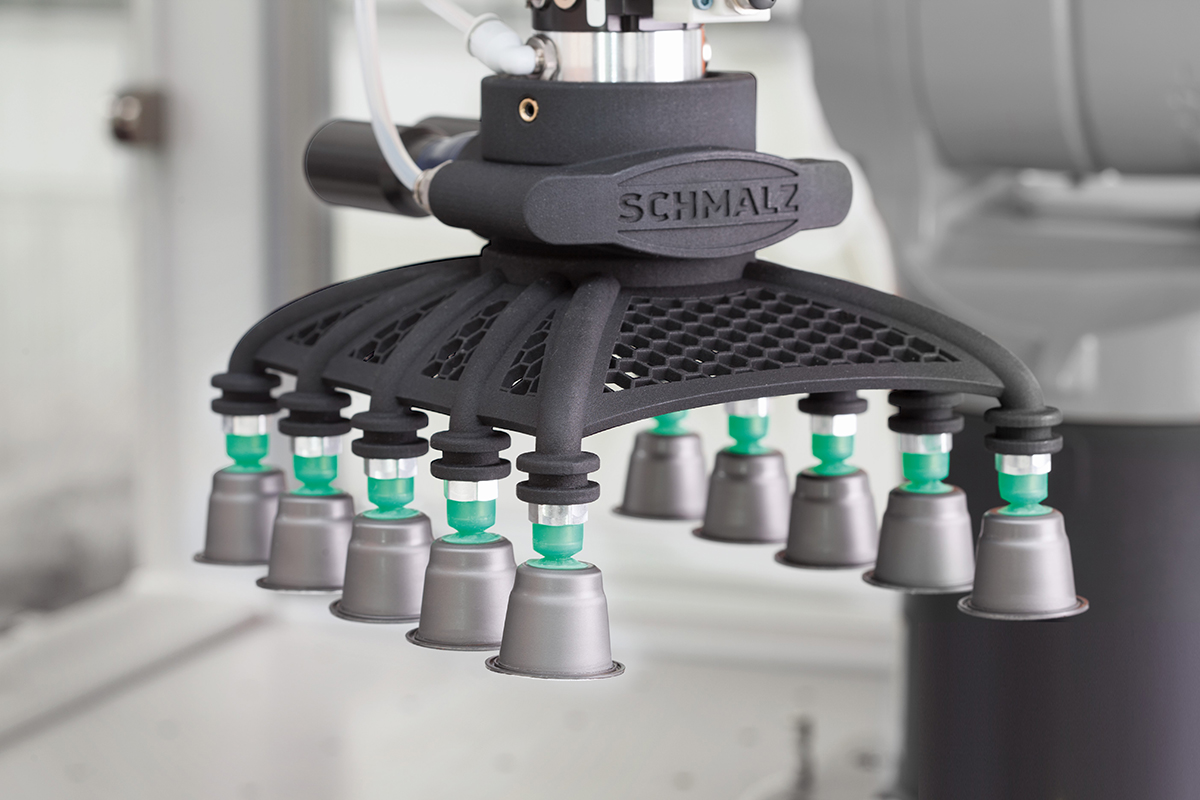
3D printed tooling has now proven itself on the factory floor, but AM has yet to fully fulfill its transformative potential across manufacturing. Still, we are seeing bits and pieces of that transformation unfold. The latest example is a new partnership between trinckle and vacuum gripper producer Schmalz GmbH to 3D print custom robotic grippers on demand.
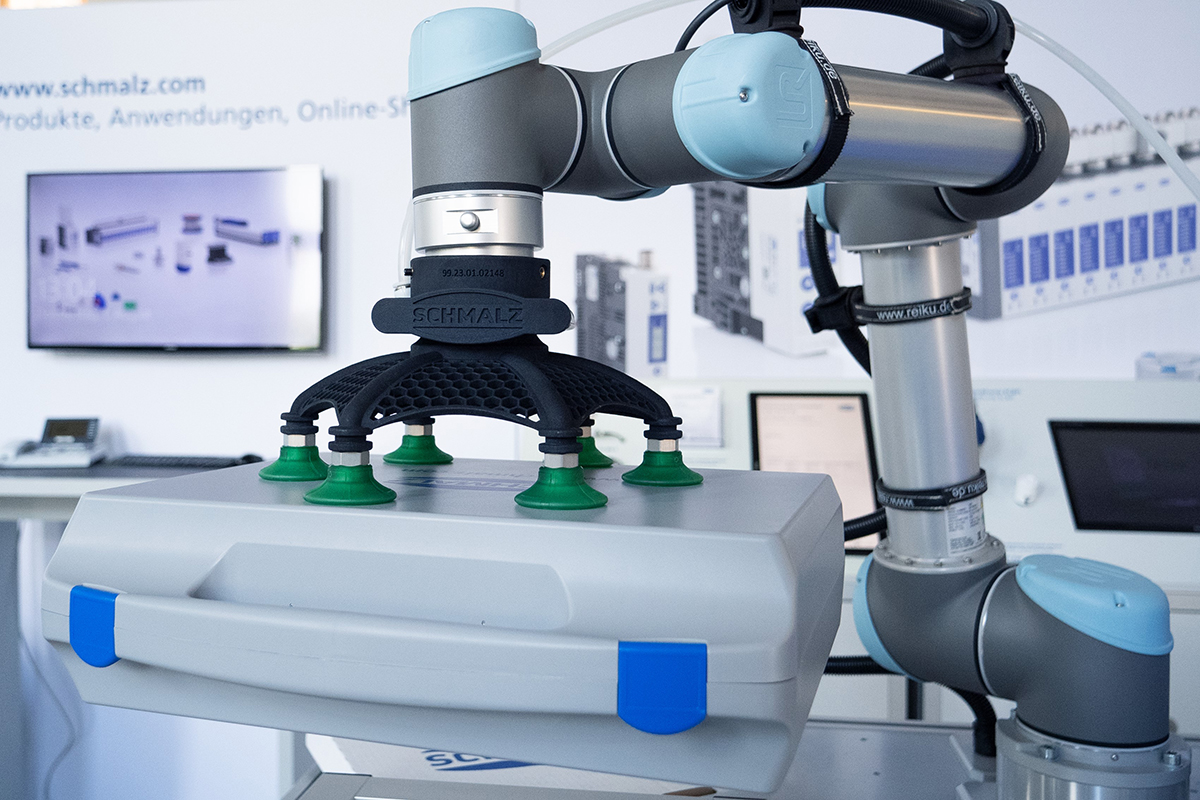
Schmalz, a German company with 1,500 employees globally, began its reach into the world of vacuum and gripping technology in 1984. In its journey to becoming a leader in the sector, the firm adopted 3D printing for use in product development and small series production. The team at Schmalz understood that, as automation increasingly impacts the production environment, new and unique handling applications ultimately require new individual gripping devices. As a result, a one-size-fits-all gripper can’t perfectly grip the vast variety of objects that need to be gripped.
Designing a gripper for a very specific task using CAD software requires time and expertise – time and expertise that could be spent on other jobs. For that reason, Schmalz teamed up with trinckle to create a custom gripper design app using trinckle’s paramate cloud software. The app is now integrated into Schmalz’s website so that clients can customize vacuum grippers in just minutes, according to the two partners.
The workflow runs as follows: a user first defines what the gripper will be gripping, either choosing from predefined workpieces or uploading their own, regardless of geometry. From that point, the user can then configure the gripper to match the shape of the part it will be handling.
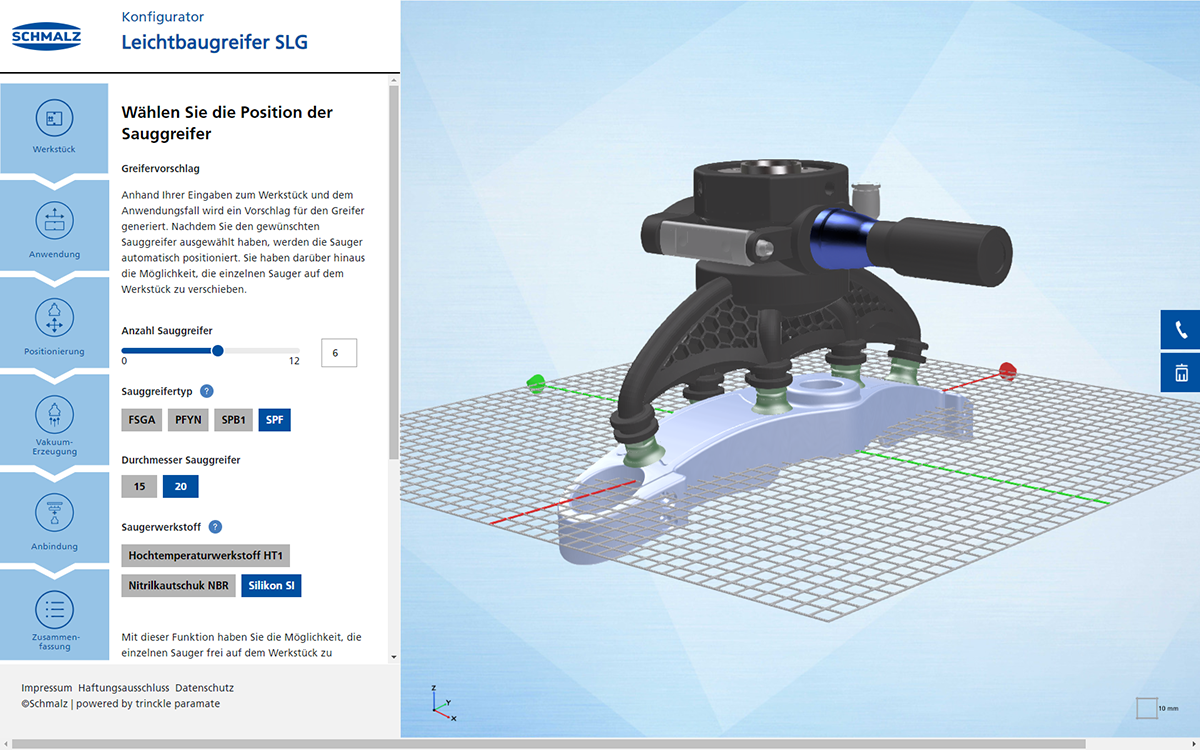
The app guides them through the process, providing recommendations based on the application—such as the diameter, type and number of suction cups—and suggesting the best location for the cups. The user can also select their own desired suction locations with the click of a mouse.
Then, the user chooses the proper flange insert and vacuum generation, at which point the customer gets their 3D printable CAD model and an offer to have it printed by Schmalz. While the process is meant to be simple enough that it can be completed in 10 minutes, the geometries of the grippers are more complex: light-weighted using rule-based algorithms.

This means that the parts are not only customized for the client, but have improved functionality, according to the partner companies. For instance, the parts are meant to reduce handling interference by incorporating air guidance into the gripper design. A robot or cobot using the gripper can hold up to 10 kilograms.
The individual application demonstrated by this partnership indicates that the world of production is slowly starting to change shape. For example, we’ve already seen new robotic grippers developed through the use of 3D printing. In fact, trinckle previously worked with Kuhn-Stoff to 3D print custom grippers using a method very similar to that described here.
However, what makes this news more interesting altogether is the future of trinckle’s software and its potential application in other fields. Paramate has already been used by Ford to automate the design of tooling. Trinckle also partnered with Luxexcel for the design of 3D-printed optical lenses.
What this suggests is that, slowly but surely, mass customization is being realized and trinckle has developed an interesting method for realizing it: deploying application-specific apps throughout industry. Now, we can observe the roll-out of new 3D printing technologies capable of handling mass production match software like paramate and, soon enough, see the entire supply chain begin to change altogether.
Discuss this and other 3D printing topics at 3DPrintBoard.com or share your thoughts below.
Subscribe to Our Email Newsletter
Stay up-to-date on all the latest news from the 3D printing industry and receive information and offers from third party vendors.
Print Services
Upload your 3D Models and get them printed quickly and efficiently.













You May Also Like
The Manufacturing Race Behind the Drone Revolution
We are in the middle of a major manufacturing shift focused on the production speed and payload capacity of uncrewed aerial systems (UAS), or drones. A recent Manufacturing Dive article...
ADDMAN to Buy Up to $10.8M in Nickel 718 Powder from 6K Additive Over 30 Months
After years of buildup, we’re finally starting to see what the US metal additive manufacturing (AM) market could look like at scale. To be sure, it’s still not quite there,...
Metal AM in a Multipolar World, Part 2: How PBF and DED Could Change by 2035
The first decades of PBF development were heavily shaped by machine capability: more power, more lasers, larger build volumes, better recoating, and improved process monitoring. These developments will continue, but...
Advanced Manufacturing at IMTS 2026: 3D Printing and AI and Drones, Oh My!
Last week’s International Manufacturing Technology Snow (IMTS) in Chicago welcomed over 90,000 attendees to the jungle that is McCormick Place. With over 1.17 million square feet of exhibit space, and...