SCC Receives Another Grant From NSF: Developing Mobile 3D Printing Platform for Training

The Additive Manufacturing Center of Excellence (AMCOE) at Somerset Community College (SCC) in Kentucky has received the National Science Foundation Advanced Technological Education (NSF ATE) grant award for the Mobile Additive Manufacturing Platform for 21st Century STEM Workforce Enhancement (Mobile AMP). This grant – the second one SCC has received from NCF – is meant to increase innovative opportunities, as well as the ‘entrepreneurship infrastructure’ in Tennessee and Kentucky.
 SCC faculty involved in AM processes and education understand the enormous benefits of 3D printing as it has already made huge impacts in applications such as manufacturing and medicine—but also quite notably, education. This was an impetus for the faculty to begin making a push for their region to do more with 3D printing than making ‘keychains and trinkets,’ recognizing that many of the schools were using ‘hobby-level’ 3D printers and not using any of the technology to its potential for manufacturing.
The staff were further inspired by companies like Hewlett-Packard (HP), Ford, Airbus, General Electric (GE), Johnson & Johnson, Dupont, and BASF—all of which we follow extensively as they are involved in ongoing research and development from design-to-print workflows to plans for automated, driverless cars, flexible materials, and more. For SCC, continuing to delve into 3D printing meant being part of an incredible, previously unforeseen revolution in production methods.
“The problem is that educators and businesses don’t realize that additive manufacturing’s true strength is in making next-generation products, the things that could not previously be fabricated using conventional manufacturing technologies because of the complexity of their design,” says Professor Eric Wooldridge, a professional engineer and director of the AMCOE.
“Additive manufacturing’s power is in the freedom for designers to reimagine and reengineer products to be lightweight, have internal moving parts and complex organic shaping, and utilize new advanced materials. We can now make things that we always knew would be the best solutions but were told that we can’t manufacture them because of the limits of the technology at the time. Now, 3D printing means we can. That is why companies like Honeywell, GE, Boeing, Proctor & Gamble, BMW, and their competitors are transitioning to additive manufacturing.”
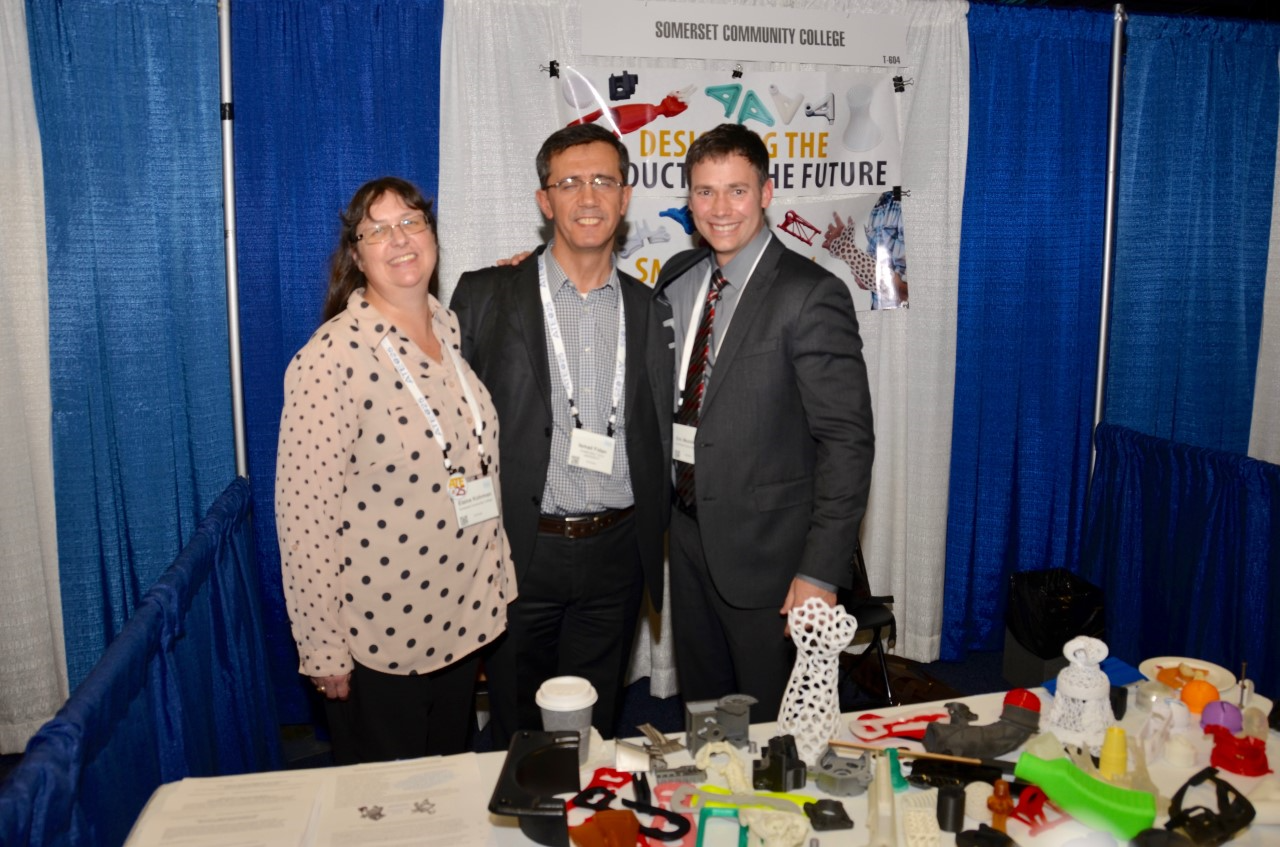
Mobile Additive Manufacturing Platform Team (Left to Right): Elaine Kohrman, Director of Grants, SCC; Dr. Ismail Fidan, Professor of the Department of Manufacturing and Engineering Technology and College of Engineering-Faculty Fellow in Innovation and Techno-Entrepreneurship at Tennessee Technological University; Eric Wooldridge, SCC professor and director of AMCOE.
This latest grant is even more progressive in nature as it will allow the SCC faculty to take their AM technology out on the road and travel to teachers and businesses in need of advanced design training. Working with Tennessee Technological University (TTU), SCC plans to build a trailer and mobile system to transport and set up the AM equipment and the portable educational system featuring 3D printers based on powder, resin, and metal-sintering production.
The goal is for students, teachers, and interested area manufacturing professionals to receive intensive, advanced training—like that used by HP, Ford, and NASA JPL. Participants will learn how to use Generative Design and Fusion 360 as SCC, TTU, and Autodesk partner in training.
“At the end of the three years of the NSF funded Mobile AMP project, we expect a complete 180-degree turnaround in how 3D printing is taught and utilized across Kentucky and Tennessee,” says Wooldridge. “And it will be a signal to all the manufacturing companies out there that this is the place to bring their advanced manufacturing work. That we have the technology and the people with the fundamental skills to make next-generation products that companies and consumers want, as well as homegrown startup innovations.”
Find out more about the SCC Additive Manufacturing program here. To find out more about SCC’s additive manufacturing/3D printing program, contact Eric Wooldridge at eric.wooldridge@kctcs.edu.
Somerset Community College is a comprehensive two-year institution of higher education. SCC has campuses in Somerset and London, and centers in Clinton, McCreary, Casey, and Russell counties. For admission and program information, visit their website.

What do you think of this news? Let us know your thoughts! Join the discussion of this and other 3D printing topics at 3DPrintBoard.com.
Subscribe to Our Email Newsletter
Stay up-to-date on all the latest news from the 3D printing industry and receive information and offers from third party vendors.
Print Services
Upload your 3D Models and get them printed quickly and efficiently.











You May Also Like
Sintavia Taps NVIDIA Blackwell for AI-Driven Additive Manufacturing Pipeline
Investors have become increasingly anxious about the sustainability of NVIDIA‘s growth trajectory, which is a rather natural outcome when a stock goes up infinity percent or so over the course...
Please Localize Your Supply Chains
Resilience is starting to feel like the only economic metric that matters, which is noteworthy, for one, because there is no defined metric that I know of that actually measures...
3D Printing Moves Deeper Into Production as Parts Near $110B by 2034
A new report takes a closer look at how much 3D printing is actually being used in real production. The numbers point to a market that is already growing at...
The Blueprint for Industrial Serial Production
Lithoz is kicking off the 2026 trade fair season with a powerful showcase of real-world applications of ceramic AM serial production capabilities alongside new material upgrades. The company is stepping...