2019 NAMIC Global Additive Manufacturing Summit Day Two


Today we arrive for the second day of the NAMIC Global Additive Manufacturing Summit. First, an MOU was signed between TUV SUD and ThyssenKrupp, the two German companies picking the show as the place to ink their cooperation in Additive. Mark Beard, Global Director for Process and Application Development at Additive Industries, was the first speaker. Mark spoke of why there were so few metals for 3D printing available. He pointed to the MAPP project and other initiatives that were unlocking machine learning and other beneficial technologies for 3D printing. He took us through the path to qualify a material and showed us how model-based process optimization for 3D printing is developing.
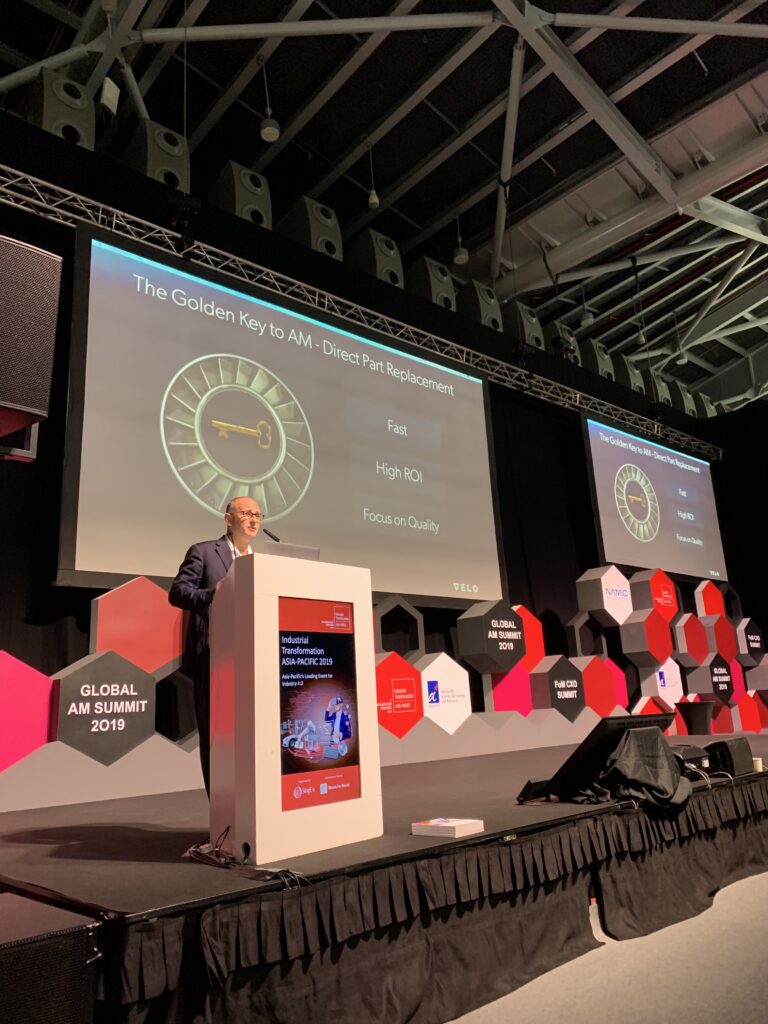
Next, Benny Buller, the CEO of Velo3D outlined the Velo advantage and approach to making parts. He showed us how the company is focusing on power and aerospace and is able to make direct part replacements. Rather than focus on design for additive manufacturing, Benny maintains that they can directly replace conventionally manufactured parts with 3D printed parts without redesign. If the firm can do this at scale they would have a real advantage over other players.
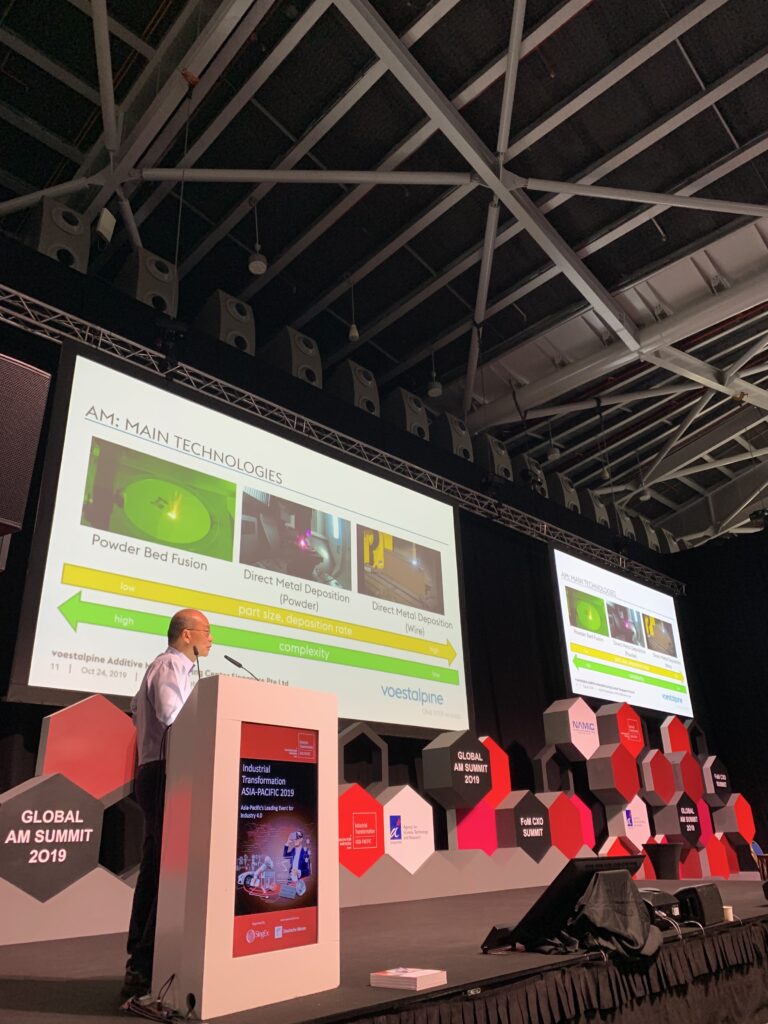
C. O. Tham of Austrian steel company Voestalpine looked at DED and showed us how hard facing parts could be made with 3D printing. DED is a less talked about technology than Powder Bed Fusion but as C.O let us know the technology has cost and speed advantages that should not be overlooked. With DED you can also repair parts by cladding them again or even repairing broken blades on a propeller. C.O. also took us through the many specialty 3D printing materials that Voestalpine offers.

Michael Agam, President South Asia of Stratasys, took us through the new Stratasys Digital Anatomy system for functional anatomical models. He spoke of a case that Stratasys did with Mini in China. Stratasys used PolyJet parts to let people mass customize their Mini cars. He said that they had to work through a lot of problems with for example UV degradation to make this happen.
Shrinivas Shetty, the Chief Executive Officer PrinterPrezz, then talked about how they want to be a “a foundry” for medical devices. The company wants to “be like a an Uber or a Grab for 3D printing medical devices.” By doing FDA approvals for several companies at a time, they say that they can do the approval process in “ten months” and reduce the costs from $5 to $10 million to $1 million. Shrinivas was very optimistic about the prospects of 3D printed orthopedic implants specifically because the surface quality of the implants means that “it can be applied to many implants.”
Benoit Valin, General Manager, Asia Pacific at Essentium, then took us through the history of plastics and acceptance criteria for parts. He talked about the limitations of 3D printers, amorphous and semi-crystalline plastics. He explained the difference between the two polymer chains in terms of noodles and explained the advantages of each. Benoit wants to open 11 centers to make and qualify materials across Asia over the next few years.
Johan Pauwels, Executive Vice President, Materialise, then went on to detail a bit of his experience in working in 3D printing from 1990. He talked of the Materialise mission statement to enable a better and healthier world. He talked about scans and Materialise preoperative planning software letting surgeons plan a child’s surgery before the child was born. He mentioned that there is a 99% chance that if you have a hearing aid that this in the ear hearing aid is printed. He put our industry in perspective by saying that we only represent 0.057% of all industry. If we grew to be 5% of manufacturing we’d already be a $640 billion industry. He showcased the Airbus overhead storage part and the Rapid Fit jigs and fixtures for production part testing.
David Tan, General Manager, Asia Pacific and Japan for Formlabs, told us how the company helped Gillette 3D print mass customized razors and shared their learning on mass customization. The firm found that you have to look for value in customized parts for the business and end customers. Glen Hinshaw, Chief Executive Officer, RESA, talked about 3D printed footwear and insoles. He showed us how his company uses in-store kiosks to 3D print customized TPU insoles using FDM printers. At a trial at Costco, he produced 50,000 insoles for paying customers. Sylvia Heisel, Director, Fashion Futurist + Creative Technologist at HEISEL, told us all about sustainable products and sustainable innovations in 3D printing and beyond towards fashion and wearables.
All in all the Namic Summit was a great event with a lot of exciting viewpoints and learning for everyone committed to 3D printing.
Subscribe to Our Email Newsletter
Stay up-to-date on all the latest news from the 3D printing industry and receive information and offers from third party vendors.
Print Services
Upload your 3D Models and get them printed quickly and efficiently.













You May Also Like
50,000 Orders and Counting: EPlus3D & Chinese AM Services Provider Are Scaling Liquid Cooling Solutions for AI Servers
An under-appreciated story driving the additive manufacturing (AM) industry this year has been the divergence between what’s driving the market in China and what’s driving it everywhere else. Let’s start...
Additive Manufacturing Has a Major Growth Opportunity; Trust Will Decide Who Captures It
After years of overpromising, the next phase of AM growth will be won by companies that consistently deliver what they say. When I entered additive manufacturing in 2014, after 15...
Seven Trends Reveal What’s Next for 3D Printing at TCT Shenzhen 2026
TCT Shenzhen 2026 opened on October 14 in Hall 15 of the Shenzhen World Exhibition & Convention Center in Bao’an, and ran through October 16. The event brought together equipment...
AM Investment Strategies 2026 Sets the Stage for AMS 2027
AM Investment Strategies 2026 Nov. 5 · 12 p.m. ET · Free online event RESERVE YOUR SPOT ↗ A one-hour online discussion featuring some of the biggest names in 3D...