Researchers Examine Effects of Gas Chemistry in Laser-based Powder Bed Fusion

In ‘Influence of atmosphere on microstructure and nitrogen content in AISI 316L fabricated by laserbased powder bed fusion,’ the researchers take on the challenge of creating parts via laser‐based powder bed fusion (L-PBF) processes while examining the effects of protective gases.
The authors explain that L-PBF is advantageous to many industrial users worldwide—often through the use of metals like stainless steel. While exposure to nitrogen can increase the quality of a structure in a beneficial manner, if the levels are too high, the integrity of the 3D printed structure can be threatened.
Nitrogen ‘pickup’ is used for austenitic stainless steel, an alloy comprised of a crystalline structure. At temperatures of 900 °C there is ‘appreciative capacity’ for nitrogen in a solidified form. Exposure during processing to nitrogen gas not only results in better strength but ductility levels are not affected, and corrosion resistance also increases. When temperatures become too elevated, however, anti-corrosive properties may be negatively transformed.
Previous research has been performed regarding the amounts of porosity that would be caused by the ‘reactivity and solubility’ of nitrogen, as well as other combinations of the following:
- Argon
- Nitrogen
- Helium
- Hydrogen
With most research resulting in the conclusion that both argon and nitrogen promote density, the authors state that their assessments did not include any chemical or structural examination.
“In the present work the influence of the gas atmosphere on the quality of LPBF parts is addressed. To this end, two batches were made: one batch was manufactured in Ar gas; a second batch in N2 gas. The microstructure, microhardness, and nitrogen contents of the powder and the L-PBF parts of are investigated,” state the authors.
Material for the study included AISI 316L stainless steel powder from LPW Technology with a particle size of (53 ± 15) µm and a certified composition (in wt %): Fe = Bal., C = 0.020, Si = 0.70, Mn = 0.76, P = 0.008, S = 0.004, Cr = 17.7, Ni = 12.6, Mo = 2.32, Cu = 0.02, N = 0.09, O = 0.02. The team used fresh powder each time.
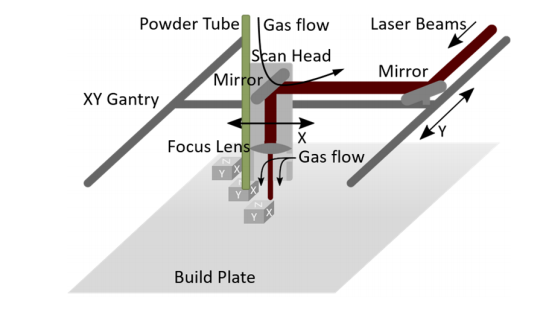
Schematics of the build chamber in the used PBF system from Aurora Labs. Placement of the three specimens is shown approximately.
During the experiment, the team noted that the nitrogen content was reduced to (0.086 ± 0.007) wt %. They stated that this indicated desorption of nitrogen from the molten powder during the L‐PBF‐Ar process and could also cause loss of nitrogen.
“The microstructure of both L-PBF 316L specimens was fully austenitic, with a cellular structure. The specimen manufactured in Ar had a more heterogeneous structure, possibly associated with an increased heterogeneous nitrogen distribution,” concluded the researchers.
“Nitrogen has a paramount importance in the alloying of stainless steel, as even minor changes will have a major impact on the mechanical and electrochemical properties. Future works will therefore focus on the influence of powder reuse with regard to nitrogen content and establishing a method for choosing the atmosphere chemistry in which the nitrogen content in the printed part is controlled.”
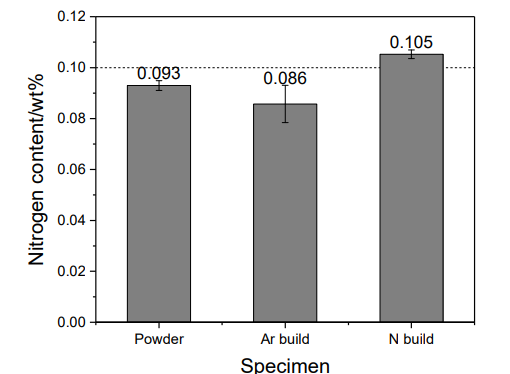
Nitrogen content of AISI 316L powder, L‐PBF build in argon and L‐PBF build in nitrogen. Dotted line marks the min. nitrogen content for AISI 316N[9] and the max. nitrogen content for the powder as specified by the supplier, LPW technologies.
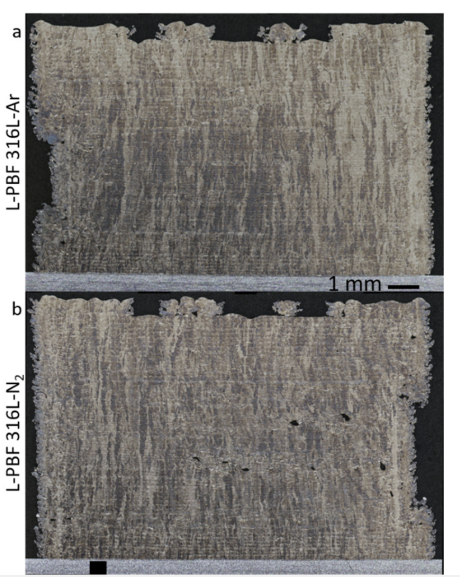
Macrograph made by stitched micrographs of L‐PBF 316L build
in Ar gas (a) and in N2 gas (b). Etched in 4% HNO3 1% HF sol. for 16 min.
Subscribe to Our Email Newsletter
Stay up-to-date on all the latest news from the 3D printing industry and receive information and offers from third party vendors.
Print Services
Upload your 3D Models and get them printed quickly and efficiently.











You May Also Like
What the 2026 Post-Processing Survey Reveals About the Future of AM
As additive manufacturing (AM) continues its transition from prototyping to production, industry attention is shifting toward one of the most demanding but often overlooked parts of the workflow: post-processing. The...
At RAPID + TCT 2026, Executive Keynotes Break Down What’s Next for AM
While AI is expected to be a major focus at RAPID + TCT 2026, the event is also putting the spotlight on something just as important: leadership. This year’s Executive...
Sintavia Taps NVIDIA Blackwell for AI-Driven Additive Manufacturing Pipeline
Investors have become increasingly anxious about the sustainability of NVIDIA‘s growth trajectory, which is a rather natural outcome when a stock goes up infinity percent or so over the course...
Please Localize Your Supply Chains
Resilience is starting to feel like the only economic metric that matters, which is noteworthy, for one, because there is no defined metric that I know of that actually measures...