China: 3D Printing Supercapacitors with Graphene Oxide Ink

In ‘Highly concentrated graphene oxide ink for facile 3D printing of supercapacitors,’ international researchers Shangwen Ling, Wenbin Kang, Shanwen Tao, and Chuhong Zhang delve further into the fabrication of 3D printed energy storage devices, using graphene-based inks for making supercapacitors.
The authors focus on the benefits of direct ink writing, suitable for creating structural and electrical materials, along with biological materials. It is normally extruded through a needle, or through mechanical pressure. It is one of the preferred types of fabrication today for researchers and scientists, with graphene offering:
- Excellent mechanical properties
- Chemical stability
- High electrical conductivity
Graphene oxide also offers better-dispersing capabilities, but it must be delivered in the proper concentrations to offer a ‘liquid to soft solid transition.’ In this research, the authors used a concentrate of GO at 200 mg/mL with a very high elastic modulus on the order of 106 Pa.

SEM images of (a), (b) porous GO obtained from the highly concentrated ink and (c), (d) its reduced sample.
“The ink was of desired rheological properties for 3D printing. Moreover, to preserve the integrity of the printed graphene structure in water, dimethyl octadecyl [3-trimethoxysilylpropyl] ammonium chloride solution [DMAOP] was used as a functionalization agent to remove the hydroxyl groups of GO before reduction,” stated the authors. “3D printed supercapacitors in different layers with scaled areal capacitance were also realized. The findings hold great promise and are very informative for the realization of futuristic high energy density supercapacitors in limited footprints for miniature electronics.”
The researchers discovered that the GO ink is suitable for creating functional devices, but a functionalization process was required. The GO structure required a thorough washing before reduction.
“However, because of the large amount of hydrophilic hydroxyl functional groups existing on GO, it is extremely prone to water permeation between GO layers resulting in the disassembly of the printed structure,” stated the researchers.
There is a need for small but powerful energy storage devices that can be ‘endowed with large areal capacitances.’ The team fabricated supercapacitors of 3, 6, and 12 layers. Electrodes were studied for ‘electrochemical performance,’ resulting in showing that the active materials could be efficiently utilized and contribute to the buildup of interfacial double layer capacitance. The researchers found that under the density of 0.2 A/g, all electrodes were capable of close gravimetric capacitances, with the suggestion that all effective materials could be used to build up interfacial double layer capacitance.
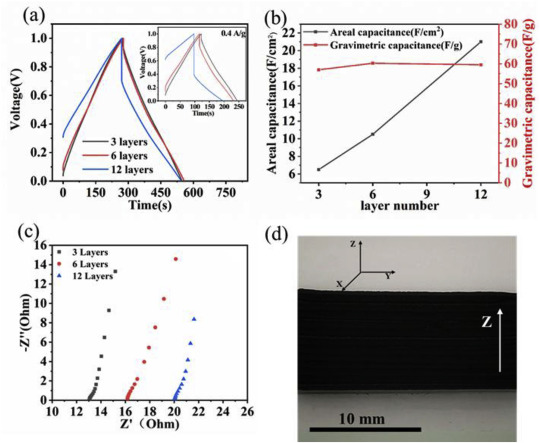
(a) Comparison in galvanostatic charge-discharge curves of 3D printed electrodes of different layers at current densities of 0.2 and 0.4 A/g; (b) the relationship between specific areal and gravimetric capacitance of the printed structure and printed number of layers. c) comparison in EIS spectra among electrodes with different printed layers; d) a digital image showing the cross section of a printed 12 layer electrode.
The authors found the huge capacitance value (made possible by 3D printing) to be ‘outstanding,’ and although conductivity may have been lessened due to surface functionalization and induced impedance.
“The findings illustrate a facile and effective strategy for the creation of a 3D structured conductive scaffold for energy storage application, which might create deep implications for futuristic power demands,” concluded the researchers.
3D printed energy storage is an important topic as it allows for more affordable but powerful ways to create items like batteries for wearable devices, information storage, and new materials like aerogels. What do you think of this news? Let us know your thoughts! Join the discussion of this and other 3D printing topics at 3DPrintBoard.com.
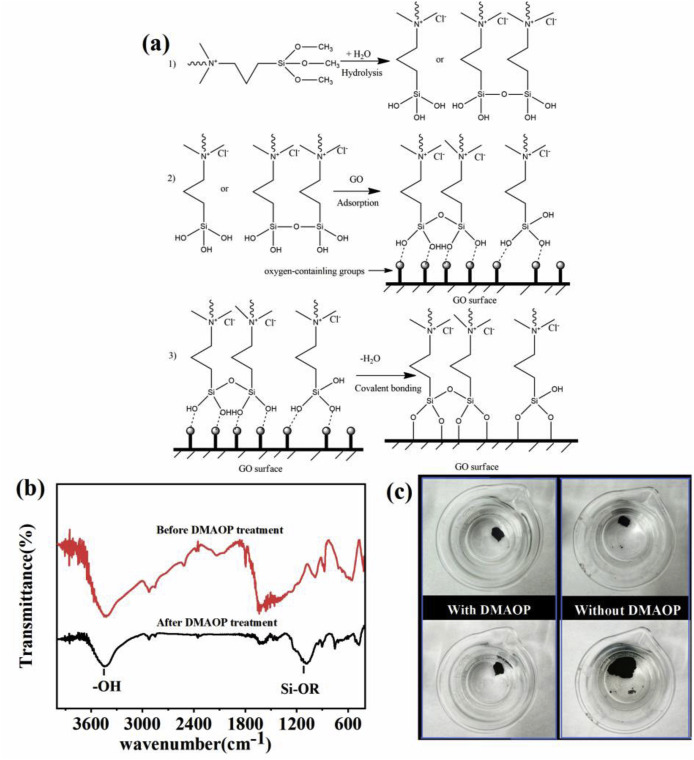
(a) The schematic showing the reaction mechanism of DMAOP with GO; (b) FT-IR spectra of GO obtained from the highly concentrated ink before and after DMAOP treatment; (c) digital images of samples with/without DMAOP functionalization soaked in water for 24h to compare their stability.
Subscribe to Our Email Newsletter
Stay up-to-date on all the latest news from the 3D printing industry and receive information and offers from third party vendors.
Print Services
Upload your 3D Models and get them printed quickly and efficiently.











You May Also Like
How 3D Printing is Making the World a Better Place, One Medical Innovation at a Time
One of the most significant sectors for 3D printing applications is the healthcare field. According to an AM Research report, the 3D printed medical device market is estimated to reach...
3D Printing News Briefs, December 24, 2025: Investment, Acoustic Guitar, Toys for Tots, & More
In this Christmas Eve edition of 3D Printing News Briefs, we’re sharing joy and good news, starting with Nanoscribe’s exciting machine milestone! Moving on, New York’s governor is investing $32...
Velo3D’s $32.6M Defense Contract Highlights Why U.S.-Made 3D Printing Is Suddenly Critical
When the U.S. government talks about supply chain security, it’s no longer theoretical. It’s now written directly into law and into defense contracts. That detail matters for Velo3D, which this...
3D Printing Used to Make Prototype Plasma Camera Measuring Charged Particles in Space
Space is a vacuum, we’ve all heard that before. But that doesn’t mean it’s completely empty, just that it has an extremely low amount of particles and matter. Stars emit...