Mosaic Manufacturing Reveals Incredible Multi-Colored 3D Printing from a Single Extruder

 Color is what makes a boring 3D printed trinket into something that turns heads. There are numerous ways in which 3D printer manufacturers have gone about enabling multi-colored 3D prints via FFF/FDM machines. Most involve adding an additional extruder to the printer or even using multi-colored filament, leaving the user without any control over what color goes where. While this is certainly a worthwhile approach, one company based in Kingston, Ontario called Mosaic Manufacturing is about to turn the color 3D printing world upside down.
Taking an innovative approach which strays quite a bit from the techniques used within the industry to date, Mosaic Manufacturing may have figured out a way to enable virtually any 3D printer to print in multiple colors with ease, and without the need for complicated modifications.
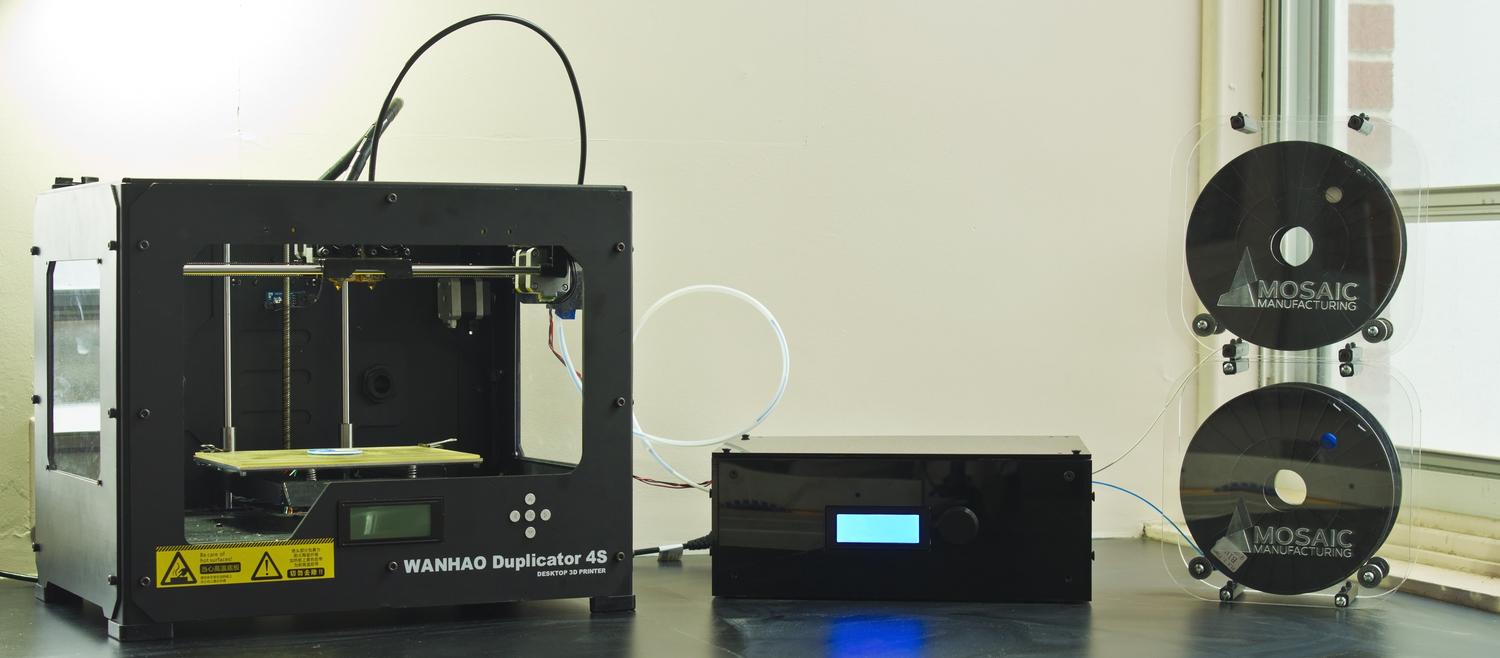
Founded by Mitch Debora, Derek Vogt, Chris Labelle, and Heather Evans, the company is not relying on multiple spools of filament connected directly to multiple extruders on a given printer, like most of the other companies have been doing. Instead, their method, which depends on a new device they intend to bring to market shortly, does the color sorting prior to the filament ever reaching the printer’s sole extruder.
“There’s a few modules in the box: motors to drive the filament, a cutter, and a connector,” explained Chris Labelle, Co-Founder and COO of Mosaic Manufacturing. “Basically we use energy and pressure, combined with an algorithm we developed to get the connections to a point where they feed in the printer unencumbered.”
The system basically will determine when to change a color based on the G-code which has been sent to the printer. When it’s time for a color change, the system will cut the strand of filament in use, and fuse the new color to it. This all takes place on the fly, well before the filament gets close to the extruder. The color can be changed every 35mm if the user desires, enabling multiple colored layers without a problem.
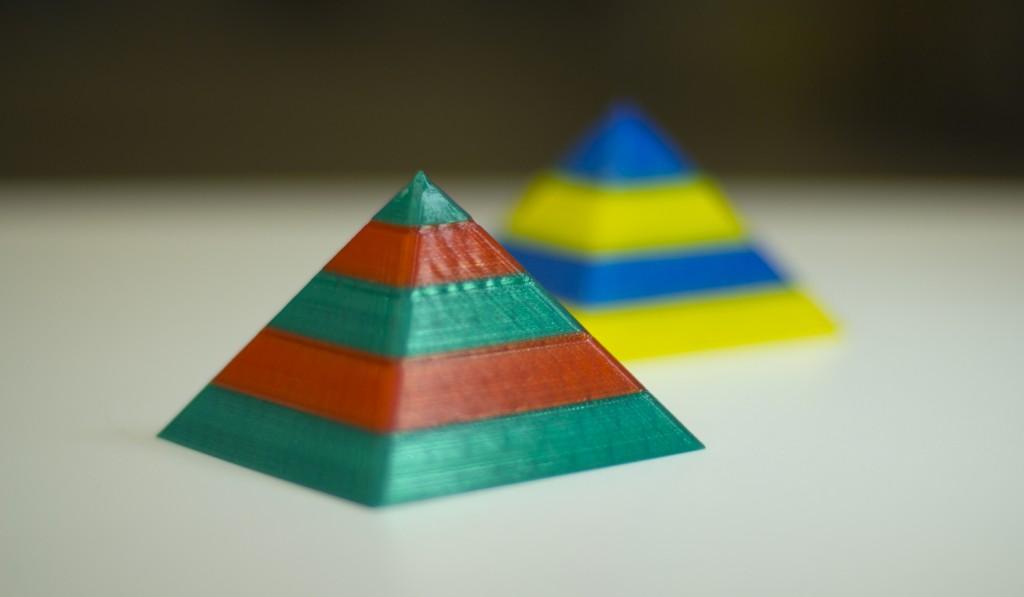
“The idea is that we create multi-coloured filament that acts just like regular filament so the printer and extruder will not discriminate against it,” explained Labelle. “The theory has proven true on all the printers we have tried so far. We have tested on a Bowden extruder and it worked great.”
What’s so great about their system is that it can be used on almost any 3D printer without the need to modify the printer in any major way. The company is still deciding on whether or not they will make this technology open source, or seek to protect their innovation via patents. The price of this multi-colored system has yet to be announced, though Labelle has stated that the box is going to be priced less than multi-extruder upgrades per color.
Let’s hear your thoughts on this innovative new method of using multiple colored filaments from a single extruder, in the Mosaic Manufacturing forum thread on 3DPB.com. Check out the video below for a brief look at how this new technology works.
Subscribe to Our Email Newsletter
Stay up-to-date on all the latest news from the 3D printing industry and receive information and offers from third party vendors.
You May Also Like
3D Printing News Briefs, April 27, 2024: Research, Digital Dentistry, Cycling, & More
We’re starting today’s 3D Printing News Briefs with some research into 3D printed luminescent quantum-dot polymer architectures and free-form laser beam shaping, and then on to an open source 4-axis...
HP & INDO-MIM Collaborate to Boost Metal 3D Printing in India
HP Inc. and INDO-MIM, a US- and India-based supplier of metal injection molding (MIM) powders and contract manufacturer, have announced that the two companies will collaborate to accelerate additive manufacturing...
3D Printing News Briefs, February 17, 2024: Shot Blasting, Service Bureaus, & More
In today’s 3D Printing News Briefs, we’re starting out with post-processing, as SKZ Würzburg is using a shot blast system from AM Solutions for its research. Moving on to business,...
3D Printing News Unpeeled: Not That Kind of Organ 3D Printing
GKN Aerospace will create a 150 jobs in Trollhattan Sweden with an investment of $60 million part of which comes from the Swedish Energy Agency’s Industriklivet initiative. The investment will...