
Researchers Recognize Transformative Power of 3D Printed Pharmaceuticals

 Authors Ghadge Snehal, Aloorkar Nagesh, and Sudake Suresh from the Satara College of Pharmacy explore 3D printing of medication, and the possibilities for the future in ‘A Decisive Overview on Three Dimensional Printing in Pharmaceuticals.’
The researchers realize the enormous impact 3D printing is having worldwide, offering truly infinite power for innovation—with a tremendous focus on the medical field and surrounding industries like pharmaceuticals. Accessibility and affordability for all means progress will just continue to accelerate—with the potential for patients to even perform their own DIY dispensing of medicine one day.
FDA approval of Spritam® in 2015 was a defining moment, not only for pharmaceuticals but also progressive technologies like 3D printing:
“Aprecia’s product, called ZipDose, is built up from layer upon layer of powders of the drug bound together by droplets of liquid,” explain the researchers, who see such approvals and acceptance with 3D printing as only the beginning for such processes.
3D printing is not only able to offer a more self-sustained approach to manufacturing medicine, but it is able to fabricate drugs in complex geometries when necessary—with accuracy, precision, patient-specific dosages, and incredible affordability in comparison to current costs. The authors expect such benefits to manifest overall in a transformation of the pharmaceutical industry offering on-demand medication fulfillment that is customized precisely to the patient—and eliminating issues with the cost-prohibitive expense that so many individuals in need face today. They expect children to benefit the most from such technology.
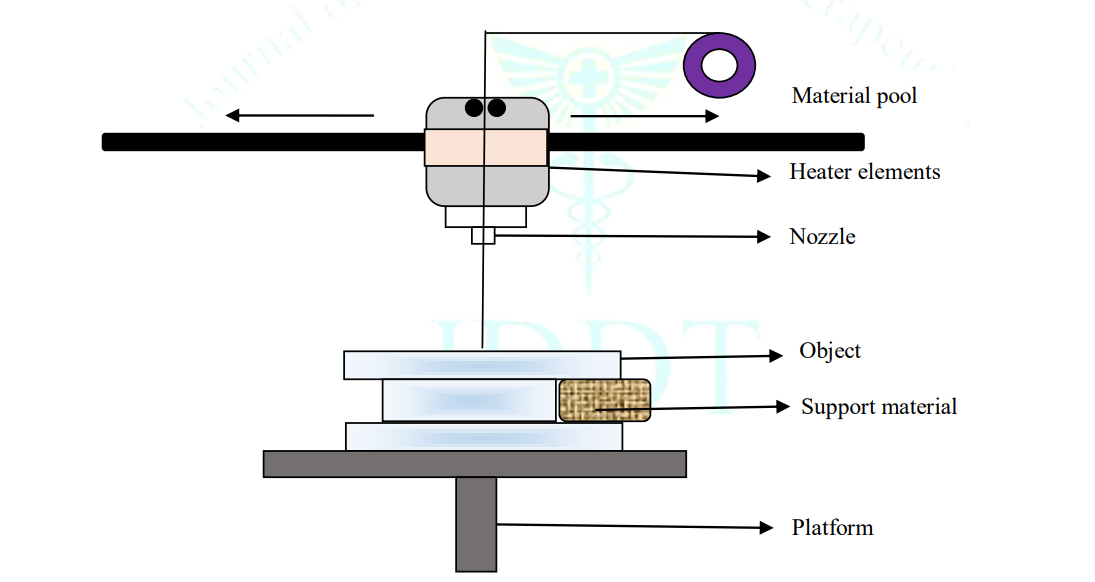
Fused deposition modeling
Currently, materials and caplet formulation are the biggest challenges, but the research team and others before them see promise with FDM 3D printing and SLA 3DP technology in creating pills with extended-release capability:
“In the future this technology could become a manufacturing technology for the elaboration of oral dosage forms, for industrial production or also for personalized dose,” state the researchers.
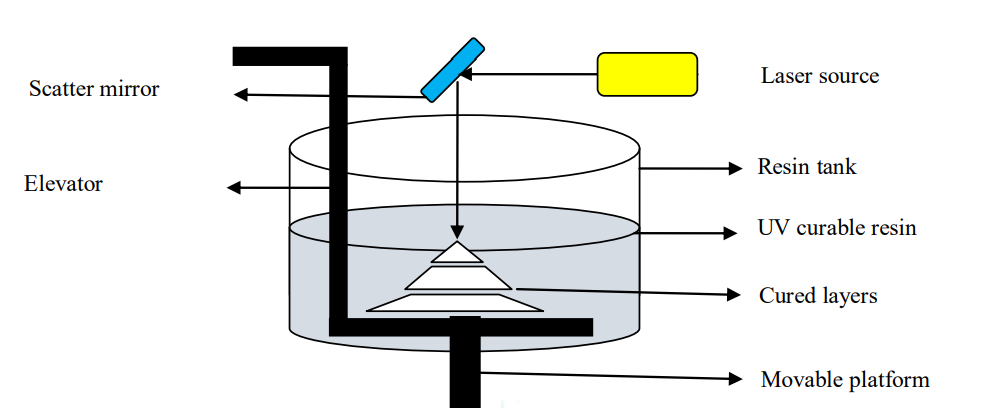
Stereolithography principle
As other techniques have been created via researchers and developers around the globe, manufacturing is on its way to becoming much more sophisticated as a whole, especially with novel formulations of:
- Nano-scale medicines
- Biomimetic particles
- Functionalized liposomes
“3DP in pharmaceutical industry represents a well-designed tool for designing simple, accurate, cheap, structured and tailored drug delivery systems,” conclude the authors. “This flexibility can offer many novel strategic approaches for the research and development of controlled-release drug delivery systems.
“With so much interest and research found in the past few years, 3D printing in pharmaceutics has reached an impressive rhythm of development and promises great progress in the future.”
While pharmaceuticals are big business around the world, it is also a big topic within the 3D printing industry, as everyone sees potential for transforming methods for manufacturing and distributing medications. Researchers have been experimenting with concepts like accelerated drug release properties, on-demand pharmaceuticals, and personalized medications. Find out more about progress in India here.
What do you think of this news? Let us know your thoughts! Join the discussion of this and other 3D printing topics at 3DPrintBoard.com.

Caplet embedded within a larger caplet (DuoCaplet), with each compartment
containing a different drug
Subscribe to Our Email Newsletter
Stay up-to-date on all the latest news from the 3D printing industry and receive information and offers from third party vendors.
Print Services
Upload your 3D Models and get them printed quickly and efficiently.













You May Also Like
The Manufacturing Race Behind the Drone Revolution
We are in the middle of a major manufacturing shift focused on the production speed and payload capacity of uncrewed aerial systems (UAS), or drones. A recent Manufacturing Dive article...
ADDMAN to Buy Up to $10.8M in Nickel 718 Powder from 6K Additive Over 30 Months
After years of buildup, we’re finally starting to see what the US metal additive manufacturing (AM) market could look like at scale. To be sure, it’s still not quite there,...
Metal AM in a Multipolar World, Part 2: How PBF and DED Could Change by 2035
The first decades of PBF development were heavily shaped by machine capability: more power, more lasers, larger build volumes, better recoating, and improved process monitoring. These developments will continue, but...
Advanced Manufacturing at IMTS 2026: 3D Printing and AI and Drones, Oh My!
Last week’s International Manufacturing Technology Snow (IMTS) in Chicago welcomed over 90,000 attendees to the jungle that is McCormick Place. With over 1.17 million square feet of exhibit space, and...

























































