Exceptional Metamaterials Are Reconfigurable & Deployable Through 4D Printing

3D printing may allow for infinite innovation in design and production, but some designers, engineers, and researchers feel constricted by the fixed qualities—leading them to expand with 4D printing and experiment with materials that can be more finely tuned. In ‘4D printing reconfigurable, deployable and mechanically tunable metamaterials,’ researchers present the best of both realms by micro 3D printing with shape memory polymers. The result is artificial metamaterials that are mechanically tunable and lightweight, and they can be reconfigured for a variety of functions.
The authors point out that metamaterials are exceptional for creating powerful attributes via microstructural design, to include the following types of properties:
- Electromagnetic
- Acoustic
- Mechanical
- Thermal
“The properties of mechanical metamaterials emerge from the 3D spatial arrangement of the micro-structural elements. Therefore, once manufactured, such properties are irreversible. However, incorporating a material with reversibly tunable properties in a metamaterial could offer the metamaterial flexibility and adaptability, leading to the ability to significantly modulate the mechanical performance in many applications,” state the researchers.
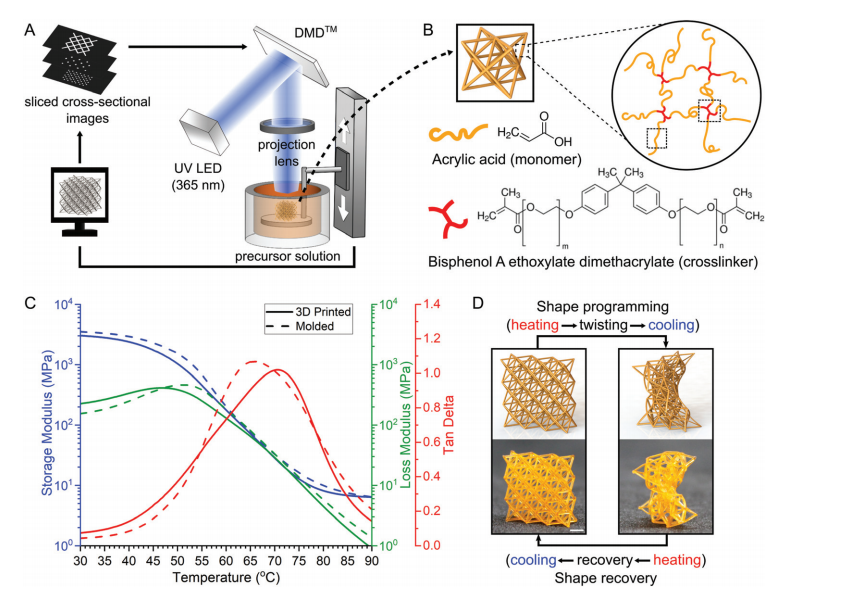
4D printing of mechanical metamaterials. (A) Schematic diagram of the digital additive manufacturing process. (B) Photocurable shape memory polymer (SMP) consisting of acrylic acid (AA) as a monomer to form chains and bisphenol A ethoxylate dimethacrylate (BPA) as a crosslinker to form
nodes. (C) Storage modulus, loss modulus and tan d of the SMP. (D) A typical shape memory cycle of a SMP microlattice. Shape programing through heating, deformation and cooling, and shape recovery to its original shape upon heating. Scale bar is 2 mm.
These types of materials are already being explored for use in luxury cars, aerospace, civil engineering, and robotics. Here, the difference is that the researchers ‘exploit a substantial mechanical property transition between glassy and rubbery states of a shape memory polymer (SMP) around its glass transition temperature (Tg) and apply it to mechanical metamaterials.’
“3D printing with SMPs has played a central role in the emerging field of 4D printing (3D printing of shape-transforming structures), but the focus has predominantly been on geometrical transformations,” state the researchers, who offer a unique study into metamaterials as they exploit the transition process.
To create 3D SMP metamaterials, the researchers used PmSL, an SLA technique that produces complex micro-structures—to include materials like responsive hydrogels too. In testing, the materials were heated in the rubbery state and then twisted. Once the temperature was lowered, they retained their shape after removal of mechanical loading. Upon increasing the heat again, the microlattice returned to its normal shape.
Complete reversal back to the original shape was the response to nearly every deformation test, leaving the researchers to state that ‘smart lightweight protective material’ can be fabricated that will morph to its conditions, whether in a rigid or shock-absorbing state. Not only that, the researchers noted that while such metamaterials can be tuned into a variety of shapes offering different functionality depending on the needs of the user, they were deployable in higher temperatures and retained ‘superior’ mechanical performance.
“Our lightweight SMP microlattices have unprecedented capability of mechanical adaptation to unpredictable circumstances such as varying external loading and geometrically complex environments,” concluded the research team. “The reconfigurable and tunable mechanical metamaterials may find a broad range of applications such as tunable shock absorbing interfaces, morphing aerospace structures, and minimally invasive biomedical devices.”
While there is still plenty of ground to cover within the realm of 3D printing, researchers have been exploring the world of 4D with fascinating results from all over the globe as they produce smart metamaterials for improving industrial applications, create multi-materials, and even origami-inspired designs. Find out more about reconfigurable and tunable 4D properties here.
What do you think of this news? Let us know your thoughts! Join the discussion of this and other 3D printing topics at 3DPrintBoard.com.
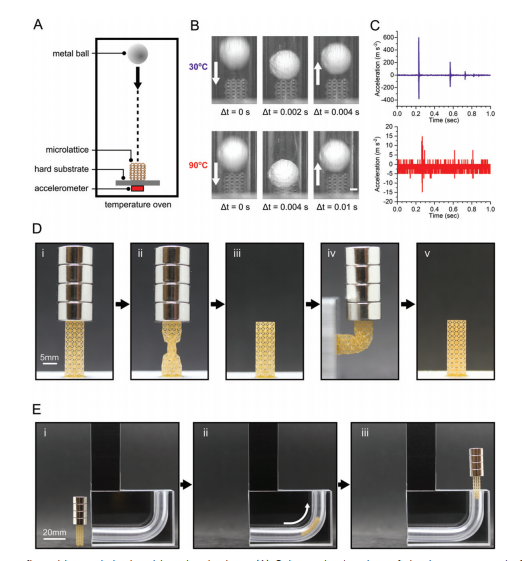
Thermally tunable, reconfigurable, and deployable microlattices. (A) Schematic drawing of the impact test platform. (B) Time-lapsed images of the KF sample during an impact loading at 30 1C and 90 1C. Scale bars are 3 mm. (C) Acceleration measured at the substrate at 30 1C and 90 1C. (D) Reconfigurable OT microlattice. (i) The sample is in its original shape and bears a load, (ii) the sample is programmed to a different geometry and bears the same load, (iii) the sample returns to its original shape upon heating, (iv) the sample is reprogrammed to a bent configuration and still bears the same load, and (v) the sample returns to its original shape again upon heating. Scale bar is 5 mm. (E) Deployable KF microlattice. (i) The sample in its original
shape (the overall thickness is larger than the inner diameter of the channel) is placed in the left compartment and bears a load, (ii) the sample is programmed to have a smaller diameter and navigates through the curved channel to move to the right compartment, (iii) the sample comes out of the channel and regains the load-bearing capability in the right compartment. Scale bar is 20 mm.

Thermally tunable mechanical property. The stress–strain curves of (A) OT4 and (B) KF4 at five temperatures. Effective Young’s modulus versus
relative density of (C) OT and (D) KF microlattices on a logarithmic scale. Moduli of both OT and KF drop significantly from 30 1C to 90 1C. A linear
relationship with a scaling factor of 1.2 for OT and a quadratic relationship with a scaling factor of 2.2 for KF are maintained at all temperatures. The
stress–strain curves of 2 consecutive compression cycles of (E) OT2 and (F) KF2 at 30 1C and 90 1C. Scale bars in the top images of the printed
microlattices are 2 mm
Subscribe to Our Email Newsletter
Stay up-to-date on all the latest news from the 3D printing industry and receive information and offers from third party vendors.
Print Services
Upload your 3D Models and get them printed quickly and efficiently.











You May Also Like
AM Asia Watch: China’s HeyGears Lands $44M to Expand Beyond Dental 3D Printing
Chinese 3D printing company HeyGears raised more than 300 million Yuan (roughly $44 million) in a new Series C funding round as it looks to expand beyond its industrial and...
The University of Utrecht: “3D Printing Could Change Who Gets to Become a Manufacturing Power”
For decades, manufacturing has mostly been controlled by countries with huge factories, lower labor costs, and industrial systems that took years, sometimes decades, to build. But Utrecht University human geographers...
3D Printing News Briefs, May 28, 2026: Continuous Fiber Reinforcement, Bioprinted Trachea, & More
In today’s 3D Printing News Briefs, America Makes announced the winners of its JAQS-SQ Project Call. Axtra3D is partnering with Keystone Industries to expand its dental material ecosystem, while BigRep...
Asia AM Watch: China’s SHINING 3D Restarts IPO Review Process
SHINING 3D is moving forward again with its plans to go public in China, after restarting its Beijing Stock Exchange (BSE) initial public offering (IPO) review process and filing updated...