Rosswag Engineering Wins EPMA Award for Hybrid Forging-3D Printing Technology Combining Open Die Forging and DMLS


Recently the EPMA 2018 Powder Metallurgy Component Awards took place, honoring outstanding contributors to the field of powder metallurgy. Awards were given in four categories:
- Additive Manufacturing
- Hot Isostatic Pressing
- Metal Injection Molding
- PM Structural (including Hard Materials and Diamond Tools parts)
A panel of independent experts from across Europe judged the contestants, using the following criteria to select the winners:
- To what extent is the PM component described in the entry expected to provide cost savings and/or improved quality?
- To what extent is the entry expected to stimulate further usage of PM materials and technology?
- How well is the entry prepared (description of component, inclusion of diagrams, photographs and other illustrations)?
- How do you rate this component in terms of excellence in exploiting PM or in terms of novelty, surpassing borders or bringing new ideas into practice?
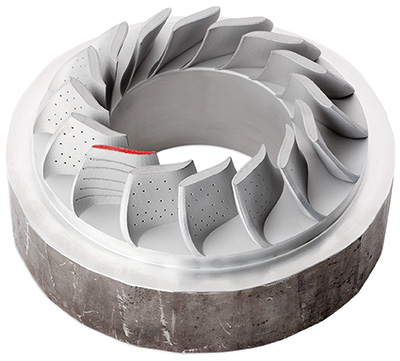 The winner in the additive manufacturing category was German company Rosswag Engineering, for its Forgebrid hybrid engineering process. Forgebrid combines the technologies of open die forging and Selective Laser Melting in order to circumvent the disadvantages of each process. Each method is only used in the segment of the part for which it is suitable. So the basic part is conventionally forged and then machined to produce a plane surface. Then, on that surface, the functionally optimized contour is added via selective laser melting.
The finished component consists of one identically material charge. The method is highly economical and environmentally friendly, as it wastes very few resources. The part’s most complex geometry does not require machining, which saves money and time, as well as reducing the need for coolants and lubricants. In addition, the excess material produced by the sawing and forging process can then be converted into powder for the additive manufacturing process.
The remains from sawing and forging are atomized to produce a fine-grained metal powder. The atomizer has a melting crucible in which the metal scrap is heated above the melting point. The molten material is atomized from the crucible via a nozzle by means of an inert gas stream to a spray. The spray particles then solidify in the drop tower. In a downstream process step, the particles are fractionated for a stable SLM process between 10 μm and 60 μm.
This hybrid process allows even large forged parts to be equipped with complex geometries that can only be realized by 3D printing. It results in an optimal grain structure profile which gives the part excellent mechanical-technological properties, especially regarding fatigue strength. By combining an inexpensive technology capable of producing parts at scale with metal 3D printing this really opens up the application field for this technology. These kinds of hybrid models should really open a lot of people’s minds as to what is possible with 3D printing as well. What other hybrids are out there?
 Rosswag was founded in 1911 and remains a family-run company, now with more than 200 employees. The Rosswag Engineering division was founded in 2014 and offers engineering services while developing new manufacturing processes – like Forgebrid. In 2017, the company began pursuing material development within its additive manufacturing department through the addition of in-house metal powder production. Rosswag Engineering has won multiple awards for its Forgebrid manufacturing process, which stands out as a novel approach that meets safety requirements and still achieves functional optimization of the component.
Discuss this and other 3D printing topics at 3DPrintBoard.com or share your thoughts below.
Subscribe to Our Email Newsletter
Stay up-to-date on all the latest news from the 3D printing industry and receive information and offers from third party vendors.
Print Services
Upload your 3D Models and get them printed quickly and efficiently.













You May Also Like
Creality K3 Opens for Pre-Order at $849, Advancing Multi-Color 3D Printing
Creality has officially opened pre-orders for the Creality K3, its latest flagship K Series 3D printer, starting at $849 in the United States. Recognized as an IFA Innovation Awards 2026...
Beyond the Printer: HP and DyeMansion Tackle the Future of Prosthetics
Making a custom orthotic or prosthetic device involves much more than producing the final part. Patients need to be measured, devices must be designed to fit their bodies, and finished...
3D Printing News Briefs, October 14, 2026: Bolus, Aerospace Tooling, Water Filter, & More
In today’s 3D Printing News Briefs, we’re starting with medical news, as Myrava has received FDA 510(k) clearance for its 3D printed bolus. Moving on to aerospace and metals, AML3D...
Can India’s AM Push Help Make it a Viable Supplement to China?
Diversifying manufacturing supply chains to locales outside of China has nothing to do with actually cultivating “substitutes” to the Chinese economy. The real stakes are these: China is an irreplaceable...