
BASF, Essentium and Materialise Partner to Accelerate Industrial Additive Manufacturing

 For more than a year, BASF and Essentium have been working together to develop advanced 3D printing materials with high mechanical strength, using Essentium’s proprietary FlashFuse technology. The two companies are now extending their strategic partnership to establish a consistent global materials supply chain that supports Essentium’s new High Speed Extrusion (HSE) 3D printing platform. Materialise will also be joining them to develop 3D printing software for Essentium’s technology. Users will be able to take advantage of the speed of HSE technology while having immediate access to Materialise’s full professional 3D printing software capabilities.
“Materialise, Essentium and BASF share a vision for growth in the 3D printing industry that builds on the creation of meaningful applications in an open and vibrant ecosystem,” said Bart Van der Schueren, CTO of Materialise. “This partnership helps to promote a more open market model, which will fuel the adoption of 3D printing in the industrial field by offering users more control, more choice in materials and ultimately lower cost and higher volumes.”

 The partnership will benefit from BASF’s material expertise as well as its large product portfolio and global network. Materialise brings its comprehensive software knowledge, while Essentium adds its developing 3D printing platform, which includes its FlashFuse technology and engineering-grade, multi-layer filaments.
“Our joint investment strengthens our co-operations with both Essentium and Materialise and accelerates the innovation potential of this powerful team to the benefit of BASF’s customers,” said Markus Solibieda, Managing Director of BASF Venture Capital.
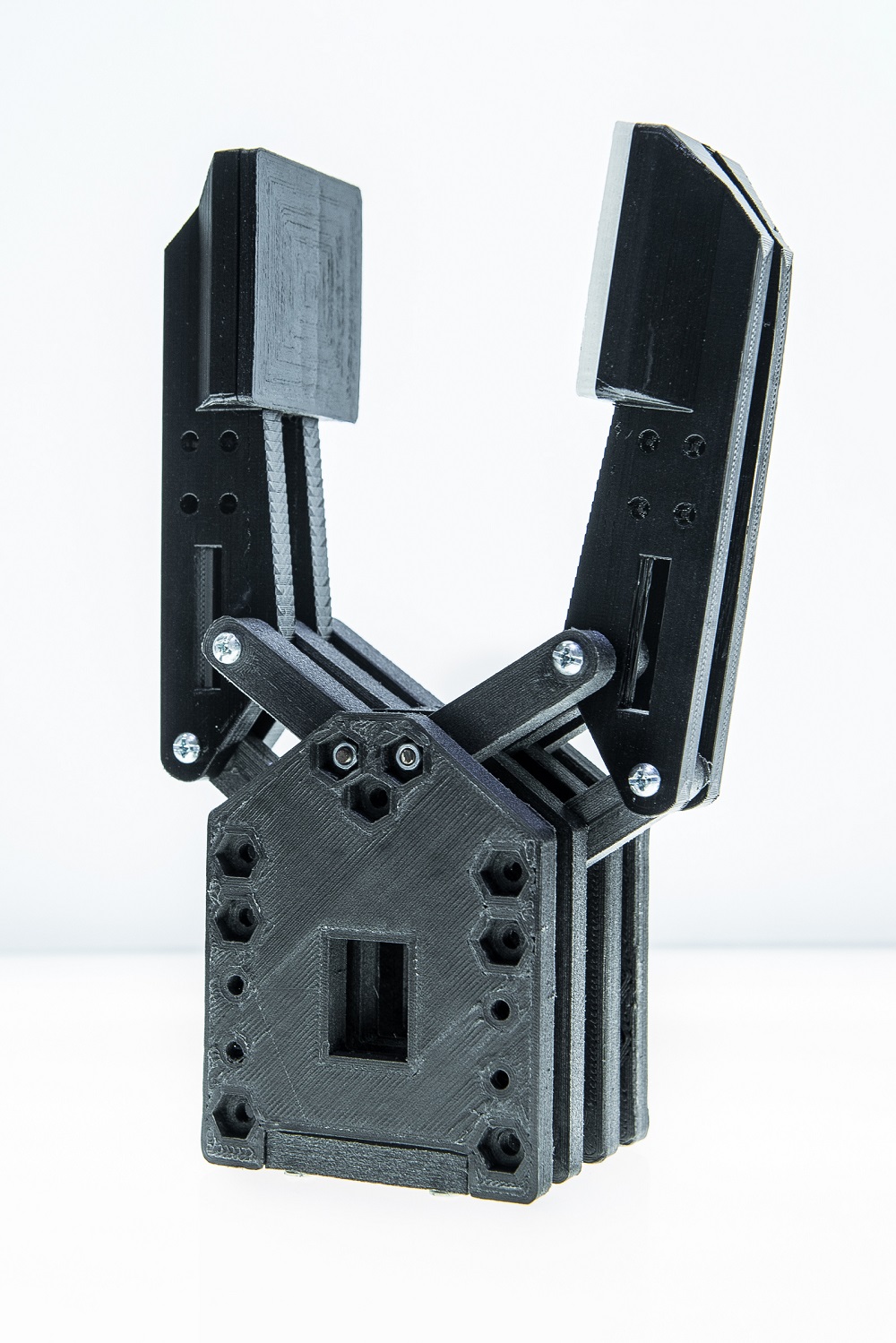
This robotic soft-touch gripper has been made with highly flexible Ultrafuse filaments using Essentium’s HSE technology.
BASF Venture Capital is leading the Series A investment round in Essentium, joined by Materialise as well as a syndicate of private venture investors.
“With this strategic investment, Essentium and BASF are focusing on improved supply chain performance, material consistency and accessibility,” said Dr. Blake Teipel, CEO of Essentium. “Essentium is also delighted to begin a new partnership with Materialise as the three companies focus efforts toward a new era for smart solutions in the global additive extrusion space. Together, we believe manufacturers everywhere will be able to accelerate production due to increased access to our new solutions, bolstered by a holistic, customer-centric approach.”
BASF, Materialise and Essentium state that they are aiming to drive the transition from 3D printing to additive manufacturing – but what does this really mean? Overall, their vision is to take 3D printing from a prototyping to a true manufacturing technology, firmly establishing a place for it on the production floor. The three companies in the new partnership plan to bring their respective strengths in hardware, software and materials together to do so. Higher speeds, stronger materials and more comprehensive software are all parts of the plan to make additive manufacturing a technology that can truly compete with other manufacturing methods in both large and small scale production settings.
Discuss this and other 3D printing topics at 3DPrintBoard.com or share your thoughts below.
Subscribe to Our Email Newsletter
Stay up-to-date on all the latest news from the 3D printing industry and receive information and offers from third party vendors.
Print Services
Upload your 3D Models and get them printed quickly and efficiently.













You May Also Like
Solid Rocket Motors: the First Big Scaling Test for AM in the US Defense Sector
The additive manufacturing (AM) industry has become obsessed with the opportunity for drones, and there’s certainly good reason for that. But before drones, the big focal point in AM for...
Why the AM Industry Should Pay Attention to Schneider Electric’s $22.6B PTC Acquisition
By late 2024, there was already enough signaling of the additive manufacturing (AM) industry opportunity in the data center infrastructure market for AM Research to write a report on the...
AM Demand Signals: Reshoring the Robotics Supply Chain
The Federal Communications Commission (FCC) recently banned the sale in the US of “almost all” new mobile robots sourced from foreign countries. IEEE Spectrum (the link in the first sentence)...
3D Printing Financials: $28M in China, U.S. Deals and a Metal AM Comeback
Money continues to go into additive manufacturing (AM). From a $30 million raise for a Chinese metal 3D printing company to new funding for naval AM and a European company...

























































