
Tooling Systems Manufacturer Wilson Tool International Introduces New 3D Printing Division

 More and more these days, we’re seeing applications for 3D printing in the tooling sector. Minnesota-based Wilson Tool International, the largest independent manufacturer in the world of tooling systems for press brakes, punch presses, and punch and die components for the stamping and tableting industries, has been a top provider of tooling solutions since 1996. The company has additional manufacturing facilities in five other countries, including Italy and China, and its extensive network of sales engineers and international distributors operate in every industrialized nation.
This week, Wilson Tool announced that it had just added a new division, called Wilson Tool Additive, to help the prolific tooling company adopt additive manufacturing capabilities. The new division will allow Wilson Tool to provide its many customers with 3D printed, made-to-order bending tools and fabrication support parts in just hours, as opposed to the days or even weeks it would ordinarily take with standard steel tools made with conventional manufacturing techniques. These reduced lead times also mean that a large inventory of parts is not needed, which saves on space and cost.
“We see this division as an investment in your future success, as it’s poised to increase your productivity in a way you’ve never imagined — through the Power of 3D. Quite simply, you will now have the ability to make made-to-order bending tools and support parts, much on your own terms,” Brian Robinson, the CEO of Wilson Tool Enterprises, said in a brochure the new division published.
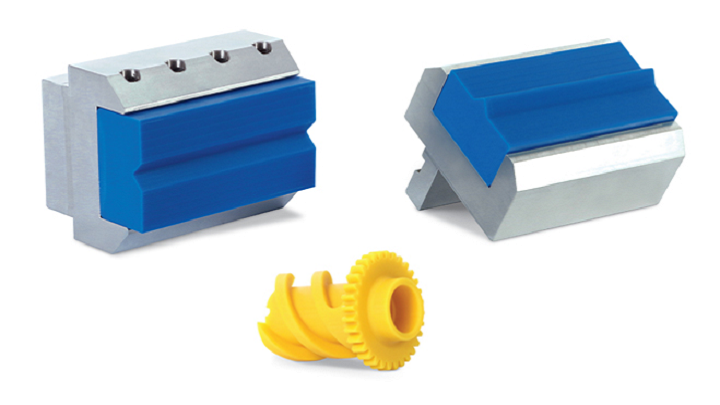
The division’s website states that its 3D printed tools are best made out of materials such as 14-gauge cold rolled or less, and well-suited for low run jobs up to about 1,000 hits. In addition to reducing lead time and the need for a large inventory, 3D printing makes it possible to eliminate tooling, as only one or two machines are needed to make finished products instead of several
The new Wilson Tool Additive division includes two new product lines – Bend3D and Solv3D – the first of which helps to lower lead times for press brake tooling. Solv3D is perfect for quick 3D printed production of support items, like fixtures, molds, and prototypes.
According to the website, “Both lines supply the quality you expect from Wilson Tool.”
The Bend3D line of 3D printed bending tools also work as air-bending and forming tools, as well as mark-free bending solutions. The pieces possess the same strength and quality as the traditional steel press brake tools that manufacturers use to bend sheet metal. The 3D printed support parts in the Solv3D line can be used to replace end-use parts that are traditionally made of plastic or steel. They can also be used as prototypes, and to replace jigs or fixtures, or shop items that would typically require the fabrication of a costly mold to replace.
“Wilson Tool International currently builds additive products using two types of processes,” Wilson Tool Additive wrote. “Determined through rigorous testing of stress resistance and longevity, these two processes offer customers a full spectrum of high-quality product possibilities.”
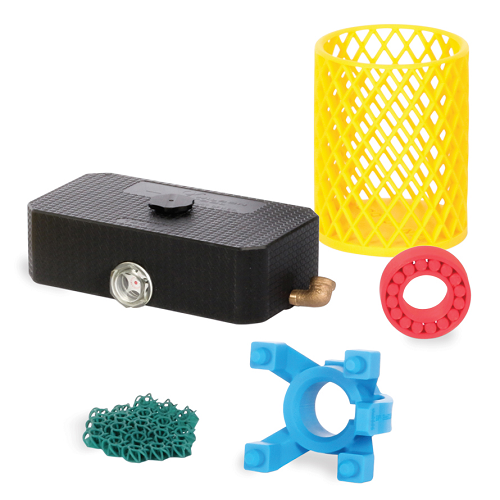 The first of these two 3D printing processes is fused deposition modeling (FDM). The plastic used is strong from two directions, and is a solid choice for fixtures and select types of tooling. The second process, grown plastic, uses light curing to build parts out of resin, and is good for finished parts that are near the quality of a mold. 3D printed tooling created with this process has limited design restrictions, in large part because it is strong in all directions.
Discuss this story and other 3D printing topics at 3DPrintBoard.com or share your thoughts in the Facebook comments below.
[Images: Wilson Tool Additive]Subscribe to Our Email Newsletter
Stay up-to-date on all the latest news from the 3D printing industry and receive information and offers from third party vendors.
Print Services
Upload your 3D Models and get them printed quickly and efficiently.













You May Also Like
3D Printing News Briefs, September 26, 2026: Bioceramic Implants, 3D Concrete Printing, & More
In this weekend’s 3D Printing News Briefs, we’ll start with an integration between PanOptimization and AMCM, before moving on to healthcare news from KLS Martin and Lithoz, and then UltiMaker...
3D Printing News Briefs, September 24, 2026: Metallic Alloys, Nanobone, Alternative Meat, & More
In this week’s 3D Printing News Briefs, we’ll discuss some materials news: a reference material for standardizing photopolymer manufacturing, metallic alloys that help reduce energy loss in electric motors, a...
AMAsia Pulse: AM Investment Picks Up Across Asia-Pacific
The first half of September brought fresh investment and expansion activity across Asia-Pacific’s additive manufacturing sector. China’s Xinjinghe secured funding for an aerospace AM hub, South Korea’s Lincsolution outlined plans...
3D Printing News Briefs, September 17, 2026: 3D Printed Boat, UAS Development, & More
We’ll start with maritime manufacturing in this week’s 3D Printing News Briefs, and continue on to defense 3D printing. We’ll end with funding for Tripo AI. Read on for all...























































