
Nanodiamond-Enhanced 3D Printer Filament Now on the Market

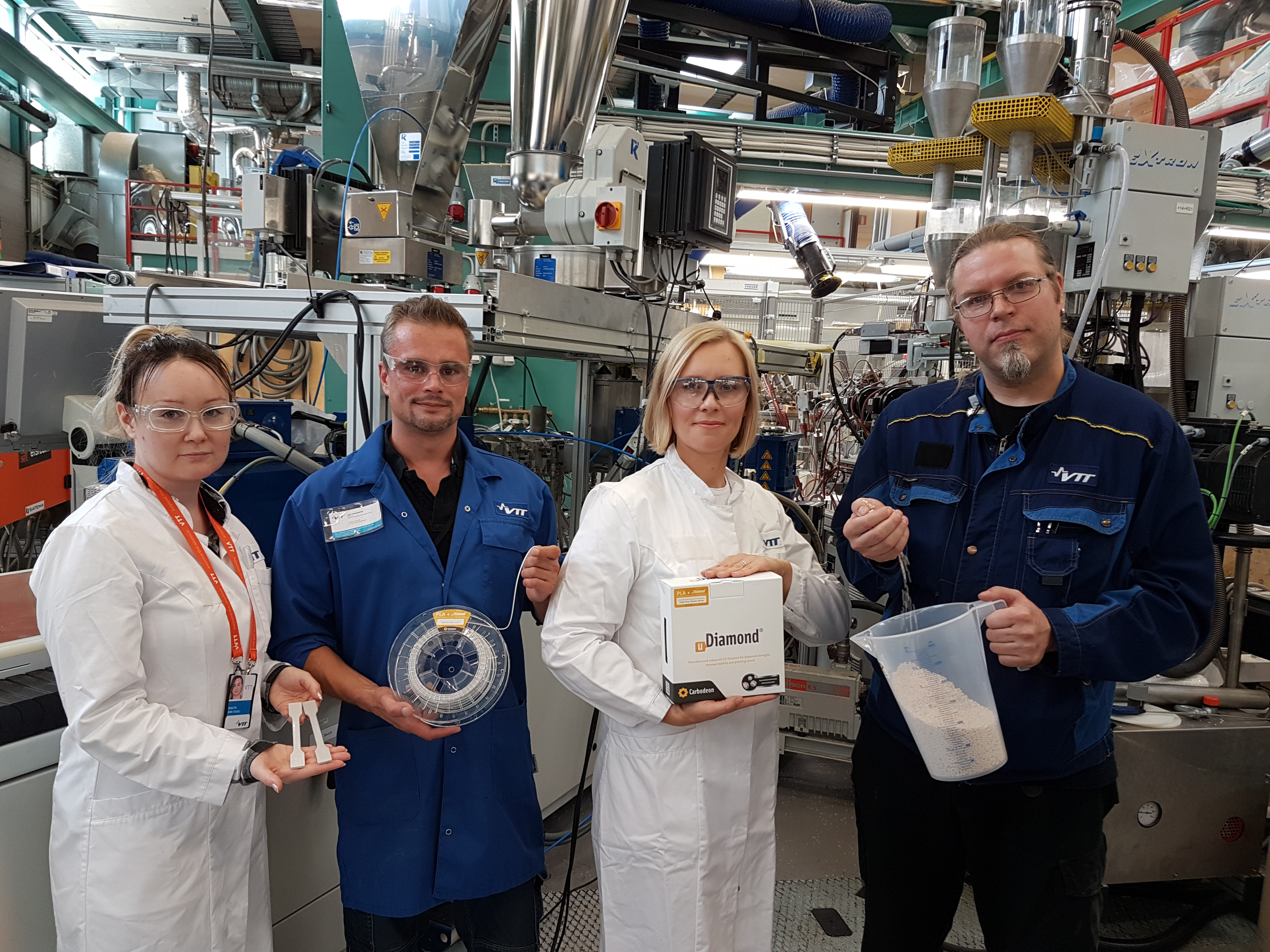
(L to R) VTT Polymer Pilot unit employees: Sini-Tuuli Rauta, Jari-Pekka Kankaanpää, Satu Pasanen and Timo Flyktman [Image: VTT]
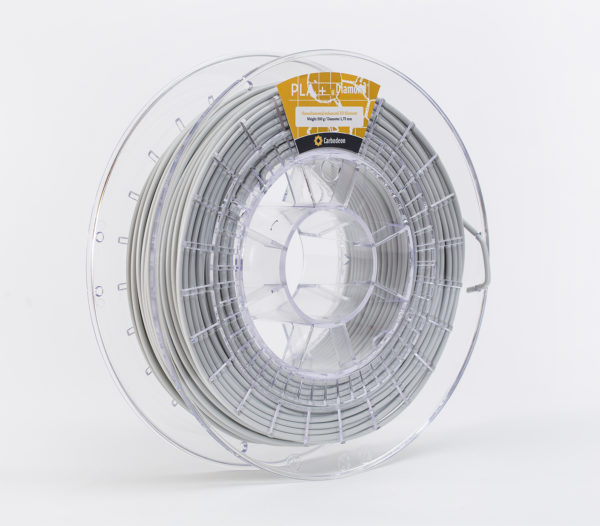
[Image: Carbodeon]
“This is the first product of a family that will be sold as a finished 3D filament and in a granular format, as well,” said Carbodeon CEO Vesa Myllymäki. “VTT has been a long-term, reliable partner in this development, and has reacted to our needs quickly.”
The Technical Research Centre of Finland (VTT) worked with Carbodeon to create methods for evenly dispersing the nanodiamonds in the filament to create a PLA composite optimized for 3D printing and produced at an industrial scale. VTT has also tested the material and prints made from it.
“Using our chemical pilot devices, we at VTT produced the nanodispersed material required for the melt processing, and thus supported the creation of a new product,” said Jarmo Ropponen, Research Team Leader at VTT’s chemical pilots.
Nanodiamonds are diamond particles produced by explosions, and they are among the most thermally conductive and hardest materials known. There are some health concerns about nanosized particles if inhaled, with studies showing that they can cause oxidative stress to the heart, lungs and brain. However, good ventilation is suggested as a way to mitigate the risk, just as it is suggested for any type of 3D printing material. Carbodeon’s nanodiamonds have been shown to be non-toxic and suitable for a range of applications according to EPA and REACH assessments.
 Although they are used in very low concentrations, the nanodiamonds in the material can still improve performance significantly. UDiamond filaments contain nanodiamond particles with a diameter of 4-6 nm.
“The melt processing of plastics became easier and the mechanical characteristics were improved with the introduction of nanodiamonds,” said Satu Pasanen, Research Scientist at VTT in charge of the plastic piloting in the development. “Based on the preliminary tests, the modulus of the 3D-printed test pieces was improved at best by more than 200% compared to the PLA-based filament already on the market. VTT´s Polymer Pilot produced the first 600 kg material batch, which Carbodeon had refined into a commercial product.”
Carbodeon has extensive patent coverage for its nanodiamond materials. the uDiamond material is suitable for both professional and consumer-level FFF/FDM 3D printers, and is no more expensive than much standard filament, costing only €35 for a 500g spool. You can learn more about uDiamond, and place an order for purchase, at Carbodeon’s website.
Discuss this and other 3D printing topics at 3DPrintBoard.com or share your thoughts below.
[Source: VTT]
Subscribe to Our Email Newsletter
Stay up-to-date on all the latest news from the 3D printing industry and receive information and offers from third party vendors.
Print Services
Upload your 3D Models and get them printed quickly and efficiently.













You May Also Like
How Should Businesses Build New Business? Dirk Simon Weighs In — Part 1
Dirk Simon had deep experience in materials and chemistry before joining the 3D printing industry. Instrumental in BASF and Farsoon’s market introduction, Dirk has spent a lot of time thinking...
The Frankenservice Part 2: Have Your Cake and Eat it Too
This series of articles delves into a thought experiment. What if we let go of using a few machines very optimally, but instead use lots of different machines to meet...
The Additive Chicken Coop, Part IV: Lemmings
If we look at our past, we can see how making custom machines, incessantly watching ourselves, and our inability to rescope shaped our industry. We have also looked at the...
The Additive Chicken Coop, Part III: Bananas
A friend of mine, Ed Davis, once pointed out the level of strategic replication in additive. I wasn’t aware of it before and haven’t been able to unsee it since....

























































