Wasproject 3D Prints a beautiful Trabeculae Pavilion in Milan

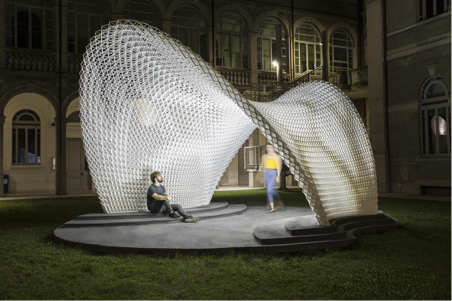
Italian 3D printer company Wasproject is rather different than most firms. It has a stated goal of saving the world through 3D printing. Developing and selling 3D printers are to them just a way through which they can develop ever larger printers that solve ever bigger problems. They also make things such as a Maker Economy starter kit which is a shipping container that contains digital manufacturing tools. The company wants to build buildings and entire villages using 3D printing. Today they showed us how to build a lovely structure in Milan. In March of last year we told you that this 3D printed trabeculae pavilion would be built and the team has been hard at work on it since.

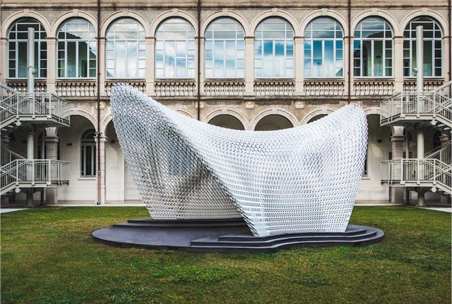
The Trabeculae Pavilion can be seen at the Politecnico di Milano, Piazza Leonardo da Vinci in Milan. The entire structure covers an area of 36 m² and weighs 335 Kilos. Measuring 7,5m x 6,0m x 3,6m the pavilion is a bioinspired lightweight structure that took 4352 hours to print. Thats a 180 days. In total it took five Wasp printers (four DeltaWASP 4070 and one 60100) to continuously produce the structure twentyfour seven out of 352 parts. The material is a mysterious biopolymer made by FILOALFA.
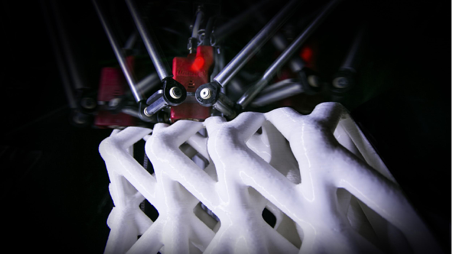
“The design is based on a computational process that finds inspiration in Nature, specifically in the materialization logics of the trabeculae, the internal cells that form the bone microstructure. From this investigation, custom algorithms have been developed to support the creation of a cellular load-responsive structure with continuous variations in sizing, topology, orientation and section, in order to maximize material efficiency.”
Trabecular bone is at the moment being 3D Printed and other companies are looking at how to get things to mimic or adhere to trabecular bones. To then take the same development and supersize it is efficient as well as fun.
“The last decades have witnessed an exponential growth in the demand of raw materials due to the rapid urbanization and industrialization of emerging economies. This research looks at biological models and at the opportunities offered by the new additive production technologies in order to find sustainable solutions to the exploitation of materials. Our objective is to explore a new model of construction: advanced, efficient and sustainable” declare Roberto Naboni, Architect and currently Assistant Professor at University of Southern Denmark (SDU).
The Pavilion
At first glance this kind of structure may seem to be more art than architecture. Pretty? Sure but useful? Probably not. Actually by looking at lightweighting buildings Wasproject is looking at how to print them the quickest. A structure such as this one could be cladded quite easily in order to become a more functional building. If we look at Wasproject’s methods and goals these are much closer to where we need to be when wanting to 3D print houses. Many other architects and 3D printing house teams are simply using old methods and old thinking to make buildings with 3D printing. There is little value add there. Through truly innovative rethinking of the structure and the idea of structure we can come to more efficient buildings in the future. Bioinspired lightweight structures such as this one could be combined with “sail-like” shells to create quick to print structures that use comparatively little material. Since every kilo that has to be schlepped to the building site is one more, on agregate this will save a lot of material and cost. If these new structures are then as functional than the old then we will have actually made progress.
Subscribe to Our Email Newsletter
Stay up-to-date on all the latest news from the 3D printing industry and receive information and offers from third party vendors.
Print Services
Upload your 3D Models and get them printed quickly and efficiently.













You May Also Like
3D Printing News Briefs, May 30, 2026: RIMPAC 2026, Acquisition, Ceramic Implants, & More
We’re kicking things off with materials news in this weekend’s 3D Printing News Briefs. Then it’s on to a hybrid manufacturing system for a maritime exercise, an expansion of industrial...
The Hidden Cost of Lost Engineering Intent
Recent reporting on the UPS MD-11 engine separation on Flight 2976 has understandably focused on the immediate question: what happened? The investigation will determine that, as it should. Serious engineering...
Scientists Create Stretchy 3D Printed Implants for High Blood Pressure Treatment
Researchers at Pennsylvania State University (Penn State) say they may have found a softer, less invasive way to treat severe high blood pressure. In a new study published in the...
Conexeu Sciences Wishes to Make a Regenerative Breast Matrix Solution (and sell shares)
Conexeu Sciences wants to commercialize a regenerative breast matrix solution. For years, Australian firm BellaSeno and Lattice Medical have been working on similar solutions. In 2018, Lattice came out with...