
US Air Force Base in Utah Creating 3D Printed Replacement Parts for F-35 Fighter Jets

 The US military has not shied away from implementing modern manufacturing methods such as 3D printing, but has actually embraced the technology. In fact, the US Air Force has used 3D printing for multiple projects, including components for aircraft and fighter jets, such as the F-35. This is what’s known as a next-generation fighter, and the 388th Maintenance Group of the Hill Air Force Base in Utah recently began 3D printing specific replacement parts for the F-35. Base officials are hoping that the technology will help to lower costs and increase availability.
Many branches of the military have turned to 3D printing to make replacement parts for those very same reasons.
“We’re always driving for speed, safety and quality. But cost-effectiveness is also a priority,” said 388th MG commander Col. Michael Miles. “This new tech has great cost-avoidance potential and provides rapid repair capabilities.”
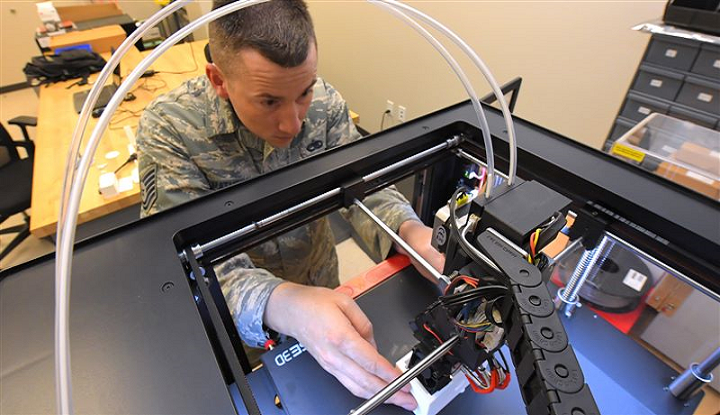
Tech Sgt. Scott Mathews, assistant manager of the 388th Maintenance Group’s Air Force Repair and Enhancement program, makes adjustments to a 3-D printer the unit is experimenting with to create pieces and parts faster and more cost-effectively. [Image: Todd Cromar]
Tech. Sgt. Mathews explained, “It’s much more cost effective for the Air Force than buying new parts.”
One of the first items the team at the 388th MG created was a small-scale replica of the F-35 fighter jet. But now they’ve moved onto 3D printing simple plastic replacement parts, such as cable splitters, fasteners, grommets, housing boxes, and wiring harnesses. Tech. Sgt. Mathews said that many areas of the shop have figured out how to make the 3D printing easier to work with by “getting away from a lot of fancy metals and getting into composites and plastics.”
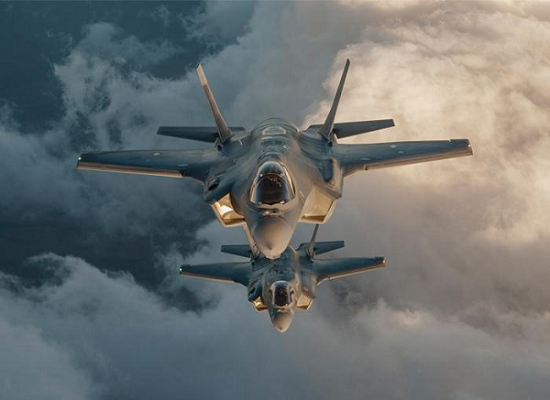
F-35 [Image: Lockheed Martin]
“There’s one printer (where) you can print with aluminum. That opens up a whole new world of opportunities,” said Tech Sgt. Matthews. “When you look at all of the different parts we could manufacture … it just boggles the mind, the things we could (make) on base. It’s just insane.”
The first two F-35 fighter jets arrived at Hill AFB in September of 2015. But, by the end of 2019, there will be three whole fighter squadrons, made up of a total of 78 jets, on the base. The active duty 388th Fighter Wing and the reserve 419th both fly and maintain the jets, while the Ogden Air Logistics Complex on base performs maintenance on all of the F-35s. Hopefully, 3D printing can soon be used to help with all of this maintenance.
Tech Sgt. Matthews said, “There’s a sense of pride knowing you played at least a minuscule role of getting them airborne.”
Discuss this and other 3D printing topics at 3DPrintBoard.com or share your thoughts in the Facebook comments below.
[Source: Standard Examiner]Subscribe to Our Email Newsletter
Stay up-to-date on all the latest news from the 3D printing industry and receive information and offers from third party vendors.
Print Services
Upload your 3D Models and get them printed quickly and efficiently.













You May Also Like
Foundation Alloy Raises $22M in Series A for Solid State Molybdenum
Foundation Alloy has just raised $22 million in Series A financing. The alloy company is trying to create a platform that will enable the solid state manufacturing of alloys. In...
Aerospace Giant IHI Bets on Freemelt E-Beam 3D Printing for Next-Gen Turbine Alloys
IHI Europe has purchased a Freemelt electron-beam powder-bed fusion (E-PBF) system. Previously, parent IHI bought two Freemelt systems, bringing the total to three. IHI is a Japanese engineering conglomerate. The...
Goldilocks’ Flywheel: Refractory Complex Concentrated Alloys (RCCAs) & The Race for the Future
Recently, Metalysis, Skyrora, and Thermo-Calc Solutions started to try to commercialize Tanbium. This alloy has been created for use in combustion chambers and rocket nozzles. Tanbium is a Refractory Complex...
3DPOD 236: AM Materials Science & Applications with Nick Sonnentag, Sunnyday Technologies & Oshkosh Corporation
Nick Sonnentag is a Senior Principal Engineer at Oshkosh, where he contributes to the development of some of the world’s toughest vehicles using additive manufacturing (AM). Drawing on experience from...























































