New Research Shows That Novel Honeytube Structures Provide Superior Energy Absorption for 3D Printed Objects


 Many industries, like automotive, robotics, and aerospace, are constantly looking for ways to make their various components and parts more lightweight. 3D printing can help with this, as it has the ability to fabricate hollow objects, which cut not only costs by reducing how many materials are used, but also weight and waste. It takes time to find the optimal balance between strength and weight when it comes to infill optimization for lightweight objects, and many choose to stick with a standard honeycomb pattern.
However, while it may seem like a good idea to keep geometrical spaces free of so much material, hollowing can sometimes lead to such issues as loss of functionality and reduced strength for your 3D printed parts. This is why research continues into these hollow internal structures – to overcome these challenges.
Honeycomb structures are generally the most efficient 3D printing infill, and a novel form of this kind of structure, the honeytube, is the focus of a new research paper, titled “Compressive properties of hollow lattice truss reinforced honeycombs (Honeytubes) by additive manufacturing: Patterning and tube alignment effects,” recently published in the Materials & Design journal.
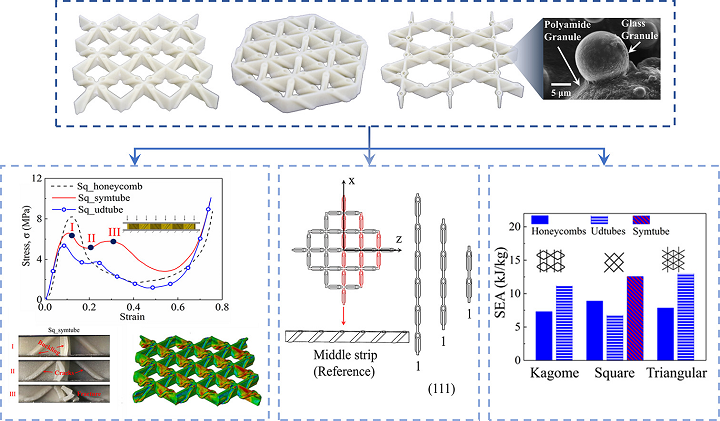
Graphical abstract
The abstract reads, “Honeytubes, a novel type of honeycomb formed by reinforcement with lattice trusses, were reported to exhibit enhanced buckling resistance. However, an in-depth analysis for the compressive performance and energy absorption capacity was lacking. In this paper, the effects of microstructure and tube alignment on compressive properties were studied. Four types of honeytubes were designed based on different topologies, geometries and tube patterns, and fabricated by selective laser sintering (SLS). Out-of-plane compression tests and finite element simulation were performed for the analysis. Results indicated that incorporation of lattice in honeycombs resulted in greater local strain in tubes and tube-rib connections. However, honeytubes exhibited superior energy absorption capability, even surpassing that of some metallic lattices. Balancing the configuration of tubes in honeytubes could ensure enhanced mechanical performance. This work demonstrates that materials designed by capitalizing on micro-topologies can regulate mechanical properties and provide insights for guiding the development of new materials.”

Honeycomb structure [Image: Materialise]
Their research shows that if they capitalize on micro-topologies, this compressiveness can be manipulated for balance. Then, by creating balanced tube patterns, one can ensure that one’s honeytubes will reach their full potential of increased compressive performance. The results of this work have definite applications in the automotive sector.
Co-authors of the paper are Jun Xu, Yaobu Wu, Lubing Wang, and Jiani Li with Beihang University, Yuwei Yang and Yuli Tian with Beijing Electric Vehicle Co., Ltd (BJEV), Zizheng Gong and Pinliang Zhang from the Beijing Institute of Spacecraft Environment Engineering, Steven Nutt with the Department of Chemical Engineering and Materials Science at UCLA, and Sha Yin, with both Beihang University and Xi’an Jiaotong University.
Discuss honeytubes and other 3D printing structures and topics at 3DPrintBoard.com or share your thoughts in the Facebook comments below.
Subscribe to Our Email Newsletter
Stay up-to-date on all the latest news from the 3D printing industry and receive information and offers from third party vendors.
Print Services
Upload your 3D Models and get them printed quickly and efficiently.












You May Also Like
Q5D and Molrix To Supply US Army With Harness Robots
Q5D Technologies and Molrix will offer their advanced harness production manufacturing units to the US Army. One production cell will be used for the SkyFoundry project, while two further systems...
CEO Yoav Zeif on Why Stratasys’ Markforged Acquisition Is Really a Bet on Industrialization
When Stratasys announced plans to acquire Markforged, the immediate focus was on the deal. Markforged is one of the most recognizable names in additive manufacturing (AM), known for its continuous...
3D Printing & the Autonomous Era: Defense Tech’s Latest Mutation
When we last checked in on the broad defense tech landscape and the role of the additive manufacturing (AM) industry in that environment, it became clear that the connecting thread...
UAS Additive Strategies: Register by June 30 to Learn About the Hottest Topic in 3D Printing
Last week, drone stocks surged on news that the Trump administration is considering a massive investment in the US unmanned aerial vehicle (UAV) industry. Earlier in 2026, the release of...