San Draw Medical Introduces New Accuracy with 3D Printed Suture Simulator


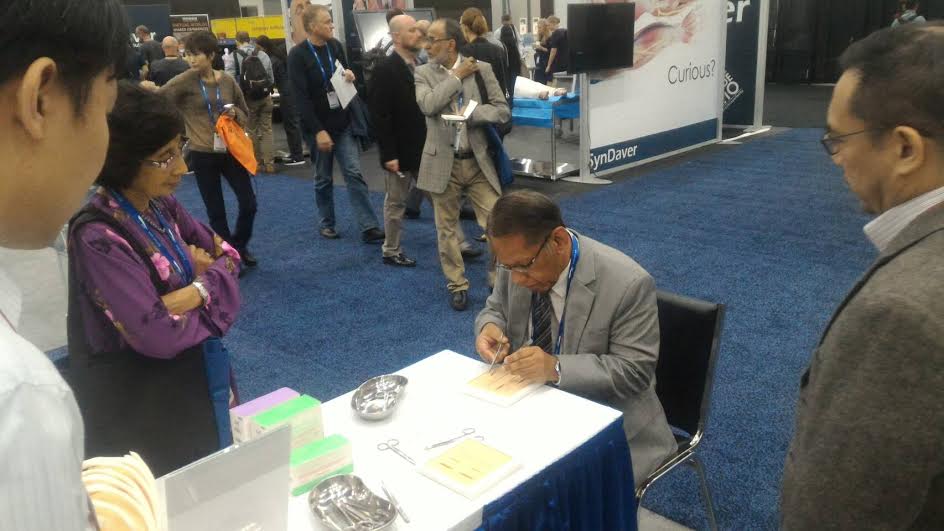
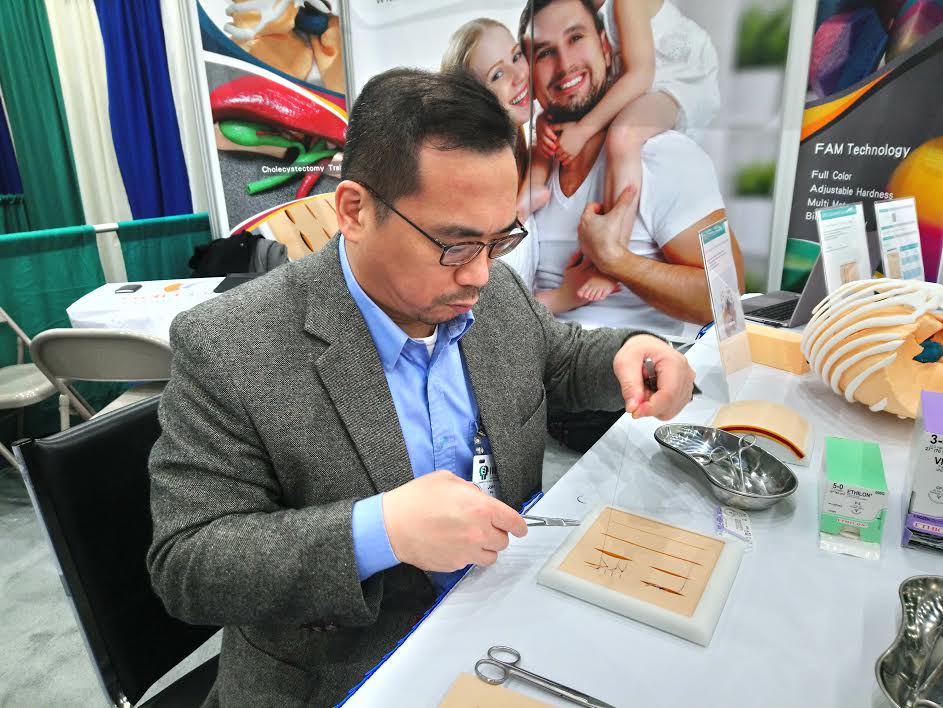
Dr. Paul Phrampus, former President of the Society for Simulation in Healthcare, practices with San Draw’s new suture simulator
If you find yourself in the emergency room needing stitches, you’re obviously going to hope that whoever performs those stitches on you knows what they’re doing. There’s not much need to worry – medical students receive incredibly thorough training, practicing all procedures on simulators multiple times before they ever have to try them on a patient. You may wonder, however, about the quality of those simulators. How close are they, in fact, to reproducing the properties of human tissue? It can be quite a different experience to practice on a training model than it is to work on an actual human being.
3D printing has improved the quality of training models so that they are about as close as a student can get to practicing on a human being. One company in particular, San Draw Medical, specializes in 3D printed training models that are highly realistic, thanks to advanced silicone 3D printing technology. Its suture simulator mimics human skin in all of its complexity, with its multiple layers and varying textures and thicknesses. Another model allows students to get a feel for giving injections to a real patient.
Now San Draw Medical has improved further on its suture training model by giving students something to suture. In traditional simulators, students have to cut the skin pad themselves with a scalpel, and it’s difficult to make a cut that actually resembles a real wound that a human would have. In addition, wounds created with the scalpel will be different every time, so it’s hard for the students to standardize their suturing technique.
 San Draw is now 3D printing skin pads with multiple wounds already part of them. There are several different types of wounds that people can suffer, and San Draw designed eight of the most common ones for the simulator with the help of surgeons. Each type has a recommended suture for the students to practice. Customers can customize their pads with any of 256 selections.
“The silicone 3D printed wounds look and feel super realistic, and I believe this product can benefit thousands of students,” Dr. John Wu, Chief Innovation Officer of CEMS, Taipei Medical University, told 3DPrint.com.
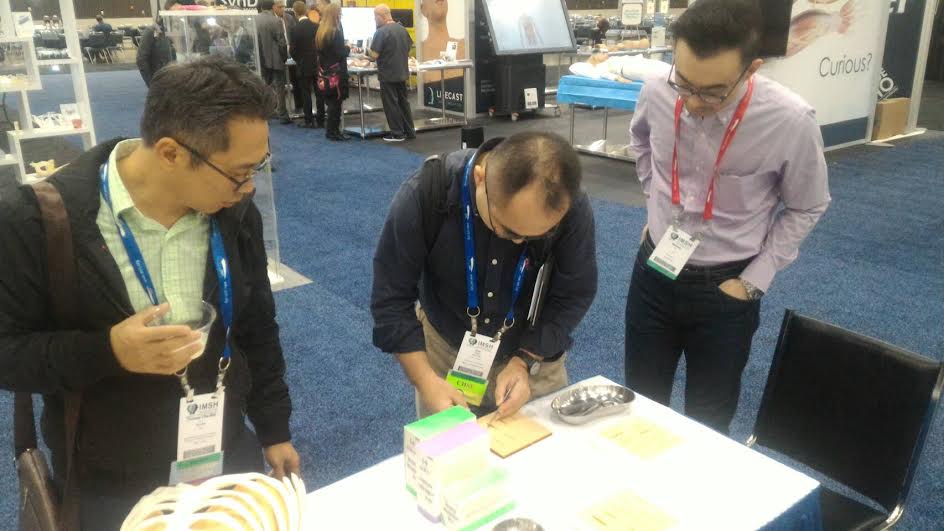
San Draw debuted the new simulator at IMSH 2018, a major medical simulation conference and trade show, which took place from January 13th to 17th in Los Angeles. According to San Draw, the company drew a great deal of attention at the show, with several medical professionals trying out the new simulator.
-
- Dr. Mohd Azhar Mohd Noor, National Defence University of Malaysia
-

- Professor Gen Ouchi, University of The Ryukyus
-
- Dr. John Wu, Taipei Medical University Hospital
You may not have realized there were so many different types of wounds, and that they all need different kinds of stitches, but it’s reassuring to think that now medical students can practice specific sutures for those specific wounds, rather than just stitching up a cut made by a scalpel. As medical training simulators get more complex and realistic, medical care gets better, and fewer errors are made. That’s comforting to a patient who has a nasty cut – it’s now more likely that the doctor stitching them up, no matter how new at his or her job, has done exactly this before.
Discuss this and other 3D printing topics at 3DPrintBoard.com or share your thoughts below.
[Images provided by San Draw Medical]
Subscribe to Our Email Newsletter
Stay up-to-date on all the latest news from the 3D printing industry and receive information and offers from third party vendors.
Print Services
Upload your 3D Models and get them printed quickly and efficiently.











You May Also Like
ASTM International Works with UK MoD on America Makes Project
The UK Ministry of Defense (MoD) will work with ASTM International on a $1.1 million project to let it work in closer concert with the US Department of War (DoW)....
UK Government Funds Research to Develop 3D Printed Metal Alloys for Nuclear Fusion
The UK Atomic Energy Authority (UKAEA), a government-funded research organization, has demonstrated a persistent interest in developing metal additive manufacturing (AM) materials for nuclear fusion applications, including multiple phases of...
Top 10 3DPrint.com Stories of 2025: Kickstarter, Consumer Goods, Bankruptcy, & More
As Vanesa Listek wrote, last year was a major turning point for additive manufacturing (AM), as the industry is working to sort itself out. Customers want proven use cases and...
3D Printing Predictions 2026: Industrial Production & Polymer Additive Manufacturing
Polymer additive manufacturing is seeing less investment, attention, and disruption than metal additive manufacturing currently. Less crucial for defense needs, it has of late had far fewer new entrants. But,...