UK Government Partnership to Develop 3D Printed Metal Alloys for Nuclear Fusion

The UK Atomic Energy Authority (UKAEA), a government-funded research organization, has demonstrated a persistent interest in developing metal additive manufacturing (AM) materials for nuclear fusion applications, including multiple phases of a project called FATHOM (FAbrication of Tungsten using HOt isostatic pressing and additive Manufacturing) conducted at the University of Birmingham.
In its latest project revolving around the intersection between the next generations of both energy and manufacturing, the UKAEA has partnered with an initiative spearheaded by researchers at the University of Nottingham’s Centre for Additive Manufacturing (CfAM) to explore the use of PBF in combining tungsten and copper to create metamaterials optimal for use in fusion reactors. Metamaterials are substances deliberately designed to function in ways that are “greater than the sum of the parts” of the underlying chemistries they’re composed of.
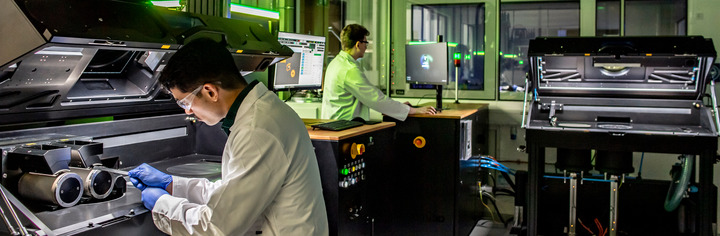
The researchers involved in the project, called DIADEM (Design of Interfaces for Additively Engineered Materials), will leverage a process called Multi-Material LPBF (MM-LPBF), in an attempt to find ways to combine tungsten and copper that result in metamaterials able to withstand conditions like “extreme heat flux, high neutron load and strong magnetic fields”. In addition to the UKAEA, the research is also supported by private sector partners, including Rolls-Royce.
Although the UK fell behind counterparts like the U.S. during the 3D printing boom of the 2010s, the island nation has been steadily making up lost ground in the 2020s. In addition to increased government funding, the UK has also attracted investment from key emerging companies like Conflux Technology, which established a business hub there last year.
Above all, the UK’s recent AM efforts have surrounded strategically targeted applications and advanced materials development. For instance, in 2024, the University of Wolverhampton announced a partnership with EOS and AMCM to establish the “UK Centre for Excellence for Additive Manufacturing,” with a specific focus on copper.
In a press release about the UKAEA’s partnership with the DIADEM project to research AM metamaterials for nuclear fusion, Allan Harte, the Fusion Technology Research Portfolio Manager at UKAEA, said, “Fusion promises to be a safe, low-carbon, sustainable part of the world’s future energy supply, and the UK has a great opportunity to become a global exporter of fusion technology. However, achieving fusion means solving complex challenges. This project, leveraging [AM] to help manufacture key fusion components, forms part of UKAEA’s ongoing efforts to bring fusion energy closer to commercial reality.”
The Director of CfAM, Richard Hague, said, “Joining two dissimilar metals has been a critical problem for the fusion sector, where the ability to blend two metals together is imperative for progress in this area. Using this state-of-the-art multi-material [AM] technique for fusion energy is just the first application — in the future, DIADEM will benefit any sector where high-performance, multi-metal components are required, such as aerospace, defence and healthcare. By mastering multi-metal [AM], we’re opening the door to a new generation of engineered materials.”
Fusion is the scientific dream that researchers just won’t give up on, and China’s recently announced breakthrough of surpassing ‘the Greenwald limit’ should breathe even more life into the fusion race. As I’ve noted before, even if nuclear fusion energy never becomes a scalable commercial reality, the pure research inspired by that goal makes the associated findings worthwhile no matter what.
Nowhere is that more true than in instances like what the DIADEM project team is working on. Materials science is the key to unlocking AM’s future, and the implications of metal AM R&D should be especially valuable to a nation like the UK, which has been dealing with dwindling control over its own critical resource supply chains for much of the last century.
One could argue that AM is all about geography: the maximization of localizing productive output. Where the UK once controlled the quantity of the world’s value chains, the latest strategy is defined by harnessing quality, prioritizing the profitability of know-how over the brute force of scale.
I think that this can be a winning strategy, all the more so if the UK can establish synergies between its own AM efforts and those of partners like the U.S., Australia, and the EU. The UK once leveraged its central location within the world island to create an all-encompassing military empire. In the 21st century, that same central location should prove quite an asset in the UK’s plan to develop itself as an advanced manufacturing hub.
Images courtesy of University of Nottingham/CfAM
Subscribe to Our Email Newsletter
Stay up-to-date on all the latest news from the 3D printing industry and receive information and offers from third party vendors.
Print Services
Upload your 3D Models and get them printed quickly and efficiently.













You May Also Like
UniFormation S10 Heads to Kickstarter with an Integrated Resin Printing and Post-Processing System
UniFormation will launch its S10 desktop resin 3D printer on Kickstarter on October 22, 2026, with pledges starting at $999. The S10 integrates printing, washing, and drying, allowing a print...
Creality Goes Pro with Sermoon P1S 3D Scanner
From making millions of value-engineered Prusa clones, Creality really has aggressively pivoted to more complex machines. The company has made strides forward in software, and the Ender’s of yore is...
Stratasys Showcases 3D Printed Automotive Applications & New Printer at IMTS 2026
Just ahead of last week’s International Manufacturing Technology Show (IMTS) in Chicago, Stratasys launched the F870, a new large-format, production-grade FDM 3D printing platform designed to drive industrial manufacturing at...
Creality Launches SPARKX i8 on Indiegogo, Bringing Fastest, No-Purge-Waste Printing
Creality announces the launch of the multi-color 3D printer SPARKX i8 on Indiegogo, at an early-bird price of $309 (MSRP $399) starting from Sept. 21. Designed for ultimate user experience,...