Finnish Startup CurifyLabs Releases Pharmaceutical Compounding 3D Printer


‘Pharmaceutical compounding’ refers to the practice of customizing medications to fit patients’ specific needs, in cases where the relevant drugs on the market aren’t suitable. The standard pharmaceuticals on the market might contain ingredients the patient is allergic to, for instance, or a custom solution might yield higher bioavailability.
One of the greatest advantages of using additive manufacturing (AM) for pharmaceutical production is the potential to give drug developers an easier path towards compounding. The Finnish startup CurifyLabs has highlighted this feature in its new release, the PharmaPrinter Aurum.
We last heard from CurifyLabs only a month ago, when the company announced the CuraBlend Vet, a system designed for custom solutions for pet pharmaceuticals. As with all CurifyLabs’ products, the PharmaPrinter Aurum is built on the company’s proprietary Compounding System Solution, encompassing hardware, software, and material inputs. It features a high-resolution touchscreen, syringe mounting with a quick-lock feature, an intuitive software layer with built-in cybersecurity features, and more,
The key difference between the PharmaPrinter Aurum and its predecessor, the PharmaPrinter 01, is that the new release’s more compact package opens the machine up to a broader potential customer base. At the same time, users will still achieve the same improvements in production speed when compared to conventional methods for pharmaceutical compounding.
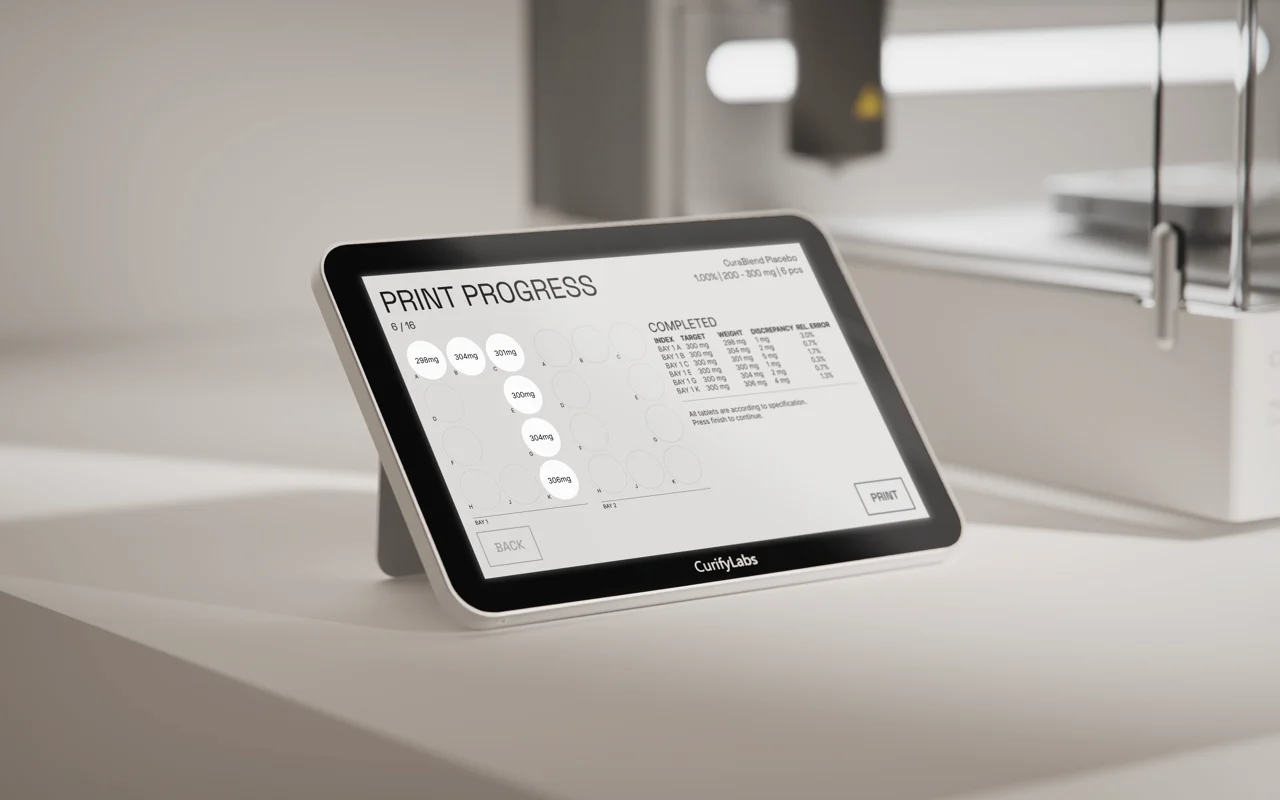
In a press release about CurifyLabs’ launch of the PharmaPrinter Aurum, the company’s CEO and founder, Charlotta Topelius, said, “CurifyLabs is transforming pharmaceutical compounding by integrating precision and automation into a traditionally manual process. For pharmacies requiring higher volume production from a smaller device, the CurifyLabs PharmaPrinter Aurum is a future-proof solution.”
I’ve always thought that pharmaceutical production is one of the most interesting applications for AM. Given how intractable the global pharmaceutical shortage seems to be, AM for pharmaceuticals could also prove to be one of the most socially critical use-cases in the world of advanced manufacturing.
If the Trump administration continues its efforts to wield the tariff weapon as a device for reshaping pharmaceutical supply chains, the precedents that we’ve already seen with the manufacturing sector at-large suggest that the pain will get worse before it gets better. The difference here of course is that pharmaceuticals aren’t conventional “manufactured goods,” they’re healthcare products.
Thus, as opposed to the administration just knocking everything over and then dealing with the wreckage, the White House has been far more proactive in creating pathways to offset damage likely to ensue from trade war policies. This is likely part of the explanation behind the administration’s coordination with pharmaceutical manufacturers on Medicare drug pricing and the in-the-works direct-to-consumer platform (TrumpRx.gov).
Will drug manufacturers also be incentivized to explore more seriously the use of advanced manufacturing infrastructure in their supply chains? There’s little clear evidence of this yet, but it is worth noting that, in 2025, pharmaceutical giants announced investments of nearly $400 billion in U.S. operations through 2030.
With that in mind, there does seem to be justification for expecting that drug manufacturers will increase their prioritization of using novel solutions, like CurifyLabs’ CSS ecosystem, as part of the overall structural shift to the pharmaceutical industry. The tangible effects may still be years away, but by, say, 2030, the idea of using 3D printing for making drugs close to the point-of-need may have moved much closer to practice than theory.
Images courtesy of CurifyLabs
Subscribe to Our Email Newsletter
Stay up-to-date on all the latest news from the 3D printing industry and receive information and offers from third party vendors.
Print Services
Upload your 3D Models and get them printed quickly and efficiently.













You May Also Like
$51 Million Revenue VMP Wants to Become a Leading Additive Manufacturing Metal Powder Producer
Chinese powder producers have traditionally had little impact on the additive manufacturing market. Typically, they offer low-cost powders without much in the way of settings or application support. But China’s...
SprintRay Releases Midas Restore
SprintRay‘s new U.S. Food and Drug Administration (FDA)-cleared Midas Restore is a material for restorative dentistry. The ceramic-doped resin is meant for definitive inlays, crowns, and veneers. The resin has...
Alibaba Selling Fiber Optic Military Drones for $200
Ukraine was saved by Turkish-made Baykar Bayraktar drones and many brave soldiers in the first stages of the conflict. Then hobbyists and their DJI Mavics showed how drones could be spotters...
The Formlabs Shuffle
For the latest development on 8/31/26, please see an update at the end of this article. Formlabs is doing a management shuffle, pointing the firm even more surely towards an...