Advanced Tissue Biofabrication (ATB) Manufacturing USA Institute Will Focus on 3D Bioprinting Among Other Biofabrication Technologies

 There’s really no sector in the United States (or much of the world) that has been untouched by the development of advanced manufacturing technologies – and no one seems to be underestimating the importance of the further development of those technologies in order to keep the country competitive. To that end, in 2014 the government established the National Network for Manufacturing Innovation (NNMI), more commonly known as Manufacturing USA.
The program brought together the industrial, academic, nonprofit and governmental sectors to establish a network of advanced manufacturing institutes for the purpose of accelerating new manufacturing technologies. President Obama proposed that the network grow to 45 institutes over the course of 10 years, and as of today, 12 have been established. The 12th, which was just announced by the Department of Defense, will be the Advanced Tissue Biofabrication (ATB) Manufacturing USA Institute, and will be led by the Advanced Regenerative Manufacturing Institute (ARMI), based in Manchester, New Hampshire.
“The investments we are making in advanced manufacturing, including today’s announcement, will ensure that the innovations needed to develop, manufacture and commercialize cutting-edge processes and materials will happen right here, in America,” said Defense Secretary Ash Carter. “They will provide important benefits to our war fighters and will help strengthen the economy that is the bedrock of our national security.”
 The ATB Institute is composed of a consortium of 87 partners, with 47 of them coming from the industrial sector and including Abbott, Autodesk, Becton Dickinson, Celularity, DEKA Research & Development, GenCure, Humacyte, Lonza, Medtronic, Rockwell Automation, and United Therapeutics. 26 are from the academic sector, including Arizona State University, Boston University, Cedars-Sinai Medical Center, Dartmouth College, Harvard University, Massachusetts Institute of Technology, Rutgers, Stanford University, the University of Florida, the University of Minnesota, the University of New Hampshire, Worcester Polytechnic Institute, and Yale University. 14 organizations from the government and nonprofit sectors complete the team.
Biofabrication is comprised of a wide range of technologies, including 3D bioprinting as well as the areas of biomaterials, automation and non-destructive testing, which the ATB Institute will explore for both Department of Defense and commercial applications. The biofabrication sector is scattered across numerous disciplines including computer science, materials science, engineering and biology, and the newly created institute led by ARMI will focus on integrating the institutional knowledge and industry practices from those varied disciplines into a cohesive biofabrication manufacturing ecosystem.
The Department of Defense leads 7 of the 12 Manufacturing USA institutes established so far. $80 million in federal funding has been given to the ATB Institute, in addition to more than $214 million contributed by the members of the consortium itself.
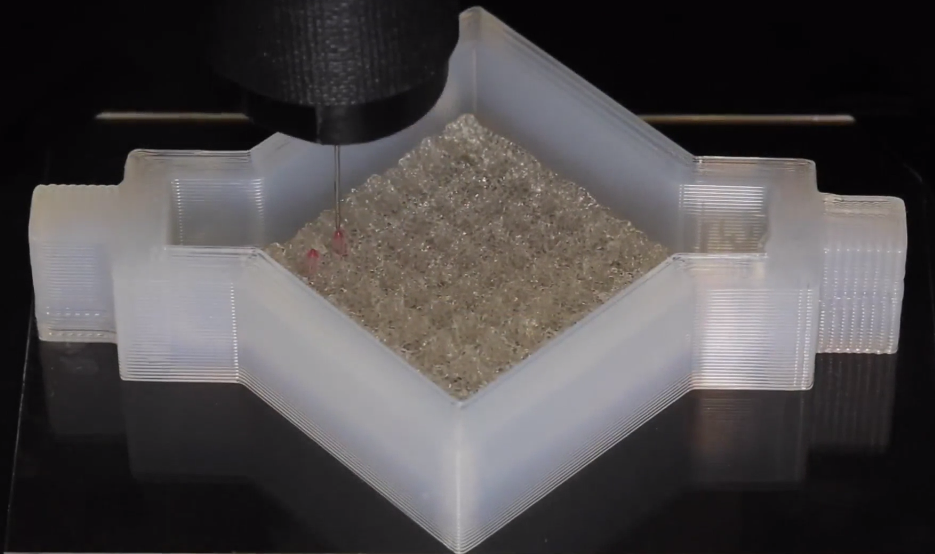
ATB Institute member Harvard University has made big strides in bioprinting research, like the development of this 3D printed vascular tissue.
While a National Additive Manufacturing Innovation Institute already exists in America Makes, the particular field of 3D bioprinting will be a major focus area for the ATB Institute. It’s an area of research that we’re big fans of here, and we look forward to following its continued development within the ATB Institute and elsewhere. Other technological areas that the ATB Institute will focus on include high-throughput culture technologies, bioreactors, storage methodologies, non-destructive evaluation real-time monitoring and sensing, and detection technologies. Discuss in the ATB forum at 3DPB.com.
Subscribe to Our Email Newsletter
Stay up-to-date on all the latest news from the 3D printing industry and receive information and offers from third party vendors.
Print Services
Upload your 3D Models and get them printed quickly and efficiently.













You May Also Like
Stratasys Showcases 3D Printed Automotive Applications & New Printer at IMTS 2026
Just ahead of last week’s International Manufacturing Technology Show (IMTS) in Chicago, Stratasys launched the F870, a new large-format, production-grade FDM 3D printing platform designed to drive industrial manufacturing at...
3D Printing Financials: $28M in China, U.S. Deals and a Metal AM Comeback
Money continues to go into additive manufacturing (AM). From a $30 million raise for a Chinese metal 3D printing company to new funding for naval AM and a European company...
Stratasys Wins $27.6M in Patent Case Against Bambu Lab; Bambu Challenges Verdict
Update, September 21, 2026: This article has been updated with a statement from Bambu Lab responding to the verdict, along with additional information about the company’s ongoing patent challenges against...
AMAsia Pulse: AM Investment Picks Up Across Asia-Pacific
The first half of September brought fresh investment and expansion activity across Asia-Pacific’s additive manufacturing sector. China’s Xinjinghe secured funding for an aerospace AM hub, South Korea’s Lincsolution outlined plans...