3D Systems Launches 3D Sprint 2.0 Software, Developed for Their Plastic 3D Printers

 Just a few months after 3D Systems released their Geomagic Control X software for 3D inspection and metrology, they’re at it again, with their official launch of 3D Sprint 2.0 Software. The single software solution was developed for the company’s line of plastic 3D printers and promises to advance 3D printing productivity and print optimization. The new software reduces the need for users to divide projects between multiple software programs, thus streamlining the 3D printing workflows into a simplified process and saving users time and money.
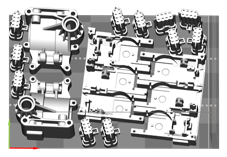 Based in South Carolina, 3D Systems is a leading provider of comprehensive 3D products and services, including production, professional, and desktop 3D printers; printing materials; on-demand manufacturing services; and digital design tools like Sculpt 3D Modeling software and Geomagic for SOLIDWORKS. They’ve had a busy year, recently with a presentation by their CEO at IMTS in September and later demonstrating their digital molding system at formnext. With 3D Sprint 2.0, they’re just continuing the trend. The software delivers many design tools specific to additive manufacturing, and that allow users to manipulate, edit, and prepare 3D models right from the interface.
Ilan Erez, Senior Vice President and Software General Manager for 3D Systems, says, “Our goal with 3D Sprint 2.0 is to make 3D printing in plastic easier and faster than ever before. Having a single software platform for 3D Systems’ plastic printers helps our customers achieve greater productivity and improved results.”
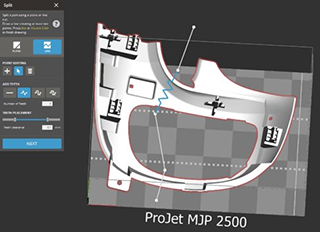
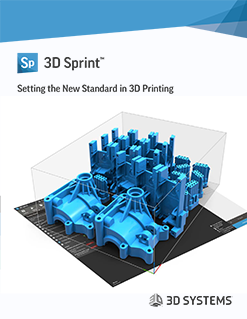 The software currently supports ProJet 1200 and ProJet MJP 2500 series printers, and will begin shipping with these immediately. 3D Systems will announce at a later date when 3D Sprint 2.0 will support their other plastics 3D printers, and also when premium software levels with advanced editing and additional CAD format support will be available. Some of the new software features let users perform advanced operations, like part splitting, offsetting, and part quality checks, and it can accommodate .stl, .obj, and .ply file inputs. According to their website, some of the other features include:
 Connectivity: The system is easily scalable and flexible, to adapt to rapid material and print technology innovation. It provides file I/O to support industry-standard 3D file formats, and support will later be provided for all native CAD and polygonal formats in the premium version.
- Analysis and Repair: It offers advanced and automated part geometry analysis, as well as error correction for translation issues in CAD and STL design files, and bad polygon geometry in 3D scans. It also features manual polygon editing tools for more difficult geometry repair, and gives you the capability to intelligently fill in holes and gaps in the polygon data.
- Design Automation: This tool can help accomplish modeling objectives for 3D printing applications, which reduces the need for any additional software. There are also easy-to-use modeling wizards available, that come with their own automated tools.
- Management and Monitoring: You have the option of loading 3D Sprint 2.0 build files created on another system directly to your printer, or submitting print jobs directly from the Print Workspace. You can efficiently manage your material usage and build priority decisions through material estimation algorithms, and the queue management tools give you complete control over job priorities, in addition to status updates on remaining build times. You also have visibility of all networked or shared printers.
Users are now able to effectively streamline their 3D printing processes with 3D Sprint 2.0, which can decrease the cost of ownership for any 3D Systems 3D printers, as you’ll no longer need to purchase expensive software seats from any third-party vendors.
“3D Sprint 2.0 is the fastest and most reliable user interface we’ve ever used. Having a single piece of intelligent software that can create estimates on numerous virtual machines makes our operations more nimble, and the level of interoperability sets a new standard for what people will expect from 3D printing interfaces in the future,” said Ian Sayers, 3D Printer and Scanner Sales for Hawk Ridge Systems, a partner of 3D Systems.
To get a glimpse of just what the 3D Sprint 2.0 software is capable of, check out this video:
Discuss in the 3D Sprint forum at 3DPB.com.
Subscribe to Our Email Newsletter
Stay up-to-date on all the latest news from the 3D printing industry and receive information and offers from third party vendors.
Print Services
Upload your 3D Models and get them printed quickly and efficiently.













You May Also Like
Why the AM Industry Should Pay Attention to Schneider Electric’s $22.6B PTC Acquisition
By late 2024, there was already enough signaling of the additive manufacturing (AM) industry opportunity in the data center infrastructure market for AM Research to write a report on the...
How Does Nike’s 3D Printing Approach Fit Into Its Restructuring Plan?
Shares of Nike stock hit all-time highs in late 2021 but have cratered in the years following, with the company losing nearly 80 percent of its market cap since peaking....
3D Printing News Briefs, October 1, 2026: Defense, Enclosures, & More
In today’s 3D Printing News Briefs, we’re starting with defense news, first from Massivit and then from AML3D. Then we’ll move on to U.S. manufacturing of a new large-format LPBF...
South Korea’s Lincsolution Lands Hanwha Defense Deal as Hanwha Invests Billions in US
I recently wrote about how the South Korean additive manufacturing (AM) firm Lincsolution is building an aerospace and defense hub, part of the company’s construction of “the largest AM facility in...