
Siemens’ New End-to-End Solution Designed to Help Companies Maximize Additive Manufacturing for Product Development

 While Siemens may not be a company you immediately associate with 3D printing—yet—they’ve been making their move into the industry in some very interesting ways, from their partnership with Local Motors in the development of 3D printed cars to their work in creating new methods in additive manufacturing. With the use of their product lifecycle management (PLM) business approach, they have quickly become part of the 3D printing landscape, and now they’ve announced a new and thorough development process, to be released in January 2017, that will fall in line with the current revolution in manufacturing.
This new development from Siemens, meant to help other companies make the most of AM practices, is made up of:
- Integrated design
- Simulation
- Digital manufacturing
- Data and process management software
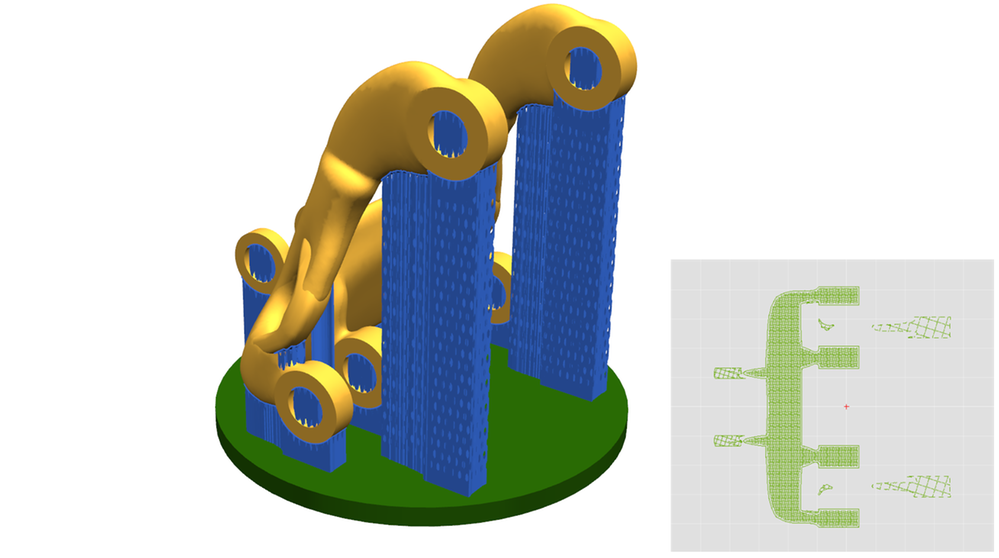 It also includes Siemens’ NX software, an integrated computer-aided design, manufacturing and engineering (CAD/CAM/CAE) software, the Simcenter portfolio, a suite of simulation software and test solutions, Teamcenter software, a digital lifecycle management system, and SIMATIC IT Unified Architecture Discrete Manufacturing and SIMATIC WinCC, two elements of Siemens’ Manufacturing Operations Management (MOM) portfolio for production execution and manufacturing automation.
 The company will be rolling out two new technologies in this development that enable automated generative design: convergent modeling and topology optimization.
Convergent modeling is something completely new, and is included in the latest NX release. Meant for engineers, it allows them to create the best 3D printed components possible along with greater speed in production, and more—to include better ease and efficiency in reverse engineering with scan to print functionality. With topology optimization, engineers have access to predictive analytics which allow for better design evaluation as well as automation in the processes for design and optimization which include performance areas such as vibration, fluid dynamics, and heat transfer.
Also new from Siemens within this development release is a 3D printing prep solution that can be used with both metal and plastic parts, with those operating the machines being able to look forward to assistance in the areas of powder bed and multi-jet fusion part preparation. And looking toward the company’s interest in 3D printed metal, NX provides 3D model preparation for both laser metal deposition and NC programming, to include simulation programs for hybrid AM tools.
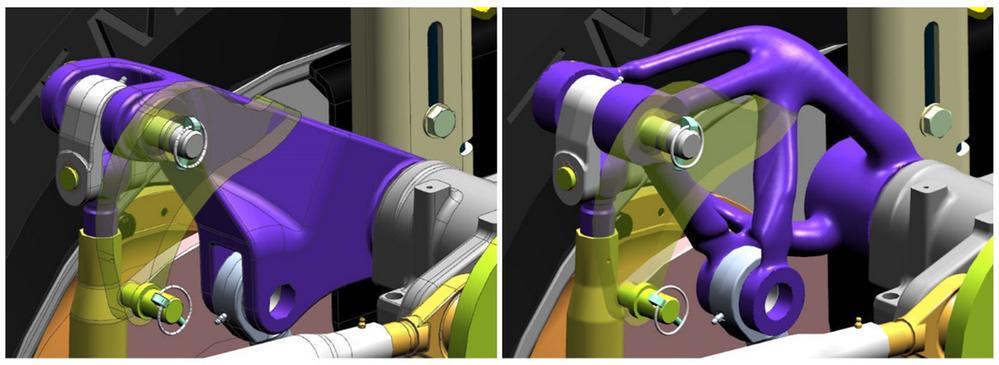
Siemens’ generative design and simulation technology: the part on the left is designed for conventional machining; the part on the right has been optimized for 3D printing with reduced mass and equal strength
“Siemens PLM Software is pushing the additive manufacturing envelope by developing solutions to help create functionally optimized geometry that is inconceivable based on conventional design and manufacturing methods,” said Dr. Ken Versprille, Executive Consultant, CIMdata. “Previously unsolvable design and manufacturing challenges are now quite feasible with these new software and production technologies. Siemens PLM Software has a vision for how the technology fits together from end-to-end and is putting that vision in place to move the industry forward.”
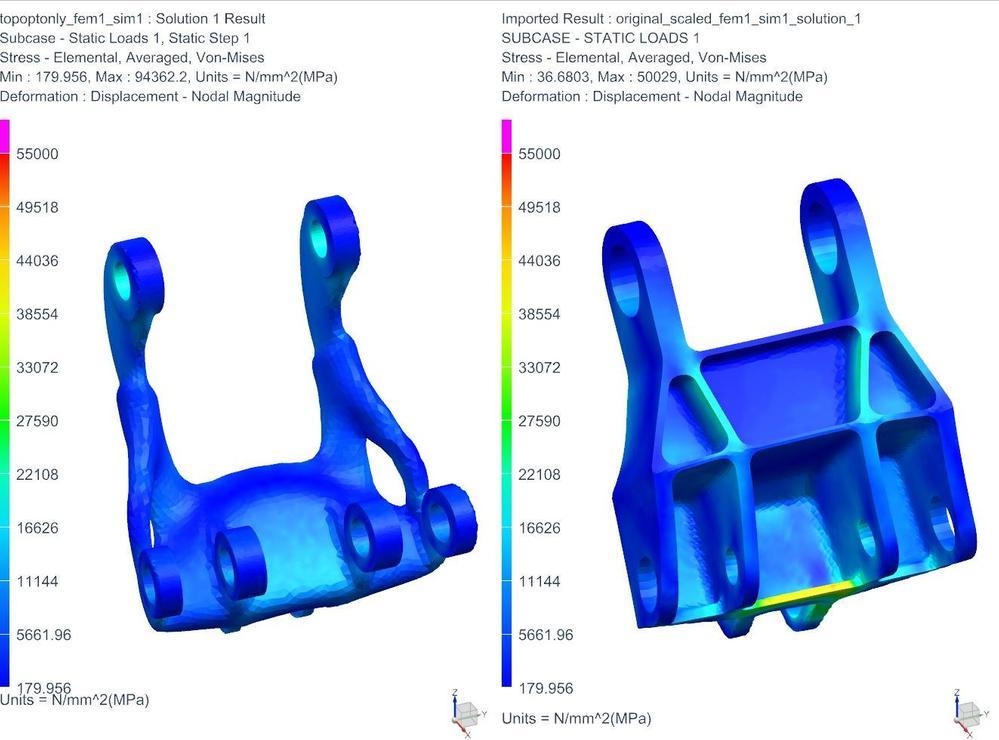
Topology optimization
Siemens reports that they have also developed—and are testing—a multi-axis robotic fused deposition modeling (FDM) programming technology. This will be used for 3D printed extruded materials like plastic and carbon-reinforced nylon. The NX system also programs the removal of supports and precision surface machining, as well as other operations relevant to both processing and inspections.
The comprehensive new systems will also use smart product models without requiring conversion or translation between processes, and automate generative design through topology optimization capabilities. With companies being able to look toward optimal performance but with a better bottom line, this new development via Siemens should offer great potential in applications such as automotive, aerospace, and that of medical device manufacturing too.
“This is just the beginning of a new generation of manufacturing capabilities, and Siemens is focused on delivering software technology to support an optimized end-to-end process with tools such as Convergent Modeling, topology optimization and 3D print preparation that are developed specifically to industrialize additive manufacturing,” said Tony Hemmelgarn, president and CEO, Siemens PLM Software.
Discuss in the Siemens forum at 3DPB.com.
[Source/Images: Siemens]Subscribe to Our Email Newsletter
Stay up-to-date on all the latest news from the 3D printing industry and receive information and offers from third party vendors.
Print Services
Upload your 3D Models and get them printed quickly and efficiently.













You May Also Like
Stratasys vs. Bambu Lab: What’s Really Behind the $27.6M Patent Verdict?
Editor’s note: This is Part 1 of a two-part series by Xu Fanglei examining the technology and patent issues behind the Stratasys-Bambu Lab dispute. Part 1 looks at the U.S....
Bambu Lab and SUSAN FANG 3D Print for London Fashion Week
At London Fashion Week, some of the more unusual pieces on the runway came from 3D printers. Chinese fashion designer SUSAN FANG presented her Spring/Summer 2027 Air-Illusion collection at the...
3D Printing News Briefs, September 26, 2026: Bioceramic Implants, 3D Concrete Printing, & More
In this weekend’s 3D Printing News Briefs, we’ll start with an integration between PanOptimization and AMCM, before moving on to healthcare news from KLS Martin and Lithoz, and then UltiMaker...
Bambu Lab Moves Beyond 3D Printing with R1 Laser Cutter
Bambu Lab has gone from one X1 printer, which did very well, to entry-level A1 systems, mid-market P2S systems, and larger H3Ds and more. They’ve also made systems that couple...























































