Technology on the Metro: Dubai Begins Using 3D Printing to Improve Public Transportation


 There’s been a lot of talk about Dubai in the 3D printing world lately – in fact, that’s an understatement. The United Arab Emirates city-state is working hard to become the 3D printing capital of the world, and it seems as though every few days they’re making an announcement that reflects their likelihood of doing just that. Just last week the Dubai Electricity and Water Authority (DEWA) awarded a contract to Convrgnt Value Engineering for the construction of the world’s first fully 3D printed laboratory, which will add to the city’s collection of 3D printed firsts, including the world’s first 3D printed office building.
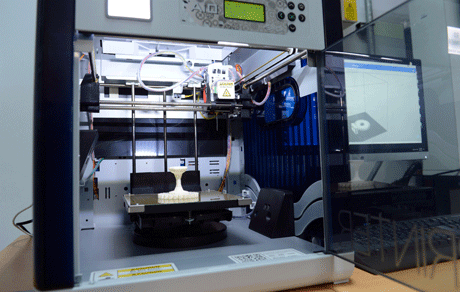 Even looking past the grand architectural, medical and environmental plans, however, the city is still regularly revealing ways in which they’re integrating 3D printing into daily municipal operations. The Dubai Road and Transport Authority (RTA) has begun utilizing 3D printing technology to print parts, both small and large, for the metropolitan train system, reducing costs and ensuring consistently efficient transportation.
“The 3D printing technology is advancing at a rapid pace across the world and RTA is strongly inclined to be a forerunner in this 3D generation by highlighting the world’s best practices adopted in the rail industry. Future scope includes developments that are required to manage obsolescence, which is a huge burden of any railway worldwide,” said AbdulMohsin Ibrahim Younes, CEO of RTA’s Rail Agency.
Components produced with 3D printing will include parts for the subsystems of ticket vending machines (TVMs), ticket gates and other parts vital to smooth day-to-day operations. According to Younes, the technology will not only save the agency a great deal of money, but it will also improve the environmental impacts of the transport system.
“The 3D printing technology would enable RTA to keep the Dubai metro assets in service longer while driving down the cost of parts and in turn passing this saving back to the customer. An example of this is that when small parts are needed, normal practice dictates a local manufacturer would need to produce hundreds to justify his cost,” he continued. “Using 3D technology stops this waste so the team at the Rashidiya Depot can now produce items made in hundreds singularly. Using 3D technology in a way that means much lower costs as the team can produce items when required and on demand while reducing carbon emissions.”
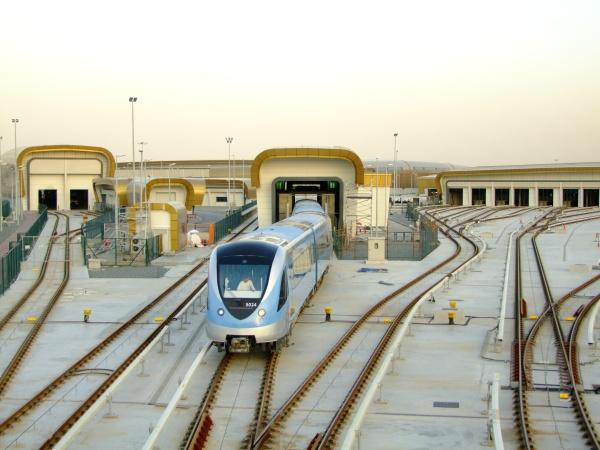
The Al Rashidiya Depot houses the Rail Agencyy’s 3D printing workshop. [Image: Railway Technology]
The new initiative is only the beginning – the Rail Agency is already discussing the expansion of their 3D printing facilities in order to print larger parts for additional systems across the Metro.
“Within a short span of time and considering that 3D printing technology is still relatively new, RTA had made quick progress to understand and accept this technology for use while implementing it to save costs, improve quality and ensure continuing availability of the Dubai Metro Rail Systems for its customers for many years to come,” said Younes.
If you’re a regular user of public transportation, chances are you’ve experienced, at least once, the frustration of delays and complications caused by equipment malfunctions. 3D printing will allow railway workers to fix those issues faster, making daily commutes a lot less maddening – perhaps other cities will follow Dubai’s example and begin using 3D printing to improve their own public transportation systems and greatly reduce stress for thousands of people. Discuss further in the 3D Printed Train Parts forum over at 3DPB.com.
[Source: Government of Dubai Media Office]
Subscribe to Our Email Newsletter
Stay up-to-date on all the latest news from the 3D printing industry and receive information and offers from third party vendors.
Print Services
Upload your 3D Models and get them printed quickly and efficiently.













You May Also Like
Russia’s 3D Printed Missiles & Can NATO Get Its Act Together?
For most of US history, however much the two major parties differed on domestic policy (in some cases a lot, overall less than you’d think), there was always essentially a...
3D Printing News Briefs, October 21, 2026: Digital Twins, AI CAD Service, AR Smart Glasses, & More
In today’s 3D Printing News Briefs, America Makes announced the winners of its MIAMI Project Call, and AM Europe released a new report. Artec 3D launched its new Artec Twins...
3D Printing News Briefs, October 10, 2026: Drones, WAAM, Ceramics, & More
We have a packed 3D Printing News Briefs for you this weekend! First, America Makes celebrated the recent National Manufacturing Day with 3D printed drones, and then it’s on to...
The Manufacturing Race Behind the Drone Revolution
We are in the middle of a major manufacturing shift focused on the production speed and payload capacity of uncrewed aerial systems (UAS), or drones. A recent Manufacturing Dive article...