OMNI3D’s Huge Factory 2.0 Industrial 3D Printer Now Available for Purchase


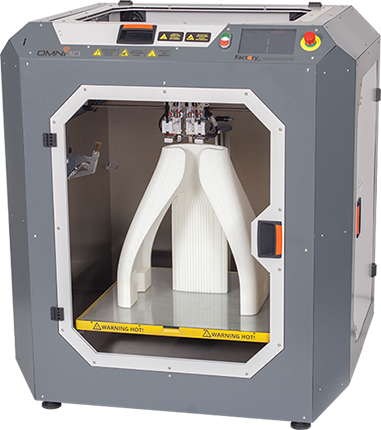
 Almost exactly one year ago, Polish 3D printer manufacturer OMNI3D unveiled their giant industrial 3D printer, the Factory 2.0. With a 500 x 500 x 500 mm build volume, dual extruders and a plethora of fancy automated features, the printer’s appeal is undeniable, and now it’s available for purchase. In fact, customers from Europe, North America and Australia have already jumped on the attractive, low-cost machine, not wasting any time in deploying the Factory 2.0 in industries including aviation, automotive, electronics and engineering.
“The device is of great interest, primarily because of its technical parameters, the attractive price and low operating costs,” said Sławomir Mirkowski, who is responsible for operations and finance for OMNI3D. “We estimate that, compared to other industrial solutions on the market, the cost of buying our printer is 4 times lower, and operating costs can be up to 5 times lower – depending on the application. This means, the devices can be used by small and medium-sized companies that have not yet been able to afford them before.”
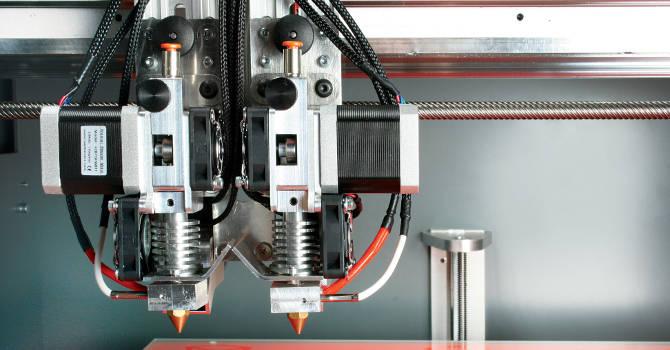
The large build volume and low price (which you can request from OMNI3D here) are just part of the Factory 2.0’s appeal. A helical drive allows for impressive precision and print repeatability, and a closed, heated print chamber enables users to print with materials commonly used in traditional manufacturing methods. The printer also offers an attractive combination of both automation and control; automatic platform calibration and a filament weighing system let you get right into printing without the headaches that can accompany printer preparation, while a large, 7-inch touchscreen allows for constant print monitoring.
“The use of 3D printing globally is constantly increasing,” said Konrad Sierzputowski, responsible for technology development for OMNI3D. “It is mainly used for the production of spare parts for production lines and equipment (33%), prototyping (16%), in R&D departments and education (10%), production of models (9%) and patterns for metal castings (8%). The technical parameters of Factory 2.0 mean that it can be used in all these fields. Therefore, in OMNI3D we believe that every Polish industrial company should be interested in the opportunities from implementing 3D printing systems.”
 Not only Polish companies, either – OMNI3D is a participant in the Polish Champion program, an initiative designed to support local businesses operating in foreign markets. Founded in 2013, the young company’s reach is already extensive, with resellers on multiple continents. In addition to the manufacture of 3D printers, OMNI3D also offers consulting services, for companies interested in implementing 3D printing, as well as training, installation, and maintenance.
They also sell an increasing selection of filaments optimized for the Factory 2.0. Currently the company offers ABS-42, ASA-39, and HIPS-20, with the assurance that additional materials will be coming soon. OMNI3D presented the Factory 2.0 at ITM (Innovations Technologies Machines) Poland 2016 at the beginning of June, and they will be showcasing it to a larger European audience at the TCT Show taking place in Birmingham, England September 28-29. Discuss further in the Factory 3D Printer forum over at 3DPB.com.
Subscribe to Our Email Newsletter
Stay up-to-date on all the latest news from the 3D printing industry and receive information and offers from third party vendors.
Print Services
Upload your 3D Models and get them printed quickly and efficiently.













You May Also Like
3D Printing News Briefs, October 21, 2026: Digital Twins, AI CAD Service, AR Smart Glasses, & More
In today’s 3D Printing News Briefs, America Makes announced the winners of its MIAMI Project Call, and AM Europe released a new report. Artec 3D launched its new Artec Twins...
3D Printing News Briefs: October 17, 2026: Affordable Housing, Bone Implants, Rubber Gloves, & More
In this weekend’s 3D Printing News Briefs, we’re starting off with quality assurance in metal additive manufacturing (AM), a new 3D printer, and 3D printed housing. We’ll finish up with...
3D Printing News Briefs, October 14, 2026: Bolus, Aerospace Tooling, Water Filter, & More
In today’s 3D Printing News Briefs, we’re starting with medical news, as Myrava has received FDA 510(k) clearance for its 3D printed bolus. Moving on to aerospace and metals, AML3D...
Can India’s AM Push Help Make it a Viable Supplement to China?
Diversifying manufacturing supply chains to locales outside of China has nothing to do with actually cultivating “substitutes” to the Chinese economy. The real stakes are these: China is an irreplaceable...