To Infinity and Beyond: Dutch Architect Plans to 3D Print a House in an Infinite Loop

A Möbius strip may look simple, but it’s a mind-boggling mathematical phenomenon. It’s easy to make one – cut a strip of paper or ribbon, give it a little twist, then tape or glue it back together, and you have a strip of material that seemingly only has one side. Pretty cool, right? Now imagine doing the same thing to a house. Dutch architect Janjaap Ruijssenaars has plans to build what he is calling a “Landscape House,” which is a relatively ordinary name for an infinite loop that people can, presumably, live in.
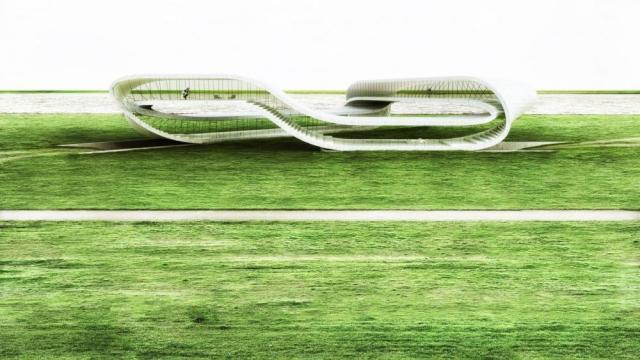
Landscape House concept
When Ruijssenaars came up with the idea for the Landscape House about three years ago, he didn’t originally plan to 3D print it, but as he developed his plans, he came to realize that 3D printing would be the most practical method of construction. Fortunately, he had a lot of resources to build on, so to speak. Just recently, a study by Research and Markets predicted that concrete 3D printing will become much more prevalent in the next five years, and actual 3D printed buildings have just recently begun to show up in reality, rather than just in starry-eyed predictions of the future.
Ruijssenaars and his firm, Universe Architecture, enlisted the help of construction group BAM Bouw en Techniek to develop a massive 3D printer based partially on the design of the D-Shape printer, which features multiple interchangeable nozzles and utilizes a binder jetting process capable of creating large-scale concrete structures. The 3D BUILDER, which Universe Architecture and BAM unveiled at Amsterdam’s Fab City, features a robotic arm on with the 300-nozzle D-Shape printhead is mounted, and uses a binding agent to solidify a mixture of sand and magnesium oxide. In the future, according to the collaborators, Caterpillar tracks may be added to the base of the printer so that it can move across the construction site.
The two companies have already built a bench in the shape of the Landscape House concept; the next step is to begin construction on a 1:4 scale model, which the team will shortly undertake at Fab City, a temporary, sustainable building campus devoted to the development of self-sufficient cities for the future.
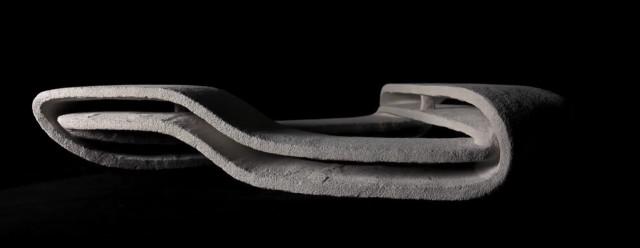
Landscape House bench
“The fact that the creation of this unique collaboration is taking place at FabCity is proof that if you bring together different innovative parties, large and small, the result is ground-breaking initiatives that are relevant for the development of the city of the future,” said Egbert Fransen, the culture intendant of the official EU2016 Arts & Design program, Europe by People.
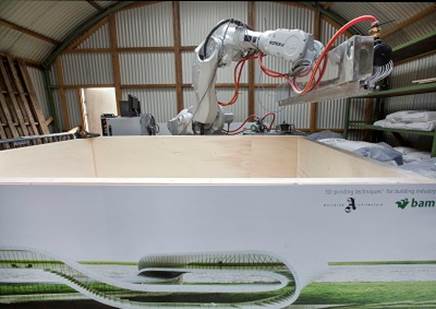
3D BUILDER
One of the principles of Fab City is the creation of a “circular economy,” in which nothing is wasted and everything is reused, to put it very simply. Ruijssenaars’ infinite building design fits nicely into the philosophy of the campus – as does the printer itself, whose own self-sustaining capabilities are not lost on its creators.
“As well as the form freedom, we are also very much taken by the circular process,” said Rutger Sypkens of BAM Bouw en Techniek. “Concrete granulate and pre-existing prints can serve as a raw material for the machine at a later stage.”
It’s all falling into place for Ruijssenaars, who had the Earth itself in mind when he came up with the concept of the Landscape House. As he told AFP:
“The ambition was to make a building that has an infinite structure, like planet Earth. Planet Earth doesn’t have a beginning or an ending and we were looking for a shape that has the same quality.”
Discuss further in the Construction 3D Printer forum over at 3DPB.com. See 3D BUILDER in action below:
Subscribe to Our Email Newsletter
Stay up-to-date on all the latest news from the 3D printing industry and receive information and offers from third party vendors.
Print Services
Upload your 3D Models and get them printed quickly and efficiently.













You May Also Like
3D Printing News Briefs, October 10, 2026: Drones, WAAM, Ceramics, & More
We have a packed 3D Printing News Briefs for you this weekend! First, America Makes celebrated the recent National Manufacturing Day with 3D printed drones, and then it’s on to...
10 Years of Multi Jet Fusion: Onsite at HP’s Vancouver, Washington Facility
At this year’s RAPID event in Boston, HP Additive Manufacturing Solutions celebrated ten years in the additive manufacturing (AM) market. The company ushered in the milestone with several innovations, including...
PharmaTher Plans U.S. Network to 3D Print Medicines on Demand
3D printing medicines has often been tied to the idea of personalization, basically making a pill in the right dose, shape, or drug combination for a patient. PharmaTher is now...
3D Printing News Briefs, September 17, 2026: 3D Printed Boat, UAS Development, & More
We’ll start with maritime manufacturing in this week’s 3D Printing News Briefs, and continue on to defense 3D printing. We’ll end with funding for Tripo AI. Read on for all...