Shining 3D Donates 3D Scanning & Printing Technology to Iraq for Preservation of Ancient Babylon

 While 3D printing is just grabbing the attention of the mainstream public, many of the companies we see working on innovative, complex projects today have been a part of the industry either centrally or peripherally for years. Take Shining 3D, for example. Founded in 2004 and headquartered in Hangzhou, the Chinese digitizing and 3D printing hardware company has been catering to the manufacturing, bio-medical, and educational sectors for over a decade now.
 We’ve been following Shining 3D a great deal this year, and especially so with the last release of their desktop 3D scanner line, the EinScan, capable of scanning large objects and doing so at greater speed, accuracy, and affordability. Now, both an EinScan 3D scanner and Einstart 3D printer have been gifted to the Iraq government as they take on a massive project to support, protect, and repair their cultural heritage of Ancient Babylon.
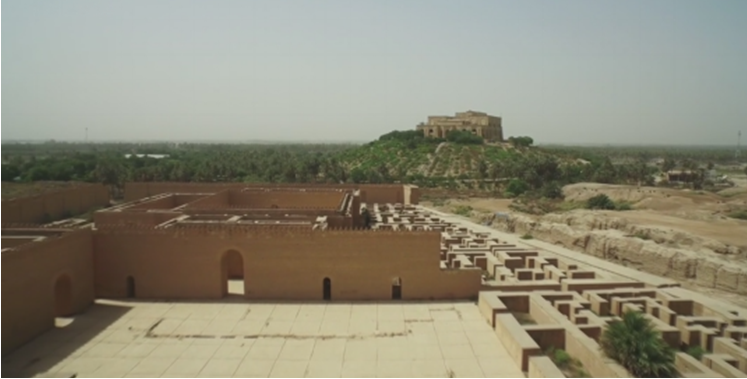
Thousands of years old, Baghad endured from the 18th until the 6th century BC. Of great historical significance for all of the world, Babylon of course is of special significance to Iraq due to its proximity–and many there worry about the threat of Babylon’s further demise due to organized terrorist threats like ISIS. There is little money or support for the preservation of the ancient city, once a thriving urban center in a long-ago world. As war and strife have visited itself upon the area perpetually, its ruins are of large concern to historians and citizens both in Iraq and around the globe.
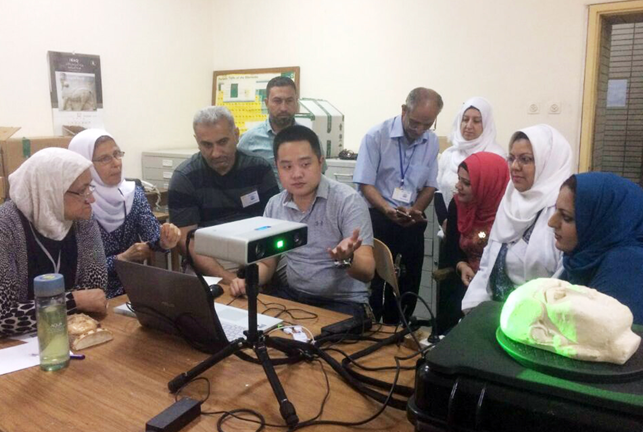
 Xinyu Zhang and Hong Liang traveled as delegates of Shining 3D to Babylon to present the scanner and printer in person to officials in the Iraqi government. The married couple also stars in and feature the trip in ‘On the Road,’ which is a very popular show on China’s video website, Youku. Along with presentation of the tools, they spent time with government officials instructing them on the proper use of the hardware, as well as introducing the technology and applications to some local citizens in hopes for preserving the relics of Babylon.
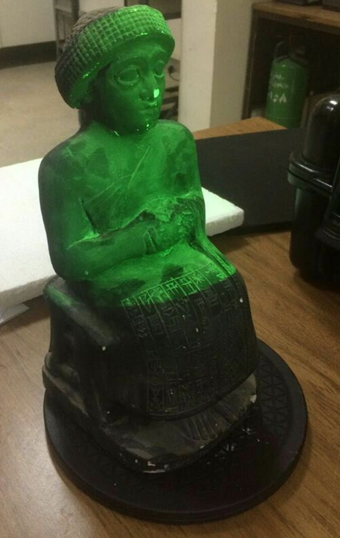 Using a porcelain doll as an example, they were able to show the Iraqis how to reconstruct it with both 3D scanning and 3D printing. After filtering the data into a computer, the lost areas and support structure are 3D printed according to what is provided in the 3D simulation.
“Shining 3D endeavors to make more breakthroughs in 3D technology in the archaeological area,” states the Shining 3D team in their latest press release. “And we believe the establishment of the digital model and information storage for cultural relics and archaeological sites by using the computer technology has a broader research and application prospect with the further development of 3D scanning and 3D printing technology.”
This certainly couldn’t be a better example of global teamwork, working to save geographic and cultural history, as well as citizens of different countries working together in both teaching and learning contemporary new skillsets that offer so much benefit for archiving and preservation. Through their efforts, all involved are being rewarded with the enormous benefits 3D printing technology offers, from a self-sustainability angle in being to handle a project of this scope that’s only made possible due to accessibility, user-friendliness, and capability of the tools.
We’ve seen 3D scanning and 3D printing being used in other operations around the world to preserve ancient artifacts, such as the Million Image Database and Project Mosul. Discuss this story in the 3D Printing Iraq forum thread on 3DPB.com.
Subscribe to Our Email Newsletter
Stay up-to-date on all the latest news from the 3D printing industry and receive information and offers from third party vendors.
Print Services
Upload your 3D Models and get them printed quickly and efficiently.













You May Also Like
Kickstarter is Testing the Next Wave of Desktop 3D Printing
3D printers are raising serious money again…on Kickstarter, that is. Over the last few months, a new group of 3D printer campaigns has attracted millions of dollars and thousands of...
Stratasys vs. Bambu Lab: What’s Really Behind the $27.6M Patent Verdict?
Editor’s note: This is Part 1 of a two-part series by Xu Fanglei examining the technology and patent issues behind the Stratasys-Bambu Lab dispute. Part 1 looks at the U.S....
Bambu Lab and SUSAN FANG 3D Print for London Fashion Week
At London Fashion Week, some of the more unusual pieces on the runway came from 3D printers. Chinese fashion designer SUSAN FANG presented her Spring/Summer 2027 Air-Illusion collection at the...
Stratasys Wins $27.6M in Patent Case Against Bambu Lab; Bambu Challenges Verdict
Update, September 21, 2026: This article has been updated with a statement from Bambu Lab responding to the verdict, along with additional information about the company’s ongoing patent challenges against...