3D Printed Model from Mimics Innovation Suite Turns a Major Surgery into a Minor One


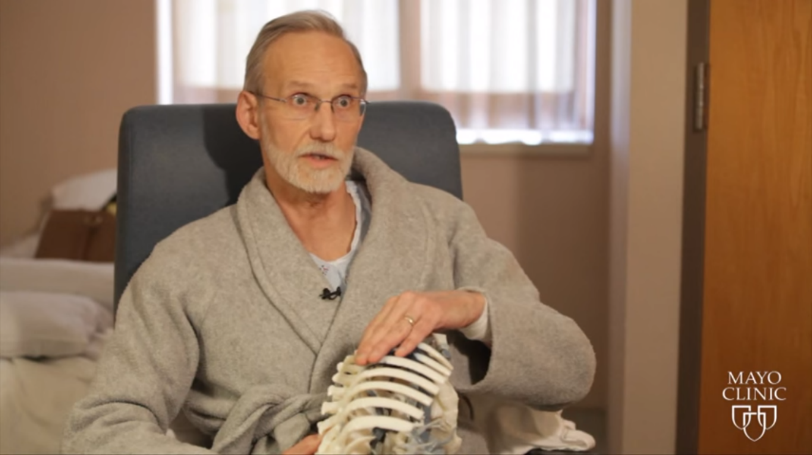
When Dr. Michael Slag was diagnosed with a rare tumor, he immediately knew the risks of the surgery that would be needed to remove it. The Pancoast tumor sitting at the top of his right lung is such a rare type of cancer that the Mayo Clinic, where Dr. Slag went for treatment, has only seen 60 cases in the last 20 years.
The potential complications were many. The tumor was wrapped around the top of his rib cage and intertwined with several critical nerves and blood vessels, which meant that its removal carried a high risk that Dr. Slag would lose at least part of the function of his right arm. For an endocrinologist whose job requires some very delicate work, even a minor loss of function could have been catastrophic.
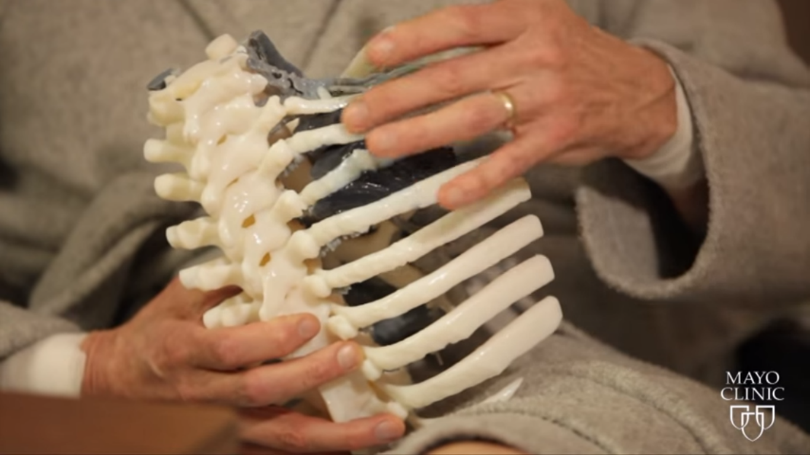
To minimize the risk, a lot of preparation was needed, and that’s what 3D printed models are for. The surgical team that would operate on Dr. Slag was fortunately armed with Mimics Innovation Suite software from Materialise.
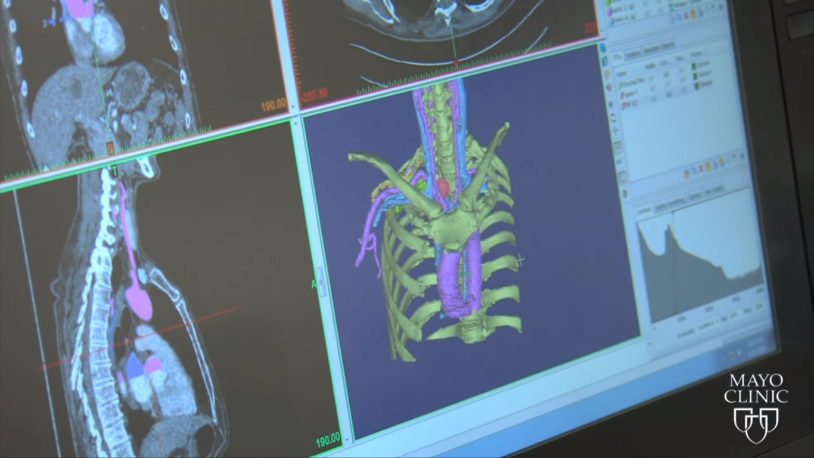
Using Dr. Slag’s MRI and CT scans, the team created a 3D model of the tumor and its surrounding area. The model, which took 70 hours to print, allowed the doctors to see the exact positioning of the tumor and how it interfered with the blood vessels and nerves.
Dr. Jane Matsumoto from Mayo Clinic studies a 3D model in Mimics
“We frequently may have a plastic surgeon, an orthopedic surgeon, a vascular surgeon, and myself: all involved in a Pancoast tumor resection,” said Dr. Shanda Blackmon, a thoracic surgeon at Mayo Clinic. “And when that’s the case, there’s nothing better than having a model, for the whole team to meet around and plan the case…Clearly everyone’s tumor is different, and it’s always in a different location.”
With a 3D map in front of them, the surgical team knew the precise location of Dr. Slag’s tumor, and were able to plot their course ahead of time, virtually eliminating any surprises that may otherwise have come up during the surgery. Only a few years ago, a procedure like this one would have involved fully opening up the patient’s chest, resulting in a long, painful recovery and lots of potential complications. With the preparation that the 3D software and printed model allowed, the surgery was reduced to a quick, minimally invasive laparoscopic procedure.
“So the surgery that we performed was basically putting a camera in the side of the chest through a small hole that was created,” said Dr. Blackmon. “We had two additional ports, that are basically tubes that we put in between the ribs, that we passed instruments through. And that was all we did to resect his tumor.”
Dr. Slag left the hospital three days after the surgery, with almost no pain, and with both arms and hands fully functional.
“It’s unbelievable,” he said. “In fact, I was walking the first night after the surgery.”
Subscribe to Our Email Newsletter
Stay up-to-date on all the latest news from the 3D printing industry and receive information and offers from third party vendors.
Print Services
Upload your 3D Models and get them printed quickly and efficiently.













You May Also Like
3D Printing Financials: 3D Systems, Prodways, and Align Build on Positive Momentum
The latest earnings from 3D Systems (NYSE: DDD), Prodways (EPA: ALPWG), and Align Technology (Nasdaq: ALGN) show that the 3D printing market continues to move forward. Some businesses are growing...
3D Printing News Briefs, August 8, 2026: Seawall Funding, Defense Capabilities, Supports, & More
We’re starting with business in this weekend’s 3D Printing News Briefs, then moving on to defense. We’ll move on to young 3D printing entrepreneurs, and finish with some research out...
Walter Reed Gets Premarket Clearance to Make 3D Printed Point-of-Care Medical Devices
The Walter Reed National Military Medical Center’s 3-D Medical Application Center (3-D MAC) has received premarket clearance to make 3D printed medical devices. This is the first time that a...
Jeff Graves Seeks New 3D Systems CEO, The Company at a Crossroads
Jeff Graves is to step down as 3D Systems‘ CEO once a replacement has been found, the company has announced. He will then retire as CEO and as Director of...