3D Fuel and Algix Announce the Release of Algae-Fuel, the 3D Printer Filament Made from Algae

 Algae in large quantities is usually a bad sign. Harmful algal blooms form when their aquatic environment is out of balance, usually due to fertilizer runoff or other environmental toxins. An algal bloom, besides being an alert to an ecological problem, can also damage its environment further by absorbing oxygen and generating its own toxins. There is no shortage of algae on the planet, which is worrisome for many environmental reasons, but every algal bloom has a silver lining thanks to companies like 3D Fuel and ALGIX.
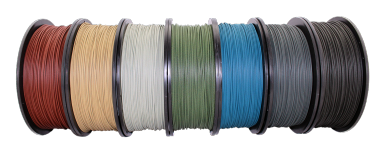
In April, the two companies announced that they would be collaborating to create a new line of 3D printer filament from algae. Today, that filament has been officially released. Algae-Fuel is available in 1.75 and 2.85 mm spools, in a wide range of nature-inspired colors: Primordial Red, Terrestrial Tan, Algae Green, Evergreen, Agave Blue, Tundra Gray and Swamp Black. According to 3D Fuel, the filament prints with a natural-feeling texture similar to bone or sandstone. At the moment, pre-orders are being taken; prices are not available on the website yet, but send them a message through the order page and they’ll send you more details.
“We believe that these products will be very attractive to many users of FDM/FFF technology,” says Barbara Zeller, Marketing Manager for 3D Fuel. “Our Algae-Fuel product line can help to increase the adoption of more sustainable filaments, because the user doesn’t have to compromise on aesthetic, sustainability, performance or quality.”
 Algae-Fuel is made from biodegradable PLA combined with algae specifically harvested from areas where its excess threatens its environment. It has improved Life Cycle Assessment results and enhanced biodegration capabilities, and it’s energy efficient: Algae-Fuel prints at a lower temperature than standard PLA, requires less energy for efficient printing, and is stronger than other filled PLA filaments.
“Part of the beauty of our process is that we take nuisance algae from aquaculture, water treatment facilities and even from algal blooms in ponds and lakes,” says Ashton Zeller, Director of R&D for 3D Fuel. “We are helping to aid in ecosystem balance and are able to provide more sustainable materials without utilizing arable cropland (as most other bioplastics require) for our bio-feedstock.”
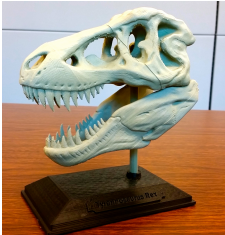
This guy was printed with Algae-Fuel.
3D printing’s environmental merits are frequently up for debate, but the fact is that the technology does go through a lot of plastic. So it’s very encouraging to see an increasing number of companies who are coming up with creative ways to make the industry more sustainable, particularly through the manufacture of ingenious, environmentally-friendly filaments. 3Dom USA has been in the news in recent months for its filaments made from coffee and beer, as well as for its biodegradable filament spools. Recycled filaments are also becoming more common thanks to companies like Fila-Cycle and Colletivo Cocomeri. There are a lot of options out there if you want to make your 3D printing a zero-waste endeavor. Just pick your material; if there’s not a filament made from it already, there probably will be soon.
Have you tried out this new filament? Let us know your experiences in the Algae-Fuel Filament forum thread on 3DPB.com.
Subscribe to Our Email Newsletter
Stay up-to-date on all the latest news from the 3D printing industry and receive information and offers from third party vendors.
Print Services
Upload your 3D Models and get them printed quickly and efficiently.













You May Also Like
The Manufacturing Race Behind the Drone Revolution
We are in the middle of a major manufacturing shift focused on the production speed and payload capacity of uncrewed aerial systems (UAS), or drones. A recent Manufacturing Dive article...
ADDMAN to Buy Up to $10.8M in Nickel 718 Powder from 6K Additive Over 30 Months
After years of buildup, we’re finally starting to see what the US metal additive manufacturing (AM) market could look like at scale. To be sure, it’s still not quite there,...
Metal AM in a Multipolar World, Part 2: How PBF and DED Could Change by 2035
The first decades of PBF development were heavily shaped by machine capability: more power, more lasers, larger build volumes, better recoating, and improved process monitoring. These developments will continue, but...
Advanced Manufacturing at IMTS 2026: 3D Printing and AI and Drones, Oh My!
Last week’s International Manufacturing Technology Snow (IMTS) in Chicago welcomed over 90,000 attendees to the jungle that is McCormick Place. With over 1.17 million square feet of exhibit space, and...