Now on Kickstarter: The New and Improved Felfil Evo 3D Printing Filament Extruder

 Nothing in life is perfect – yes, including 3D printing. Unfortunately, no matter how carefully we craft our designs, mistakes and flaws happen. This can be infuriating, as any artist in any discipline knows. Making takes valuable time, and materials cost money, so starting from scratch can feel like defeat. And, if you’re at all eco-minded, throwing away your useless creations, recyclable or not, is guilt-inducing.
A group of Italian designers understands your pain, and the Earth’s. In June of this year we wrote about Felfil, an extruder designed specifically for printing your own filament from recycled materials, including your own damaged or flawed prints. The extruder was invented by Alessandro Severini, Fabrizio Pasquero, Giulio Cravino, and Fabrizio Mesiano, also known as Collettivo Cocomeri (which translates to “Watermelon Collecti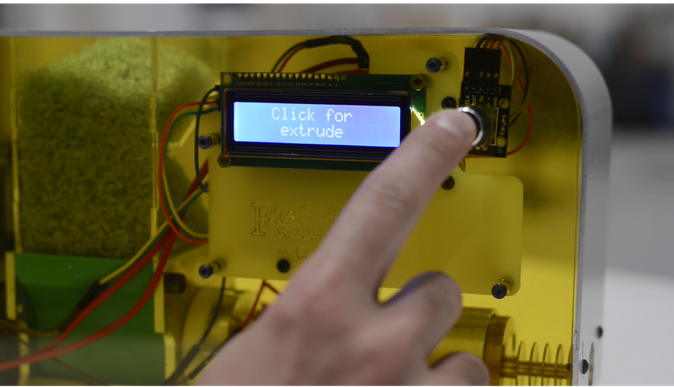 ve”), a student group which was born out of an Ecodesign course at the Polytechnic of Turin in 2011. After graduation, the group became a business, and the Felfil, which started as a Masters dissertation, became a popular product.
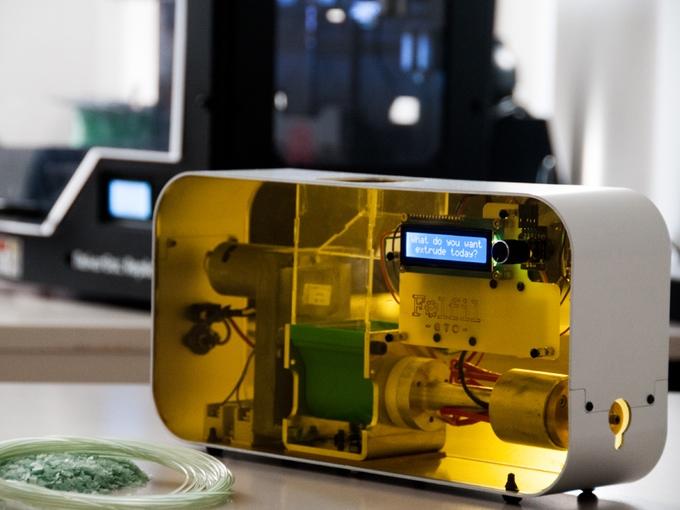
Now, Collettivo Cocomeri is releasing a new and improved version called the Felfil Evo. “Evo” stands for evolution, the team explains, as the new extruder has evolved from the original, DIY Felfil to be safer, more durable, more compact, and easier to use. Using the Evo is as simple as the push of a button: just put your recyclable material in the 3D printed hopper, choose the correct setting from a menu, and let the machine do the rest.
“Even though we truly believe in your manual skills,” said Pasquero, “we decided to simplify the process for the laziest ones, and for the less experienced, so no more excuses are allowed!”
To fund the Evo, the company is running a Kickstarter campaign that, with over three weeks left, is already well on its way to being funded. A goal of €30,000 (about $34,172 USD) is set for November 14th, and, if successful, shipping is slated to begin in January 2016.
 Several options will be available for backers, and, later, for buyers. The Basic Kit, which is priced starting at $194 (€170) for super early bird backers, includes a gearmotor, structural support, an extruding screw, thermal insulation, a folding chamber, and a nozzle, as well as 200g of PLA pellets. This kit, the company states, contains only the essential components, and is perfect for experienced makers who want room to personalize their Evo: other components, such as heaters and electronics, are up to the buyer to select and purchase according to their needs. The Complete Kit includes all necessary components plus an assembly instruction
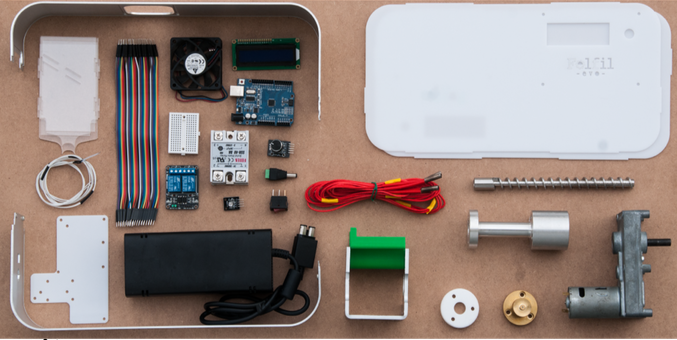 manual, and starts at $342 (€300). Finally, for the inexperienced and/or lazy, a fully assembled Evo is offered starting at $444 (€390).
The source files for the original open source Felfil are still available for free download if you’d like to try it out before buying the new and improved one. According to Collettivo Cocomeri, the original has been downloaded by nearly one thousand makers. With the Evo’s improved design allowing for more ease of use and freedom to experiment, it will be unsurprising if the new model quickly surpasses those numbers. Discuss this new component in the Felfil forum thread on 3DPB.com.
Check out the Kickstarter video below:
https://d2pq0u4uni88oo.cloudfront.net/projects/2062953/video-596089-h264_high.mp4
Podcast: Play in new window | Download
Subscribe to Our Email Newsletter
Stay up-to-date on all the latest news from the 3D printing industry and receive information and offers from third party vendors.
Print Services
Upload your 3D Models and get them printed quickly and efficiently.













You May Also Like
10 Years of Multi Jet Fusion: Onsite at HP’s Vancouver, Washington Facility
At this year’s RAPID event in Boston, HP Additive Manufacturing Solutions celebrated ten years in the additive manufacturing (AM) market. The company ushered in the milestone with several innovations, including...
These 3D Printed Lattices Can Sense Damage Before Failure
A new paper, “Full-Field Damage Monitoring in Architected Lattices Using In situ Electrical Impedance Tomography,” points to lattices being able to detect damage. This could really help composites in critical...
3D Printing News Briefs, October 3, 2026: Hypersonics, Hotends, & More
We’re starting off with defense in this weekend’s 3D Printing News Briefs, as Titomic was awarded a $5 million U.S. defense contract, and VulcanForms announced a partnership with Specter Aerospace...
3D Printing News Briefs, October 1, 2026: Defense, Enclosures, & More
In today’s 3D Printing News Briefs, we’re starting with defense news, first from Massivit and then from AML3D. Then we’ll move on to U.S. manufacturing of a new large-format LPBF...