
Wound Up — 3Dom USA’s New Coffee 3D Printer Filament Takes Bio-materials to the Next Level


 Materials, materials, materials! That’s what 2015 seems to be all about within the FDM/FFF 3D printing space. While hardware manufacturers battle it out for the fastest, most accurate, most affordable 3D printer on the market, perhaps more important is the work being done in the materials space, as new materials are able to transform the capabilities of these very machines.
One company leading the way when it comes to composite filaments for 3D printing is Fargo, North Dakota-based 3Dom USA. In fact, it was only three weeks ago when we covered their brand new Glass filled PLA material. It appears that this was just a start in what should be a long line of new PLA composites released by the company over the coming months, particularly after they’ve just announced a partnership with another company in the Fargo area, c2renew.
C2renew is a developer of proprietary biocomposite formulations which are able to meet specific needs of their end users. They are known for their use of agricultural waste products such as flax fiber and shive, wood flour, soybean and sunflower hull and even sugar beet pulp to devise new materials. Via this partnership with 3Dom USA, the two companies expect to unveil a multitude of new biocomposite filaments for 3D printing.
The first of these materials is one that 3Dom calls ‘Wound Up‘. Wound Up is a PLA composite consisting of coffee waste byproducts. Basically the part of the coffee bean that’s not used by us humans is able to be repurposed for this incredible new material, which the company says produces products with a noticeable natural grain.
“Now a cup printed with Wound Up is a true ‘coffee cup,’ they joke”
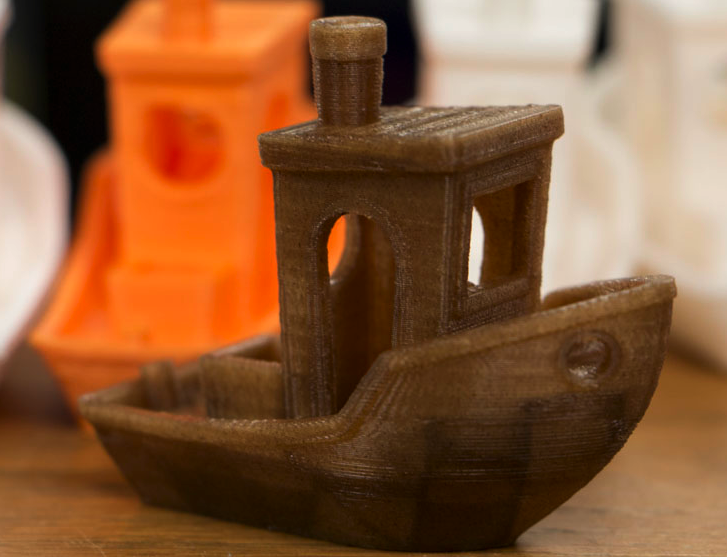 Wound Up is able to be printed on any typical FDM/FFF 3D printer that can print with PLA and comes in one obvious color, brown. Not only is the filament itself ecologically friendly and a great way to repurpose waste, but the filament comes on 3Dom’s trademarked Eco-Spool, which consists of 100% bio-based materials and reduces the overall impact to the environment.
It’s certainly refreshing to see companies like 3Dom and c2renew taking the initiative to reduce the environmental impact of all the plastics which are being used within the rapidly expanding 3D printing industry.
For those interested in trying this new filament out, it is currently available on the 3Dom USA website in both 1.75mm and 2.85mm diameters, and priced at just $49 per 1kg spool. Stay tuned for new innovative materials coming from this partnership in the months ahead, and let us know if you’ve used any of these new materials in the 3Dom Wound Up forum thread on 3DPB.com. Check out the short promo video below, showing off this new material.
Subscribe to Our Email Newsletter
Stay up-to-date on all the latest news from the 3D printing industry and receive information and offers from third party vendors.
Print Services
Upload your 3D Models and get them printed quickly and efficiently.












You May Also Like
50,000 Orders and Counting: EPlus3D & Chinese AM Services Provider Are Scaling Liquid Cooling Solutions for AI Servers
An under-appreciated story driving the additive manufacturing (AM) industry this year has been the divergence between what’s driving the market in China and what’s driving it everywhere else. Let’s start...
Seven Trends Reveal What’s Next for 3D Printing at TCT Shenzhen 2026
TCT Shenzhen 2026 opened on October 14 in Hall 15 of the Shenzhen World Exhibition & Convention Center in Bao’an, and ran through October 16. The event brought together equipment...
With Increased Aerospace & Defense Focus, CORE Industrial Partners Buys More Manufacturing Firms
Private equity’s march into manufacturing continues with CORE Industrial Partners’ latest acquisitions. CORE purchased Fathom a few years ago, and later bought 3DXTECH LLC, Triton 3D LLC, and Gearbox3D. It...
Can India’s AM Push Help Make it a Viable Supplement to China?
Diversifying manufacturing supply chains to locales outside of China has nothing to do with actually cultivating “substitutes” to the Chinese economy. The real stakes are these: China is an irreplaceable...


























































