
Materialise and Indian Hospital Collaborate to Save Two Teenage Heart Patients’ Lives

Whenever I cover a story about 3D printed medical models that  assist surgeons and help communication with patients, I have the feeling no one can argue with this obvious and critical use of the technology. But it’s less common to see a story about this application of the technology in medicine, where you can say that without it, patients would probably die.
Well, this story is an uplifting one about how two teenagers in India  were turned away from much needed heart surgeries because the surgeries were too complicated. Both teenagers, Krishna and Izam, suffered from congenital heart disease, and doctors would be taking chances risking highly complex surgeries due to each teens’ unique structural defects.
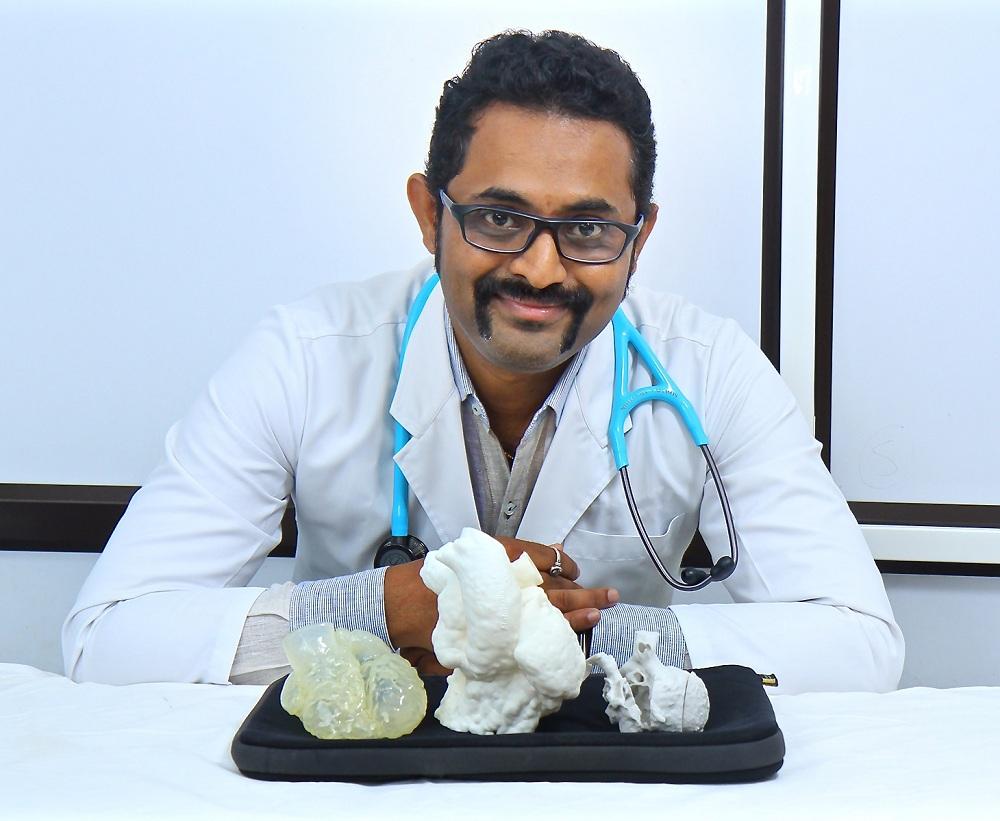
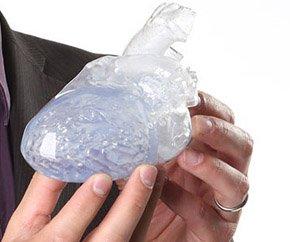
Dr. Mahesh and 3D printed models of the patients’ hearts
At Kochi, India’s Amrita Institute of Medical Sciences (AIMS), Dr. Mahesh Kappanayil (Pediatric Cardiologist) and Dr. Rajesh Kannan (Radiologist) gave the teens full heart evaluations. It was then that the pediatric cardiac team decided physical models would help the surgeries immensely. Both surgeries took place in August of 2015.
As a leader in the application of 3D printing for medical purposes in India, Dr. Mahesh has this to say about how the printed models helped the surgeries happen successfully:
“Sometimes, all the traditional ways of evaluating and planning treatment still fall short. Using these precise models to actually look ‘inside’ the heart, understand the lesions and precisely plan the operations much before the actual surgery was a definite game-changer. I’m proud to be an early adopter of 3D Printing for medical applications in India.”
It was Materialise that helped make the heart models using its HeartPrint service. Two cases that had once been dismissed as being too difficult for doctors to risk now have become case studies for 3D printing’s true life saving abilities.
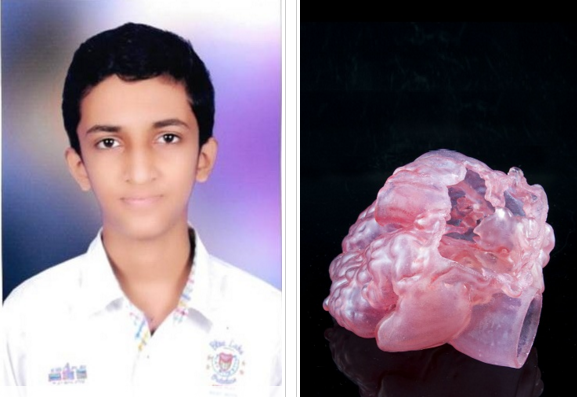
15-year-old Izam and the 3D printed model of his heart
Vickneswaran Renganathan, Business Development Manager at Materialise, helped facilitate the communication between his company’s engineering team and the AIMS medical team. He describes this kind of work as fulfilling Materialise’s mission statement:
“For Materialise, these two cases are living proof of our mission statement: to work for a better and healthier world. I felt very proud that my role at Materialise allowed me to impact patients’ lives in such a positive way.”
 In an interesting twist, 3D printing already made its mark on 19-year-old Krishna’s life. Last year, he assembled his own DIY 3D printer! I am betting that as he heals from surgery and feels better, the technology that once captivated his maker spirit, and then saved his life, will be a part of his future.
And his case will also be remembered as one that shows complex surgeries that seem too risky can perhaps take place through use of 3D printed models. I never tire of writing these incredible stories, but I have to say, this one is one of the most inspiring ones yet.
Let’s hear your thoughts on yet another awesome medical application for this technology. Discuss in the 3D Printed Heart forum thread on 3DPB.com.
Subscribe to Our Email Newsletter
Stay up-to-date on all the latest news from the 3D printing industry and receive information and offers from third party vendors.
Print Services
Upload your 3D Models and get them printed quickly and efficiently.













You May Also Like
The Manufacturing Race Behind the Drone Revolution
We are in the middle of a major manufacturing shift focused on the production speed and payload capacity of uncrewed aerial systems (UAS), or drones. A recent Manufacturing Dive article...
ADDMAN to Buy Up to $10.8M in Nickel 718 Powder from 6K Additive Over 30 Months
After years of buildup, we’re finally starting to see what the US metal additive manufacturing (AM) market could look like at scale. To be sure, it’s still not quite there,...
Metal AM in a Multipolar World, Part 2: How PBF and DED Could Change by 2035
The first decades of PBF development were heavily shaped by machine capability: more power, more lasers, larger build volumes, better recoating, and improved process monitoring. These developments will continue, but...
Advanced Manufacturing at IMTS 2026: 3D Printing and AI and Drones, Oh My!
Last week’s International Manufacturing Technology Snow (IMTS) in Chicago welcomed over 90,000 attendees to the jungle that is McCormick Place. With over 1.17 million square feet of exhibit space, and...

























































