Taiwan’s ITRI Showcases Metal 3D Printed Saxophone

 Guitars. Violins — both acoustic and electric. Cellos. Drum sets and Indian tabla drum pairs. The saxophone… 3D printing musical instruments is becoming more common, but it is not necessarily an easy process to get the sound right. The most recent 3D printed instrument to hit the news comes from Taiwan’s Industrial Technology Research Institute (ITRI),which has successfully completed the printing of perhaps the most popular woodwind instrument. Whenever I write about 3D printed instruments, I usually emphasize how “ancient” the instrument is compared to how “futuristic” 3D technology — emphasizing the merging of the traditional with the modern. But I can’t take that angle for this story. Why? Because the saxophone, which was invented by the Belgian instrument maker Adolph Sax in 1840, isn’t that old.
 The saxophone was patented in 1846, and Sax was motivated to popularize his newly invented instrument which he wanted as a powerful instrument for the woodwind section, one that was recognizable and vocal. He got just this, too. Traditionally, saxophones are made from brass and played by a single reed. Used in chamber music, military bands, and probably best known for its contributions to jazz music, the saxophone adds much character to musical arrangements and can also stand on its own as a solo instrument too.
Other individuals have already 3D printed a saxophone; Olaf Diegel holds the distinction of printing the world’s first saxophone and he elaborated on some of the challenges that accompanied the project. Not a stranger to 3D printed musical instruments, Diegel is known for 3D printing both a guitar and a drum set. He added the saxophone to his list of instruments in July 2014. His was printed in Duraform nylon powder. That is perhaps the greatest difference between Diegel’s sax and ITRI’s sax: the machines and materials used in the process. ITRI used a metal 3D printer to make its saxophone.
Taiwan’s ITRI, which collaborated with Yifeng International, Inc. for this project, wanted a way to exhibit its Optical Engine for Material Grain Microstructure Controlling Additive Manufacturing Technology. ITRI unveiled its first metal printer last May, which was marketed mainly for producing jewelry. (Optical Engine technology has already been nominated by R&D 100 Awards in Taiwan this year.) ITRI’s Optical Engine for Material Grain Microstructure-Controlling Additive Manufacturing Technology can adjust the interactions between the laser beam and the material in the solidification process to change the material grain microstructure of the metal. The optical engine can alter strength, hardness and toughness of different parts of a component, if needed
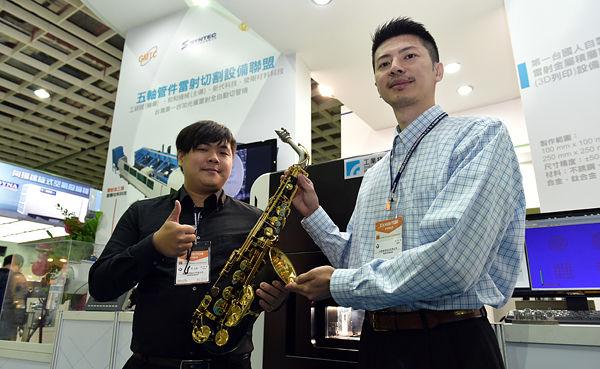
According to Yu Guixin, Assistant Manager of ITRI, most 3D printers can only manufacture “single mechanical propert[ies],” however, the Optical Engine technology used by ITRI can create different levels of toughness and hardness in one single component. Manufactured by a metal printer, this saxophone may not be the first 3D printed sax, but it is likely the toughest. The printer used for the saxophone uses titanium alloy powder and can manufacture “10 cm3 and 25 cm3 work pieces, achieving precision of 50 µm (equal to the radius of a human hair), and a density of about 99%.” That’s one tough saxophone!
Again, when I am writing these pieces on musical instruments, I always want to hear their sound. Maybe we will get the chance to do so at some point! What are your thoughts on this 3D printed instrument? Let us know in the Metal Saxophone forum thread on 3DPB.com.
[Source/Photo: CTIMES]Subscribe to Our Email Newsletter
Stay up-to-date on all the latest news from the 3D printing industry and receive information and offers from third party vendors.
Print Services
Upload your 3D Models and get them printed quickly and efficiently.













You May Also Like
The Manufacturing Race Behind the Drone Revolution
We are in the middle of a major manufacturing shift focused on the production speed and payload capacity of uncrewed aerial systems (UAS), or drones. A recent Manufacturing Dive article...
ADDMAN to Buy Up to $10.8M in Nickel 718 Powder from 6K Additive Over 30 Months
After years of buildup, we’re finally starting to see what the US metal additive manufacturing (AM) market could look like at scale. To be sure, it’s still not quite there,...
Metal AM in a Multipolar World, Part 2: How PBF and DED Could Change by 2035
The first decades of PBF development were heavily shaped by machine capability: more power, more lasers, larger build volumes, better recoating, and improved process monitoring. These developments will continue, but...
Advanced Manufacturing at IMTS 2026: 3D Printing and AI and Drones, Oh My!
Last week’s International Manufacturing Technology Snow (IMTS) in Chicago welcomed over 90,000 attendees to the jungle that is McCormick Place. With over 1.17 million square feet of exhibit space, and...