ESA’s 3D Printed Rover Workshop Hints at Business Potential for Space Robotics

At a four-day robotics workshop that the European Space Agency (ESA) Academy held at the European Space Research and Technology Centre (ESTEC) in the Netherlands, university students from a number of different countries assembled 3D printed ExoMy rovers, a project that culminated in running tests on the robotic systems on the workshop’s final day. The ExoMy is a 16-inch replica of the Rosalind Franklin rover, a nearly 700-pound Mars rover that the ESA plans to launch for the first time in 2028.
The ESA unveiled the ExoMy at the end of 2020, releasing build instructions and control software via GitHub, with guidelines of a two-week timeframe and a $600 budget for anyone attempting to 3D print the robot. At the ESTEC workshop in early July, students assembled the already printed components and then underwent a crash course in developing software to operate the ExoMy systems.
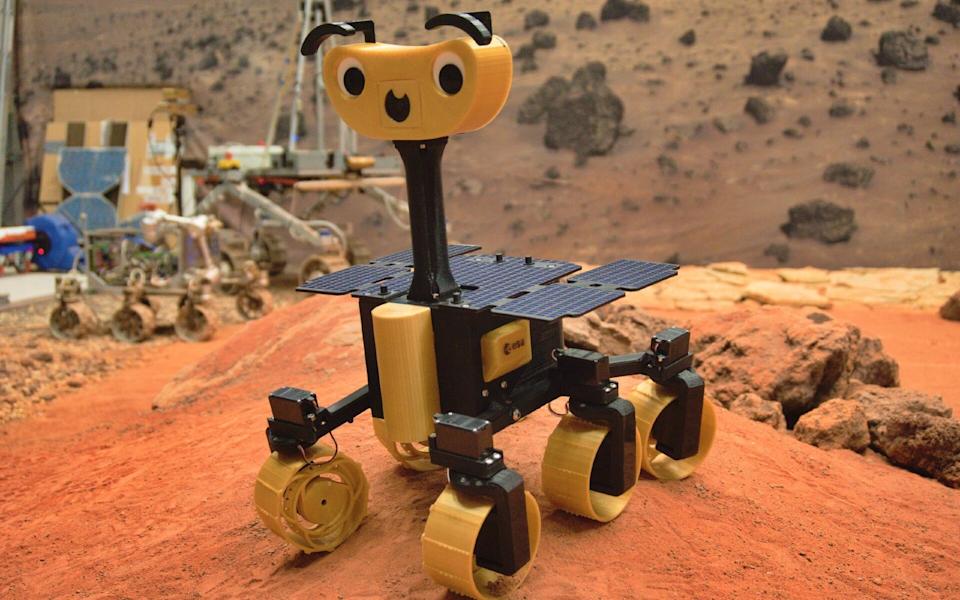
3D printed ExoMy rover. Image courtesy of ESA-SJM Photography.
The experiments that concluded the program involved testing the ability of the ExoMy to autonomously find a blue ball hidden amidst an environment designed to replicate the Martian environment. ESA internal research fellow Lennart Puck — part of the ESA’s Planetary Robotics Lab, and one of the instructors at the workshop — explained that the experiments’ conditions were influenced by challenges that the ESA anticipates operators of the Rosalind Franklin will face when the rover finally touches down on Mars’ surface:
“Direct remote control between Earth and Mars isn’t feasible,” Puck said, in an ESA press release. “In the best case, we have around four minutes delay. In the worst case, it’s over twenty minutes delay.
“Robots are a part of our daily work [at the ESA]. However, the students are from different, non-robotics backgrounds. So, in the workshop, we tried to show them step-by-step how robotics systems work. There are many different backgrounds needed in robotics. But the main thing I hope students take away is that working with robots is fun.”
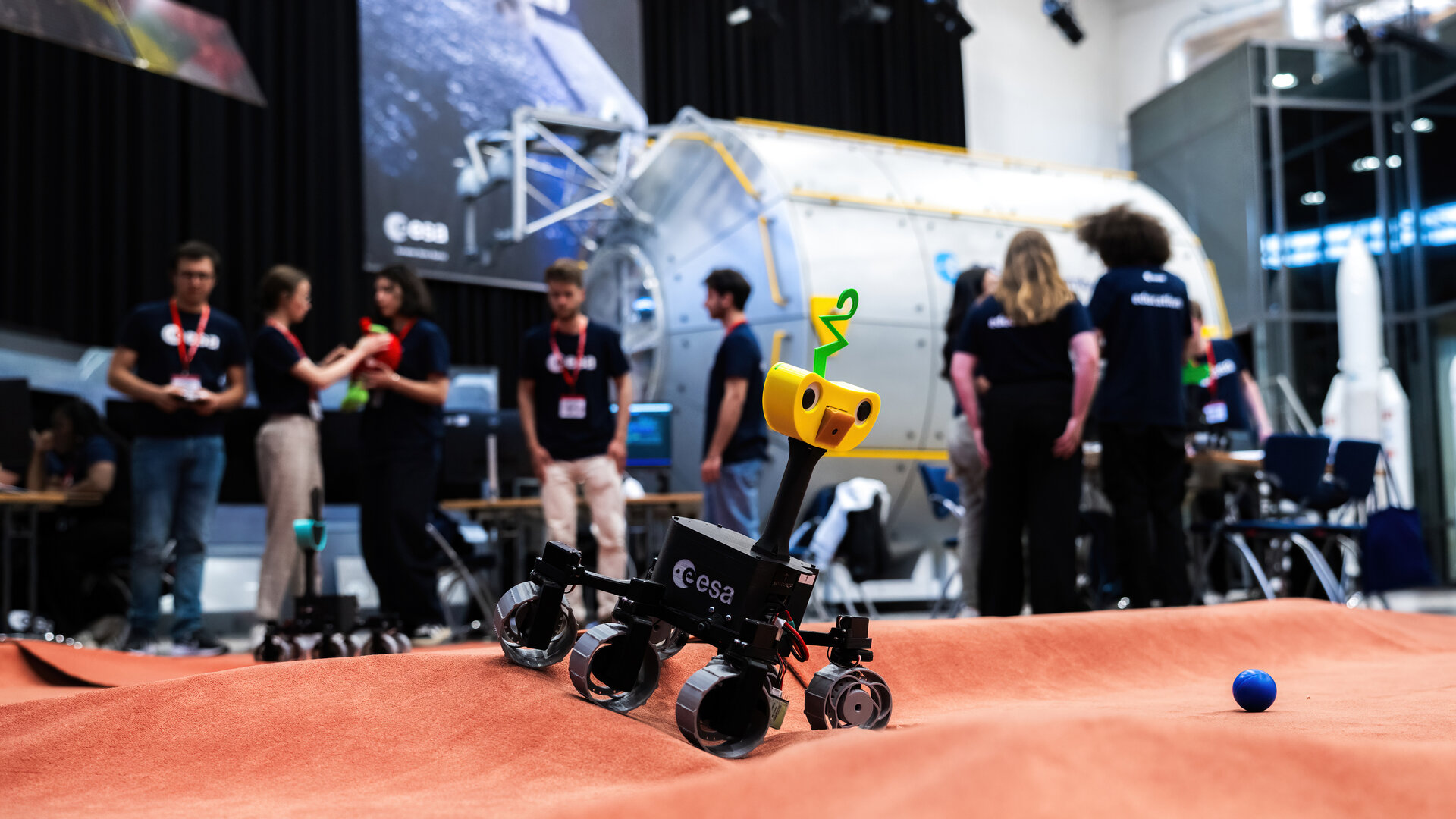
3D printed ExoMy rover. Image courtesy of ESA-SJM Photography.
The project does sound fun, and it also appears to be a window into the next decade of the space industry. There is at least one clear precedent for what the ESA is doing with ExoMy: NASA’s CubeSat Launch Initiative, which began in 2011 as a way to encourage U.S. educational institutions to get involved with R&D into small research satellites.
AM has been, in no small way, responsible for enabling the continuation and growth of such educational projects, and that decade-plus of CubeSat R&D has led to the present point in which the market for 3D printed satellite parts is poised for billions of dollars of growth by 2033. It’s not unreasonable to expect that the market for space industry robotics will see levels of growth similar to those forecast for satellites, providing another big opportunity for 3D printing market penetration.
As is always the case in the manufacturing sector, one of the most important factors in determining the long-term outcome will be the quality of the workforce development that’s needed to support the growth trajectory. One of the best ways to set workforce development initiatives up for success is to create learning processes that are as enjoyable as possible.
Subscribe to Our Email Newsletter
Stay up-to-date on all the latest news from the 3D printing industry and receive information and offers from third party vendors.
Print Services
Upload your 3D Models and get them printed quickly and efficiently.













You May Also Like
Bambu Lab and SUSAN FANG 3D Print for London Fashion Week
At London Fashion Week, some of the more unusual pieces on the runway came from 3D printers. Chinese fashion designer SUSAN FANG presented her Spring/Summer 2027 Air-Illusion collection at the...
3D Printing News Briefs, September 26, 2026: Bioceramic Implants, 3D Concrete Printing, & More
In this weekend’s 3D Printing News Briefs, we’ll start with an integration between PanOptimization and AMCM, before moving on to healthcare news from KLS Martin and Lithoz, and then UltiMaker...
The Money Behind AM: What to Watch at AM Investment Strategies 2026
For years, simply being a 3D printing company could attract attention from investors. New machines, new materials, faster speeds, and the promise of mass production were often enough to get...
Stratasys Showcases 3D Printed Automotive Applications & New Printer at IMTS 2026
Just ahead of last week’s International Manufacturing Technology Show (IMTS) in Chicago, Stratasys launched the F870, a new large-format, production-grade FDM 3D printing platform designed to drive industrial manufacturing at...