Canadian Artist Guillaume Lachapelle Creates Haunting, 3D Printed Dioramas


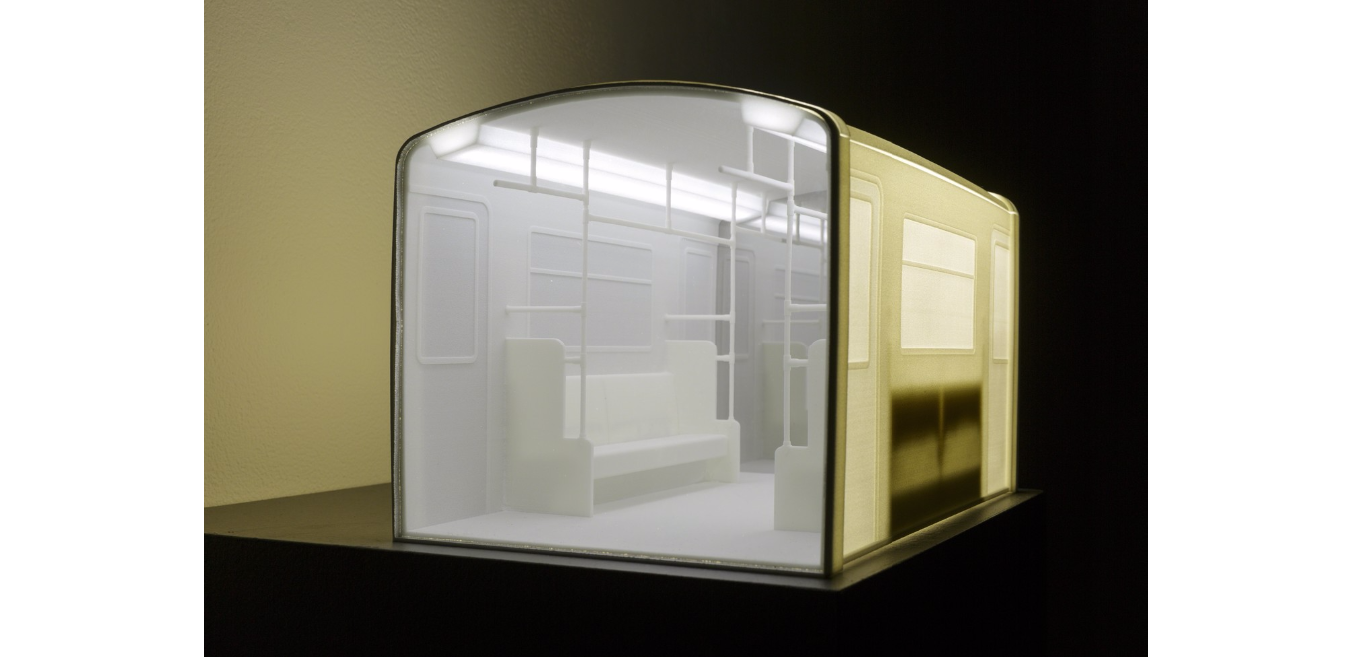
Metro, 2013
There’s something so compelling and, conversely, off-putting and potentially even anxiety-provoking about the 3D printed dioramas of Montréal-based artist Guillaume Lachapelle. This sculptor–who is clearly inspired by architecture and the human impulse to organize and standardize space, particularly communal space–creates meticulous models reminiscent of the miniature stage sets produced in intricate detail. Lachapelle’s sets, however, are sterile versions of those often elaborate maquettes. Rather than suggesting that, in the context of one of the small-scale worlds that action will erupt momentarily, the Québec artist’s sets are devoid of human presence, monochromatic and in a sense scrubbed clean of life.

Nuit étoilée, 2012
The models, some of which are no larger than about 6″ x 6” x 12”, largely represent interior spaces arranged in grid-like fashion. Relying on feints of mathematical perspective, including utilizing mirrors in many instances, the sculptor creates the illusion of diminution into seemingly infinite space, most ironically within the confines of the small diorama.
One piece, titled Nuit étoilée (Starry Night, 2012), of the three representing exterior spaces, recreates an ubiquitous parking lot lit by four-armed streetlights, the poles of the lamps and the lines painted onto the tarmac stretch out and diminish into the distance as though the lot is endless. Another piece, Rêve collectif (Collective Dream, 2014), again relies on an orderly grid and diminution to invoke the homogeneity of suburban life as expressed in the seemingly limitlessness of a landscape filled with identical houses.
Lachapelle turned to the banality of interiors like train cars and office spaces with Metro (2013) and Vie secrète (Secret Life, 2014), respectively. With mirrors and, with the ease of reproducing veristic details that 3D design facilitates, the sculptor again creates the illusion of endlessness and even tedium at the same time that the virtuosity of these works in their protective cases lends an air of magic to the mundane, whether the factory-produced seats and poles of the subway car or the pipes and duct work of an other, subterranean world actually do hint at secrets perhaps never to be revealed.
In a 2010 interview with Montréal newspaper La Presse, Lachapelle explained that, prior to the advent of 3D printing, he used traditional methods and materials for creating and manufacturing his sculptures. Now, he creates the models (presumably after producing a series of conventional, 2D sketches) using SketchUp and then 3D prints them in nylon and other materials (although nylon seems to be a favored medium).
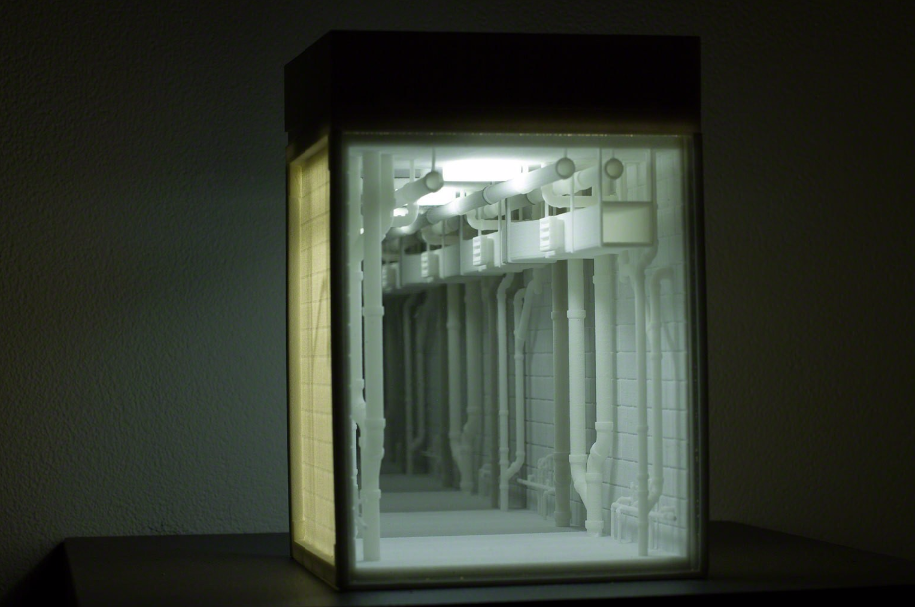
Vie secrète, 2014
This past summer, Lachapelle exhibited his work at Art Mûr, a Montréal gallery. The show, which he titled Visions, presented a sort of retrospective of his oeuvre with older works produced using more traditional techniques and more recent ones that were largely produced via 3D printing. Notably, it is difficult to discern which works originate from his pre-3D printing period and which do not.
This indistinguishability is certainly, among other things, a testament to the capacity of 3D printing not to usurp or render obsolete traditional methods of artistic production but, rather, to augment them and, in the case of Lachapelle’s work, to facilitate the kind of uncanny verisimilitude that makes his work so compelling and unsettling at once.
Discuss these incredible creations in the 3D Printed Dioramas forum thread over at 3DPB.com.
Subscribe to Our Email Newsletter
Stay up-to-date on all the latest news from the 3D printing industry and receive information and offers from third party vendors.
Print Services
Upload your 3D Models and get them printed quickly and efficiently.












You May Also Like
Orano Federal Services & UNC Charlotte Show How AM Could Cut Costs in Nuclear Energy Resurgence
Outside of the defense sector, few industries have been impacted by Russia’s ongoing occupation of Ukraine more than nuclear energy. The same appears to already be happening in response to...
Loughborough University Using Freemelt’s EBM Technology to Drive AM Research
To help drive additive manufacturing (AM) research, Loughborough University in England is using Electron Beam Melting (EBM) technology from Swedish metal AM company Freemelt. This work is being led by Moataz Attallah,...
3D Printing Predictions 2026: Industrial Production in Metal Additive Manufacturing
The industrial metal additive manufacturing world is splitting, with commoditization and lower-cost parts driving the production of millions of components for consumer electronics, machinery, dental, and beyond. Meanwhile, large parts...
Wayland Additive Integrates Calibur3 into Autodesk Fusion Machine Library
UK-based Wayland Additive announced that it’s collaborating with multinational software corporation Autodesk in order to help make its NeuBeam Electron Beam Powder Bed Fusion (PBF-EB) process more accessible, thus advancing...