Backflip Demo Showcases Scan-to-CAD’s Revolutionary Capabilities

Markforged founder Greg Mark’s new startup, Backflip AI, only just came out of stealth and is already making waves in the design and manufacturing industry with its AI-powered CAD tools. The company’s latest innovation is a SOLIDWORKS plugin and standalone app that transforms the process of converting 3D scan data into fully parametric CAD models.
In an exclusive interview, Mark discussed the company’s vision, the new plugin’s capabilities, and the broader implications for CAD users across industries. Mark’s demo showcased how engineers and manufacturers can seamlessly convert scanned parts into fully editable CAD files, eliminating the traditional bottlenecks in reverse engineering.
Turbocharging CAD with AI
Backflip’s core philosophy is CAD agnosticism—empowering users to retain their existing CAD workflows while significantly enhancing efficiency. “We love CAD. Keep your CAD,” said Greg Mark. “We don’t want to force anyone to change what they’re already good at. If you’ve spent thousands of hours mastering SOLIDWORKS, NX, or any other CAD system, we want you to stay there. Our goal is not to make you switch—it’s to turbocharge your existing workflow. The plugin allows you to work within your CAD environment and seamlessly convert scanned data into something fully editable without jumping between tools.”
The AI-driven plugin allows users to convert STL files and scanned meshes into editable parametric models without switching software. The company aims to extend support to multiple CAD platforms, ensuring seamless integration across the industry. The demo highlighted this flexibility, showing how users could work within their preferred CAD environments.
How It Works
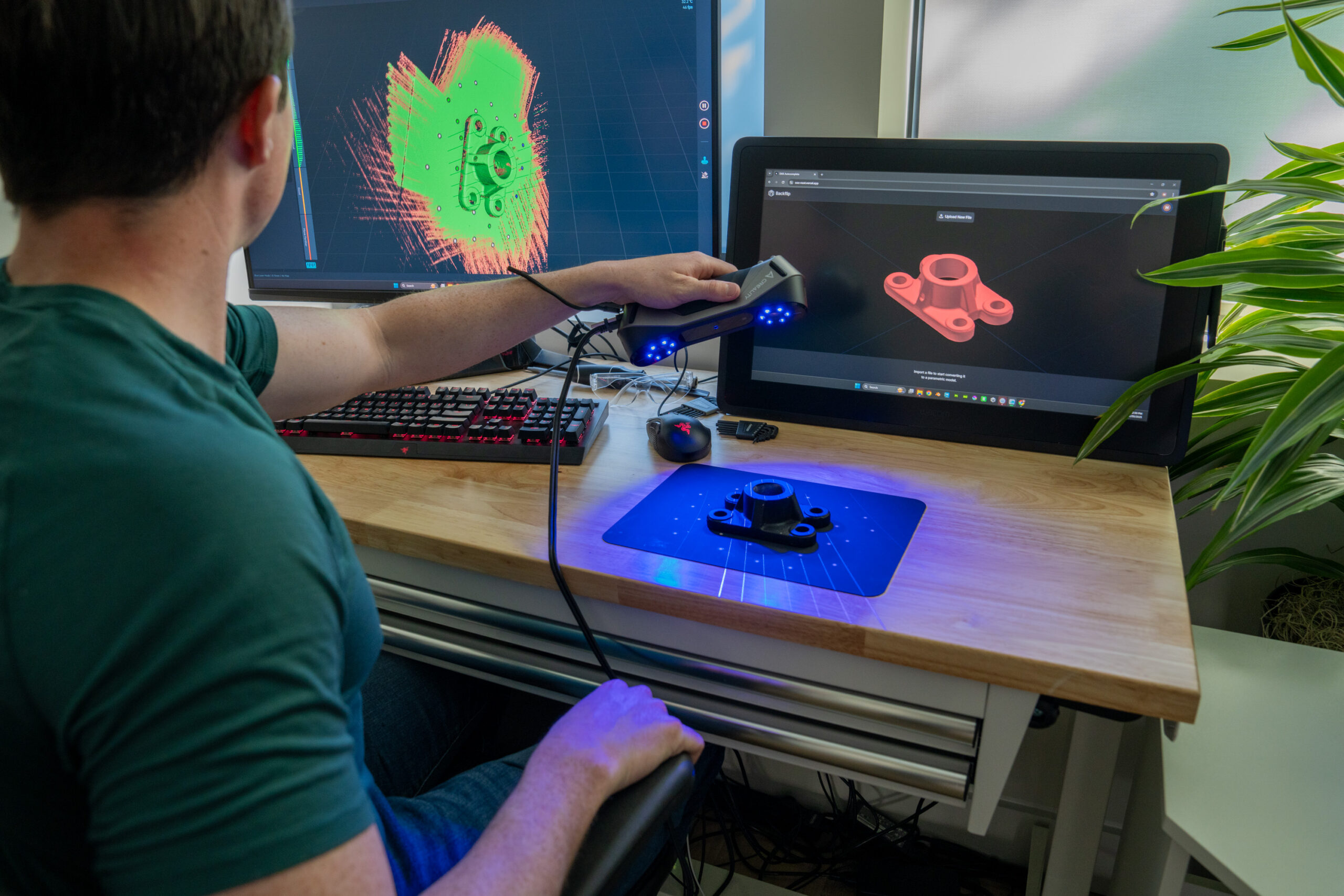
The SOLIDWORKS plugin operates as a side panel where users can upload STL files. Backflip’s cloud-based GPU processing then generates four different parametric variations of the part, allowing users to select the most accurate model. The plugin then automatically rebuilds the model within SOLIDWORKS, creating a full feature tree as if it were manually designed.
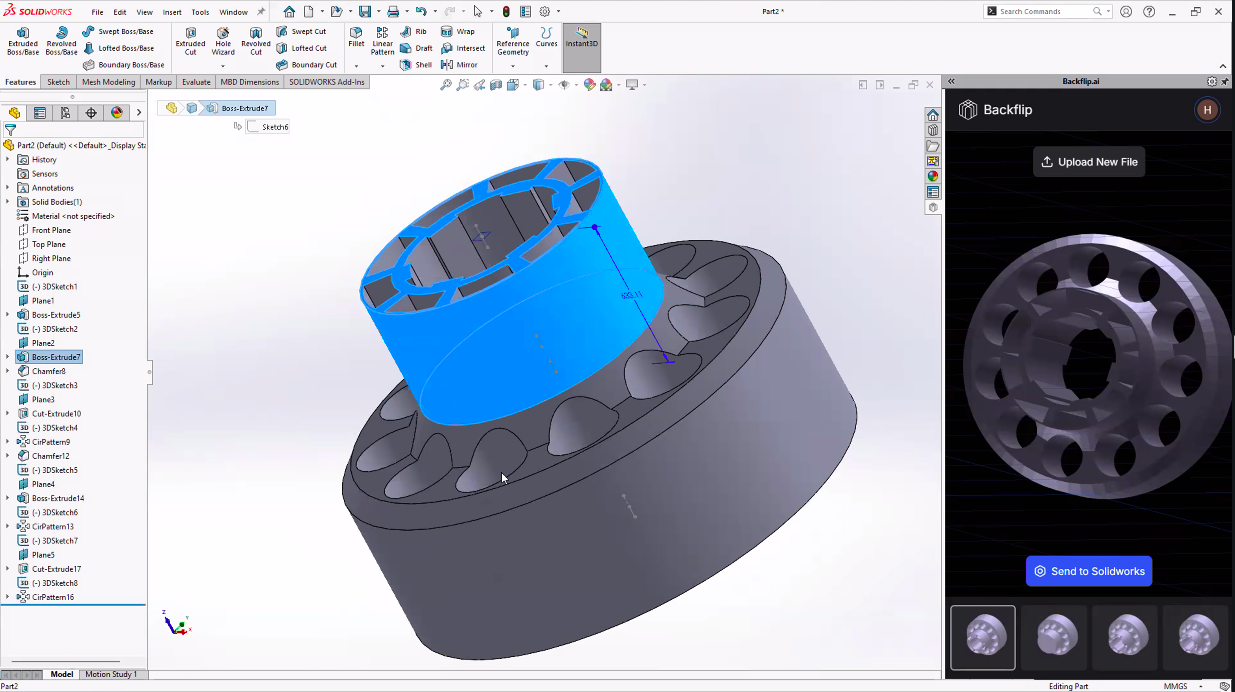
“This is not some black-box magic,” explained Mark. “SOLIDWORKS sees it as a fully native model, complete with sketches, extrusions, and patterns. What that means is, as far as your CAD software is concerned, you built this part yourself. It was incredibly difficult to get this right, but we knew it had to be done properly. We want AI-assisted design to be fully interoperable with professional CAD workflows. This isn’t just a halfway solution—it’s a true extension of the designer’s capabilities.”
Unlike existing AI tools, like ChatGPT and DALL-E, in which advanced software that has never actually encountered the physical world fabricates text, images, and movies, the models created by Backflip feel as though they were made by a human. That is, the AI can handle standard CAD operations such as extrudes, revolves, chamfers, and fillets, building a complete feature tree.
Addressing Manufacturing Challenges
One of the key applications of Backflip’s technology is in manufacturing maintenance and repair. When a machine part breaks, it often halts production lines, costing companies millions in downtime. Traditionally, engineers must manually reverse-engineer a part, a time-consuming process. With Backflip, a simple 3D scan can be instantly converted into a manufacturable CAD model, significantly reducing downtime.
Mark highlighted the importance of this approach for industries like automotive and aerospace, where aging equipment often lacks digital design files. “3D printing as an industry has a counterintuitive workflow,” he said. “If you’re machining a part and the hole comes out too small, you don’t redraw the entire part—you just adjust the tool offset. But in 3D printing, people actually have to go back into CAD and modify the geometry itself. With Backflip, you bring in an STL, and it instantly becomes parametric. You can tweak it, make adjustments, and send it back to the printer or the factory floor without having to redraw everything from scratch. That’s huge for companies dealing with constant iteration and production adjustments.”
Expanding Beyond SOLIDWORKS
While SOLIDWORKS was chosen as the initial platform due to its widespread adoption, Backflip has plans to expand. Future plugins will support CAD software like Siemens NX, PTC Creo, and Autodesk Fusion 360, among other cloud-based CAD platforms. For users outside these ecosystems, a standalone web app will offer step file conversions for broader compatibility.
“The reason we started with SOLIDWORKS is simple—it has a massive user base, and it’s a tool we know well,” Mark said. “But our vision extends beyond any single CAD system. We want Backflip to be accessible to every engineer, regardless of the software they use. That’s why our next steps involve rolling out integrations for other major CAD programs. At the same time, we’ll also offer a standalone app for users who just need to quickly convert STL files to parametric CAD without a plugin.”
A unique aspect of Backflip’s tool is its educational component. The plugin doesn’t just create a part—it shows users how it was built, step by step. “It’s like having a turbocharged CAD assistant,” said Mark. “For experienced engineers, it speeds up workflows. For new users, it provides an on-ramp into professional CAD software. One of the biggest barriers to CAD adoption is the sheer complexity of starting from scratch. But if you can scan a part and immediately see how it was reconstructed—extrudes, cuts, patterns—it becomes much easier to modify and learn from. We’re not just automating design; we’re teaching people how to think like CAD engineers.”
The demo reinforced this by visually walking through each design step, highlighting how the AI intelligently detects design intent and reconstructs parts in a way that aligns with best CAD practices. This functionality not only streamlines engineering work but also serves as a learning tool for those new to CAD modeling.
The Future of AI in CAD
The company is still finalizing pricing but plans to offer a freemium model similar to Onshape. A free tier will allow public model sharing, while pro and enterprise versions will offer private designs and additional features. With AI inference running on cloud GPUs, pricing will factor in usage-based costs.
“We’ll have a free version where models are public, and then reasonably priced pro and enterprise options for businesses that need privacy and additional features,” Mark explained. “We’re not in the business of making CAD less accessible. Our goal is to give people more power to design and iterate faster, without putting up unnecessary cost barriers.”
Mark compared Backflip’s current stage to early iterations of generative AI, stating, “We’re at GPT-2 level now. By the end of the year, we expect to hit GPT-4-level accuracy. Right now, it handles about 10% of parts really well. Within months, that’ll be 95%. That’s why we’re keeping beta testing tight—we want to refine it before opening the floodgates.”
For now, Backflip is focused on rolling out its beta program, gathering user feedback, and refining the experience before a broader launch. Interested users can sign up for early access on Backflip’s website.
Subscribe to Our Email Newsletter
Stay up-to-date on all the latest news from the 3D printing industry and receive information and offers from third party vendors.
Print Services
Upload your 3D Models and get them printed quickly and efficiently.













You May Also Like
HG Laser & The Overlooked Sources of China’s Advanced Manufacturing Strength
Chinese state-owned enterprise (SOE) HGTech (Huagong Tech) just reported that it achieved record revenue in H1 2026, amounting to just over $1 billion. The company credited the results to success...
3D Printing Financials: $28M in China, U.S. Deals and a Metal AM Comeback
Money continues to go into additive manufacturing (AM). From a $30 million raise for a Chinese metal 3D printing company to new funding for naval AM and a European company...
AMAsia Pulse: AM Investment Picks Up Across Asia-Pacific
The first half of September brought fresh investment and expansion activity across Asia-Pacific’s additive manufacturing sector. China’s Xinjinghe secured funding for an aerospace AM hub, South Korea’s Lincsolution outlined plans...
3D Printing Market Hits $4.48B After Six Straight Quarters of Growth
The additive manufacturing market continued to grow in the second quarter of 2026, adding another quarter to what is becoming a much more consistent expansion for the industry. Worldwide revenue...