
Tethers Unlimited Wins NASA Grant to Convert Plastic Waste to 3D Printer Filament In Space

NASA has selected the Tethers Unlimited, Inc. Positrusion Recycler for use on the International Space Station and awarded a Phase II SBIR to the company for their patent-pending technology which will turn plastic waste into 3D printer filament for in-space manufacturing of tools, replacement parts, and various satellite components.
This Small Business Innovation Research (SBIR) Program award means TUI’s Positrusion Recycler will be developed to convert plastic waste. The device uses novel techniques to process plastic into very high-quality filament for 3D printers.
“Positrusion is a new approach to making 3D printer feedstock that produces filament with much more consistent diameter and density than traditional extrusion processes,” said Jesse Cushing, the principal investigator for the Positrusion project. “That consistency will improve the quality of tools and other parts produced by 3D printers on the station.”

Dr. Rob Hoyt of TUI
And as with many technologies developed for use in space, TUI says they see significant potential for the Positrusion system to be used in recycling plastic waste in the consumer market here on Earth.
Jeffrey Slostad, TUI’s Chief Engineer, says that for a recycler to be used on the ISS, it had to meet exceptionally stringent safety requirements.
“Its design needs to minimize the amount of time an astronaut must spend operating it,” Slostad says. “So we designed the Positrusion Recycler to be as safe – and simple – to operate as a microwave oven. We believe a consumer version of this machine will be ideal for recycling household and office waste.”
Tethers Unlimited develops 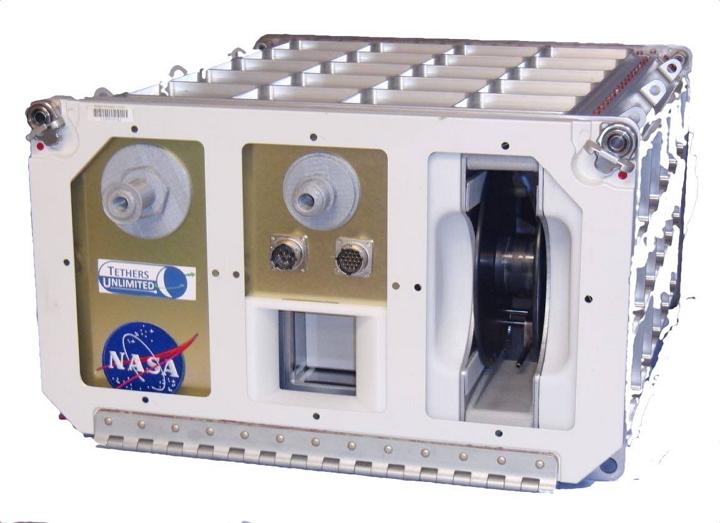 technologies for space and defense missions, and the company’s products include space propulsion systems, software-defined radios for small satellites, and a variety of systems for in-space additive manufacturing.
TUI has also developed an ecosystem of additive manufacturing technologies such as 3D printed Versatile Structural Radiation Shielding, Structural Multi-Layer Insulation, and the Trusselator and SpiderFab fabrication technologies for use in building satellite components like antennas and solar arrays.
“We are very excited to continue working with the NASA Marshall Space Flight Center to enable sustainable in-space manufacturing. Our long-term goal is to create the capability to construct the habitats, spacecraft, and other infrastructure necessary for exploration and settlement of the solar system using raw material launched from Earth as well as resources available in the space environment,” says CEO and Chief Scientist at TUI, Dr. Rob Hoyt.
What do you think of the idea of 3D printing in space? Do you think inventions like the Positrusion Recycler will ultimately end up being used by consumers to recycle plastic waste into 3D printing filament? Let us know in the Positrusion Recycler forum thread on 3DPB.com.
Subscribe to Our Email Newsletter
Stay up-to-date on all the latest news from the 3D printing industry and receive information and offers from third party vendors.
Print Services
Upload your 3D Models and get them printed quickly and efficiently.













You May Also Like
Oerlikon Adds ATLIX’s xBUILD 5000, Plans More for 2027
Oerlikon has installed a new ATLIX xBUILD 5000 metal 3D printer at its facility in Huntersville, North Carolina, marking the first production deployment of the system worldwide. The machine will...
The Manufacturing Race Behind the Drone Revolution
We are in the middle of a major manufacturing shift focused on the production speed and payload capacity of uncrewed aerial systems (UAS), or drones. A recent Manufacturing Dive article...
Stratasys vs. Bambu Lab: Why Europe and the U.S. Reached Different Results, Part II
Editor’s note: This is Part 2 of a two-part series by Xu Fanglei examining the technology and patent issues behind the Stratasys-Bambu Lab dispute. Part 1 looked at the $27.6...
3D Printing News Briefs, October 1, 2026: Defense, Enclosures, & More
In today’s 3D Printing News Briefs, we’re starting with defense news, first from Massivit and then from AML3D. Then we’ll move on to U.S. manufacturing of a new large-format LPBF...

























































