Chinese Doctors Complete Extremely Difficult Wrist Surgery Thanks to 3D Printing

3D printing is beginning to really prove itself as an operating room tool in hospitals around the globe. So far it has only caught on in a small percentage of hospitals mostly within a few select countries, with the United States and China seemingly leading the way. Without a doubt though, within a a few years time, 3D printers will be commonplace within hospitals everywhere.
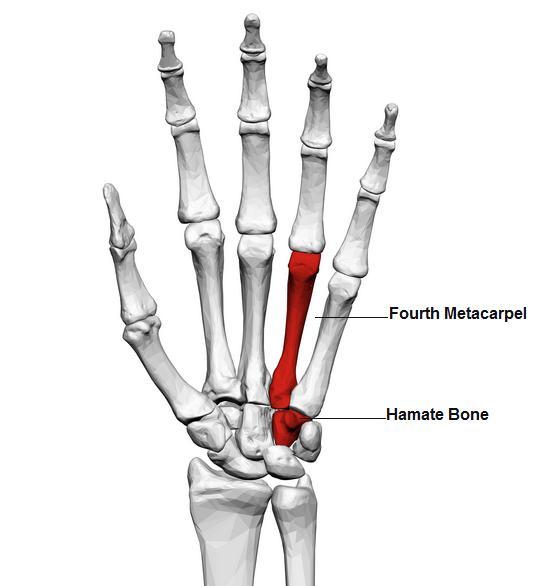 One 21-year-old university student in China, named Xiao Wang, was guilty of doing something that many of us do on occasion. He was walking around playing with his cell phone, not paying attention to where he was going, when he accidentally fell directly on his wrist, causing a significant injury. When taken to the Wuhan Puren Hospital, in the Central China province of Hubei, doctors did a CT scan on his wrist discovering that not only had he fractured his right hamate bone, but he also had broken his fourth metacarpel. For those of you unfamiliar with these bones, the fourth metacarpel is the bone on the top of your hand that connects to your ring finger, while the hamate is a tiny little bone that makes up the wrist, located just below this fourth metacarpel (see image).
This caused a significant problem for orthopedic surgeon Liu Rong, who could not accurately see the exact breaks of both these bones on traditional x-rays and CT scans. Since the breaks were so close together the surgery seemed nearly impossible. There was hope though, as Liu Rong and his team decided to utilize 3D printing in order to more accurately assess the damage to Wang’s right wrist.
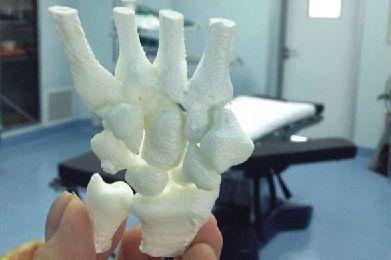
The 3D printed wrist model
This allowed the surgeon to tailor a surgery specifically to Wang’s injury, using the 3D printed wrist model as a perfect guide in doing so. The model allowed for much improved accuracy on behalf of the surgeon, as well as much reduced surgery time for Wang, who did not need to be under anesthesia nearly as long as he would have if the surgery would have been attempted via traditional means.
Surgeon Liu Rong said that such a fracture, like the one experienced by Wang, normally could be overlooked, and if it were not to be repaired, the patient would have life-long pain in his/her hand, as well as a loss of functionality to the hand itself. Prior to the use of 3D printing, this may have been the prognosis for Wang.
This is just one more shining example of why 3D printing will make such a huge impact, not just in the fields of manufacturing, but in that of medical technology as well. As for Wang, he is expected to make a full recovery, and probably will be more responsible when using his cell phone in the future.
What do you think about this incredible use of 3D printing technology in order to repair an extremely complicated wrist/hand fracture? Discuss in the 3D printed surgical wrist model forum thread on 3DPB.com.

Subscribe to Our Email Newsletter
Stay up-to-date on all the latest news from the 3D printing industry and receive information and offers from third party vendors.
Print Services
Upload your 3D Models and get them printed quickly and efficiently.











You May Also Like
Stratasys Partners With Defense Prime Heavyweights to Qualify SAF PA12 for Industrial 3D Printing
Perhaps the most valuable lesson that the additive manufacturing (AM) industry has learned in its technical maturation era over the last five years or so is that you can’t really...
Via EOS Partnership, Texas’s ACMI Is the First Customer for the AMCM M 8K 3D Printer
EOS’s two major announcements in the last few months have been the launch of the EOS M4 ONYX at Formnext 2025 and the news from a couple of weeks ago...
Reuniting ExOne and voxeljet: An Investor’s View on Building a Global Industrial Sand Printing Leader
Authored by Whitney Haring-Smith, Chair of the Board, ExOne Global Holdings & Managing Partner, Anzu Partners At Anzu Partners, we invest with conviction in industrial technologies that create categories—and then...
VulcanForms Raises $220M as Investors Back Scaled U.S. Metal 3D Printing
VulcanForms has closed a $220 million Series D funding round, a large vote of confidence at a time when investment in 3D printing has become more selective. Investors are backing...