“Fossilized” Project Takes a Creative but Practical Approach to Concrete 3D Printing


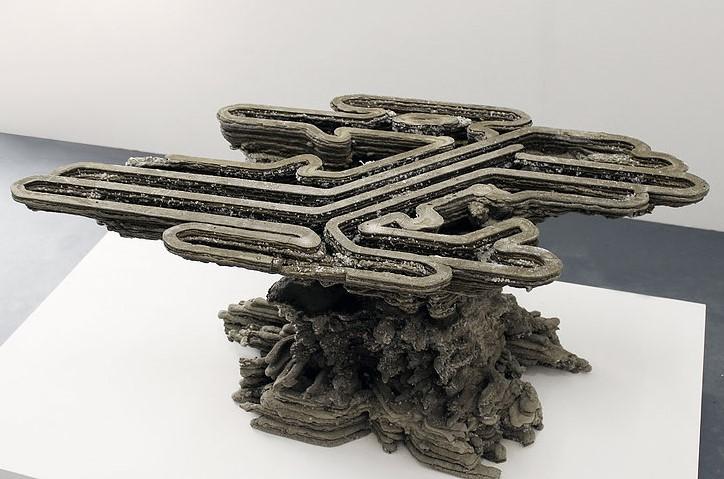 Concrete is usually not a material that one associates with artistic expression. It’s a utilitarian material, meant to be poured and scraped, walked upon or leaned against. 3D printing, however, has revitalized concrete’s creative potential. Incredible shapes and textures have been created by artists armed with concrete and 3D printers, but the material’s functional attributes aren’t being ignored: concrete is also being explored as a medium for 3D printing entire buildings.
A group of students at the Bartlett School of Architecture have been experimenting with concrete printing as a way to combine both the artistic and the functional. The team, which calls itself Amalgamma, is composed of four Masters students — Alvaro Lopez Rodriguez, Francesca Camilleri, Nadia Doukhi and Roman Strukov — who took on a year-long research project to develop new methods for 3D printing concrete. The project, entitled “Fossilized,” had several objectives.
“Fossilized is a project that attempts to counteract current ‘stagnant’ 3D printing practices, aiming to reinstate the concept of craftsmanship back into architectural design by adopting a more tectonic approach to 3D printed form,” the team states. “Rather than focussing on actual form generation, this is achieved through an understanding of aggregation and heterogeneity at the material level, encouraging the dissolution of boundaries at the massing, structural and material scales.”
The results of the project are anything but stagnant. Amalgamma’s printed concrete structures are twisting, multi-layered columns that resemble ancient, decaying trees. Despite their fragile appearance, though, the structures are strong; one of the team’s objectives is to produce sculptural elements that can also serve functional architectural purposes.
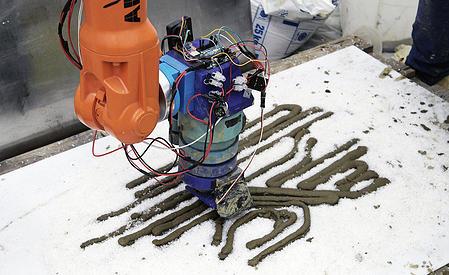
To achieve these results, the group created a novel method of 3D concrete printing that actually combined two different techniques. The first was basic extrusion, using a large industrial robotic arm to extrude the concrete material. The second was powder bed printing. Normally, powder bed printing utilizes a laser beam or binding agent to fuse layers of powder together; Amalgamma’s process used the “powder” – in this case, a granular, rock salt-like substance – strictly as a support material.
Basically, the concrete is extruded onto a bed of the granular material. As the layers of concrete are extruded, a second tool head on the robotic arm deposits more of the granular material around it. The support material combines with the wet concrete to strengthen the weaker parts of the structure. Not only that, the salt-like material adds an extra element of beauty to the finished columns, making them appear as if they are covered with ice, frost, or some sort of lichen.
 Amalgamma believes that their technique could dramatically reduce the amount of material wasted in traditional construction methods. Rather than using solid, heavy slabs of concrete to create columns or walls, the Fossilized method allows for structurally sound elements to be produced with much less material:
“Although 3D printing a whole structure from start to finish may not be possible due to fabrication constraints, it could be possible to print, for example, a floor-wall-ceiling assembly or a stair-floor-wall assembly as one whole architectural chunk – each chunk equally designed as a unique object capable of existing independently.”
Fossilized is the only project Amalgamma has completed so far, but they continue to develop the process under the tutelage of several Bartlett professors. We’ve seen several 3D printing and other tech-related startups form out of student collaborations; I wouldn’t be at all surprised if, within a few years, Amalgamma turns into an innovative and successful architectural firm. Discuss your thoughts on this project in the Fossilized 3D Printed Concrete forum over at 3DPB.com.
Subscribe to Our Email Newsletter
Stay up-to-date on all the latest news from the 3D printing industry and receive information and offers from third party vendors.
Print Services
Upload your 3D Models and get them printed quickly and efficiently.













You May Also Like
3D Printing News Briefs, June 13, 2026: Management Changes, Project Calls, & Wheelchairs
We’ll kick this weekend’s 3D Printing News Briefs off with some advisory board and management changes, and then move on to project call news. We’ll end with some heartwarming stories...
Researchers Combine AI and Bioprinting to Create Tiny Blood Vessel Networks
If 2026 has a theme in bioprinting, it may be blood vessels. Researchers can already print incredibly sophisticated tissues. The harder part is keeping those tissues alive. Without a network...
University of Arkansas Researchers Test Metal 3D Printing in a Mars-Like Atmosphere
If humans eventually establish a long-term presence on Mars, they will face a major manufacturing challenge almost immediately. Tools will break. Parts will wear out. Equipment will need repairs. But...
UT Researchers Use 3D Printing to Develop “Tabletop EUV Lithography” Process
Photolithography, the semiconductor manufacturing process whereby lasers transfer patterns onto chemical layers coating a substrate, is one of the most amazing industrial processes humanity has ever created. It is also...