Robot’s Versatility is Thanks to 3D Printed Grippers from Materialise

 When I was a kid, my grandmother had a tool that resembled a giant wooden pair of scissors. She used it to retrieve items she had dropped; I used it to make lots of noise and terrorize the dog. (I’m not proud.) It may seem obvious and unnecessary to say that technology has come a long way since then, but I’m going to say it anyway. Technology has come a long way since then. I’m not sure how much personal grabber-tools have changed, but in terms of industrial equipment, grippers are becoming better at being hands than hands are.
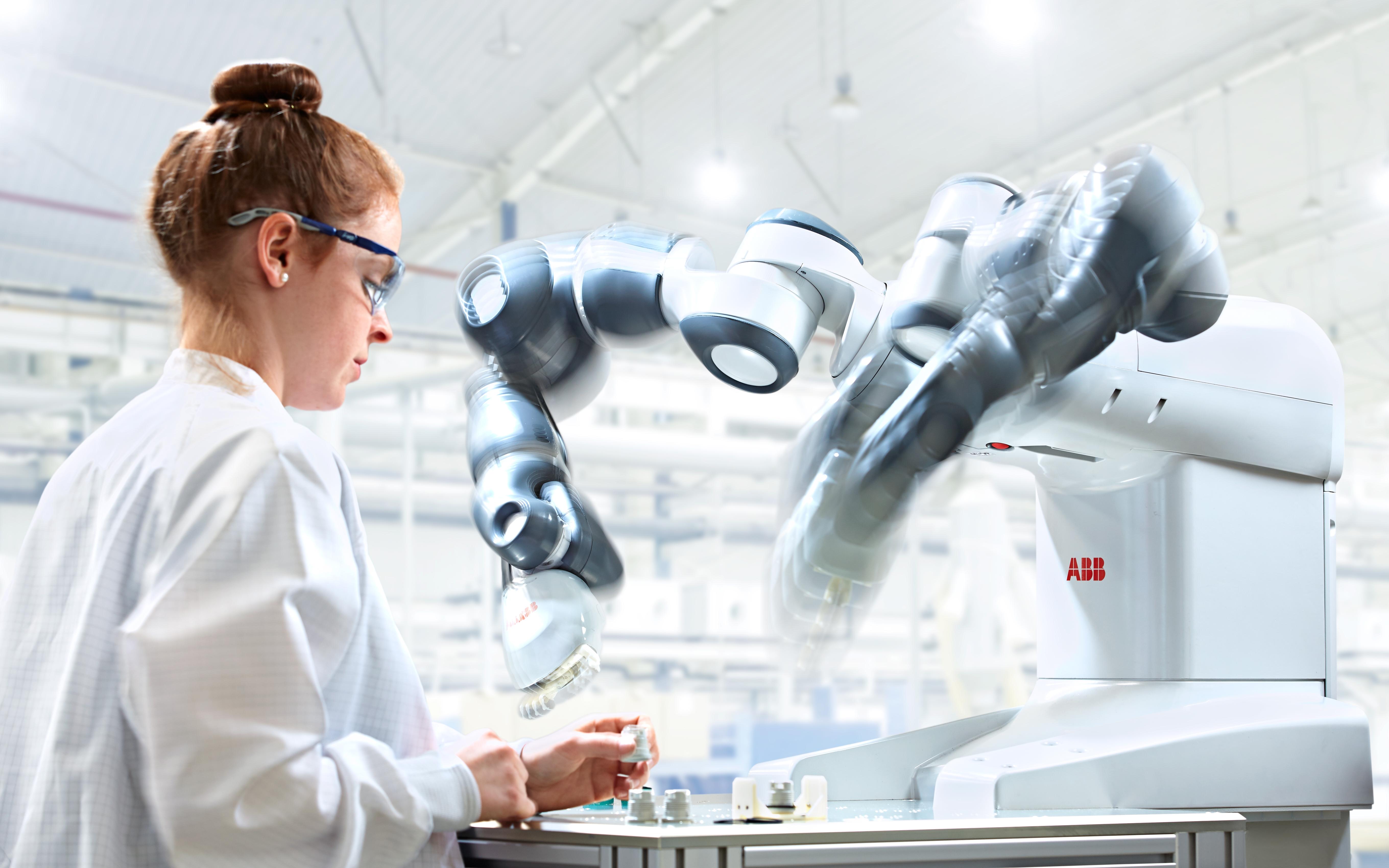
 Introducing YuMi, the newest robot designed by power and automation technology company ABB. YuMi was introduced to the public at Expo Milano 2015, a six-month-long exhibition that invited over 140 participating companies to present their best ideas for sustaining a healthy planet and food supply through technology. At the exhibition, YuMi demonstrated its food-handling and sorting capabilities, but it was originally designed for assembly lines in the consumer electronics industry. The robot’s versatility, making it suitable for many more applications than its original concept intended, is largely thanks to its 3D printed grippers, which were designed by Materialise.
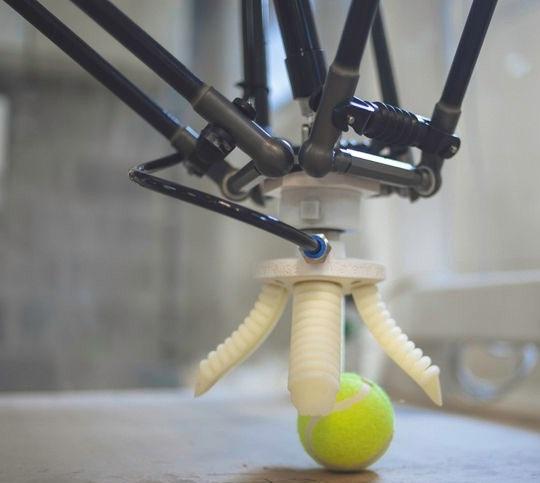
Materialise first designed its grippers about two years ago. Unlike most gripper designs at that time, Materialise’s grippers did not require hinges, operating instead by air pressure and vacuum. That made them much less liable to wear out and require maintenance. The grippers have three finger-like bellows that, when pressure or vacuum is applied, move and curve inward and outward like actual fingers. The first iteration of the grippers were laser-sintered with polyamide (PA12). However, while PA12 is a flexible material, the flexibility tends to lessen over time, so the team began looking for a new material.
They found what they were looking for in TPU 92A-1, a flexible, laser-sintered rubberlike material. Its strength and flexibility made it ideal for the finger-like attachments, which are now printed separately from the base so that they can be customized to the application for which they are being used.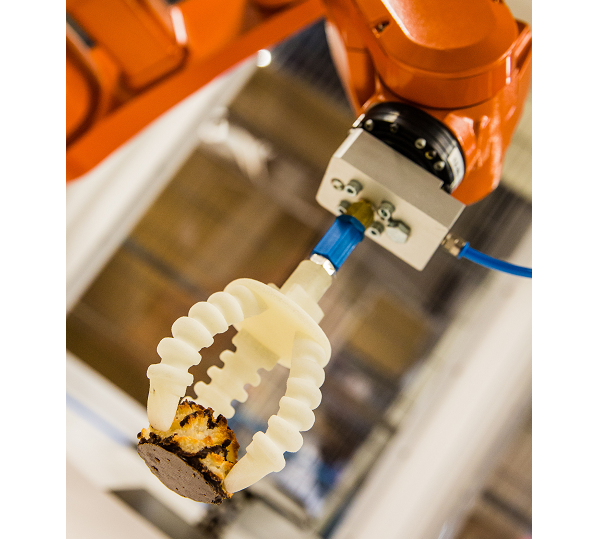
“For example,” the company says, “this could mean an additional longer finger to grip a product from underneath for added security, or interlocking fingers like those on a pair of human hands. This also means it is possible to replace individual fingers without having to replace the base or functional parts.”
At Expo Milano, a fascinated audience watched YuMi pick through and package a pile of apples with its multiple arms at the Future Food Market exhibit. The robot has the ability to grip things both delicately and firmly at the same time, and, due to its versatility, can handle fragile, complex, or oddly-shaped objects equally well. The multitasking robot is so lightweight and takes up such little space that it can easily work on an assembly lines alongside humans without requiring additional space. As for Materialise, they are still working to improve their gripper design. The next modifications they will look at, according to Manager of Engineering Services Philippe Schiettecatte, will involve different materials and wall thicknesses. In the meantime, watch YuMi and its grippers in action below.
Let’s hear your thoughts on this design in the 3D Printed Gripper Forum thread on 3DPB.com.
Subscribe to Our Email Newsletter
Stay up-to-date on all the latest news from the 3D printing industry and receive information and offers from third party vendors.
Print Services
Upload your 3D Models and get them printed quickly and efficiently.











You May Also Like
3D Printing News Briefs, November 29, 2025: Submarine Industrial Base, Running Shoe, & More
In this weekend’s 3D Printing News Briefs, we’ve got more news from Dyndrite, which has launched the NXG Slice Viewer for Nikon SLM Solutions. Farsoon Europe has news to share...
Materialise Launches New CO-AM Tools Amid New Industrial Phase in AM Software
When Materialise launched its CO-AM platform about three years ago, the company aimed to leverage cloud-based engineering capabilities to enhance the openness of the additive manufacturing (AM) software experience and...
A U.S. AM Hub in the Indo-Pacific: ASTRO America’s Guam Ecosystem Is Officially Open
A multi-year effort by the Applied Science and Technology Organization (ASTRO) America to build an additive manufacturing (AM) hub in Guam that can serve the U.S. Navy’s demand for submarine...
Stratasys Makes Navy Parts for Trident Warrior 25
The US Navy’s Trident Warrior 25 is a live fire manufacturing exercise hosted by FLEETWERX, an organization that wants to bring together companies and academia to drive Navy innovation, along...