Ravensbourne Graduate Creates Functional Furniture with 3D Printing

You may remember Vishal Patel from an earlier article we wrote about his waterproof cell phone case. Now, Patel has turned his attention back to dry land with the creation of a functional work desk built using 3D printed brackets.
Patel recently completed his degree in Product Design from Ravensbourne, a digital and new media university in London. For his thesis, he was interested in exploring the creation of furniture using desktop 3D printing. He wanted to design a piece that was possible to print on either an industrial printer or a desktop and be truly utilitarian.
 After working through a series of concepts and creating an initial set of 3D models in Solidworks, he began to produce prototypes on his printer. He used the simulation tool in Solidworks to project the ways in which the pieces would react to various pressures applied to them. However, he didn’t rely solely on the digital models for information; he also engaged in his own hands-on testing.
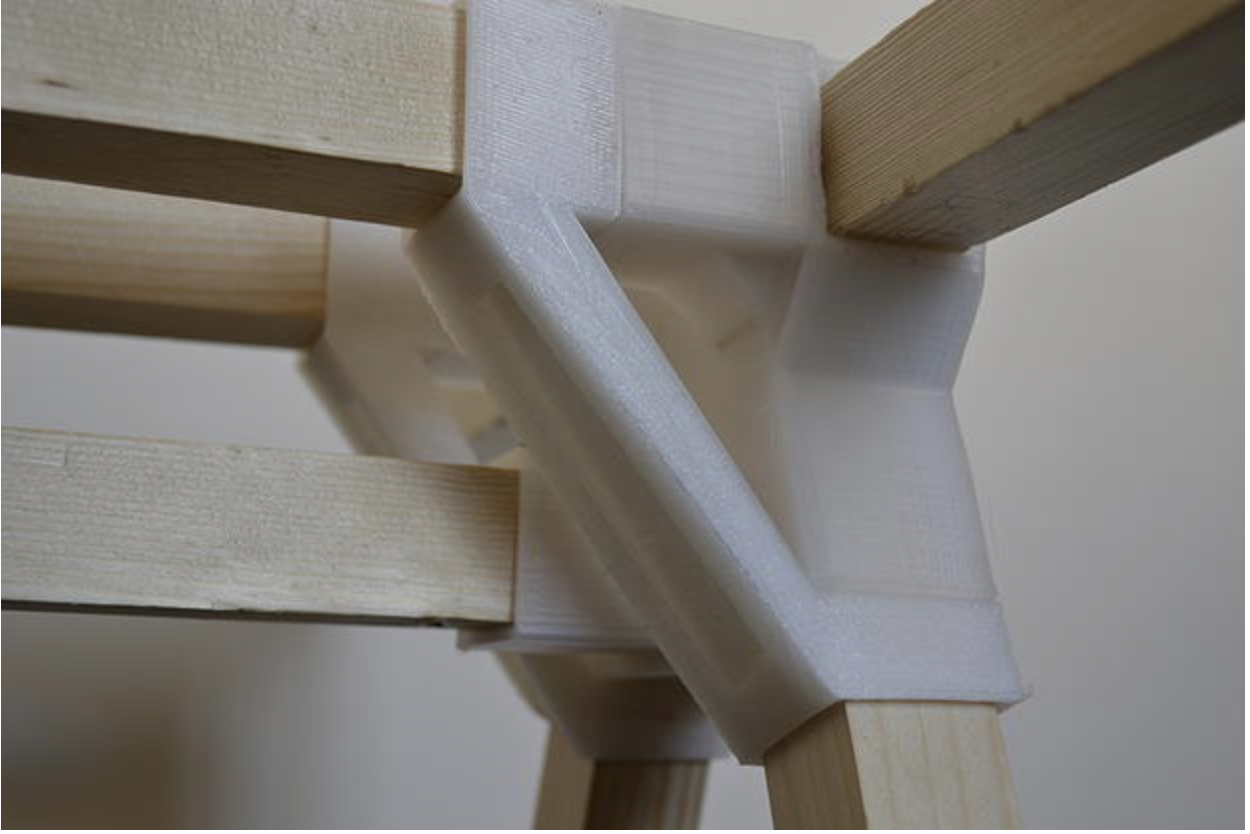
“I tested each design by standing on it and moving in every direction as well as jumping on it,” Patel said. “Through this I found that I had to add brackets to the desk because otherwise it was very unstable, those brackets helped to give the desk both structural support and shape.”
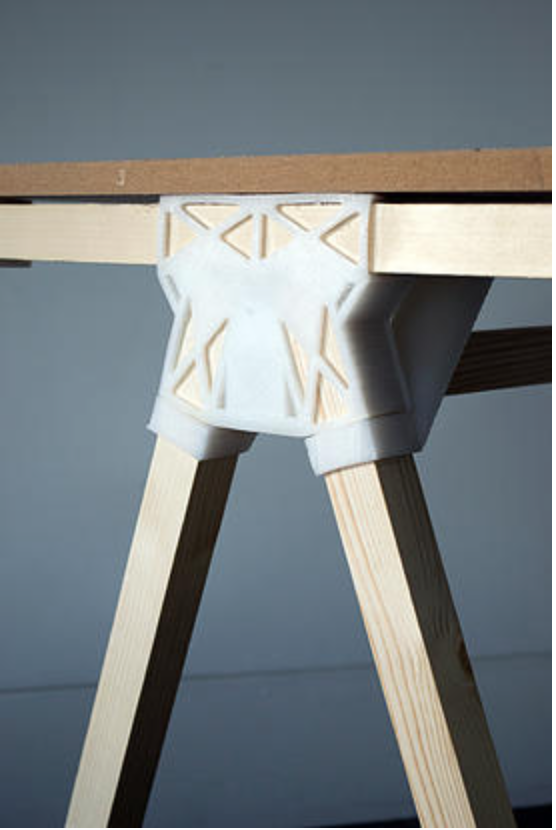 Patel created the parts so that they can fit on any printer with at least a 225 x 145 print bed. He also worked to maximize the print/filament ratio such that all of the parts can be printed using only 1kg of filament. The only other material requirements for the creation of this functional piece are a series of 2″ x 2″ pieces and a sheet of 48″ x 24″ wood for the surface.
The design wasn’t born overnight, and through this process Patel realized that you have to work with a 3D printer in a different way than with other tools. The 3D printer isn’t just a portal for the creation of whatever flits through the imagination, but rather has its own requirements and possibilities. Ignoring those characteristics creates problems for the project, as Patel noted:
“From prototyping to the final product, I had to scrap several design[s] that were causing problems as they kept taking up time and simply were not working. The first design was made from ABS and had a layer separation problem, even when I reoriented the layers in relation to the structural pressure, it simply
kept breaking. I also created using Colourfab Bronze and Taulman Nylon 645 but eventually chose a different material for the final product.”
Patel used a Wanhao Duplicator 4 to create the final pieces from Taulman Nylon Bridge. The pieces created include 2 main joints, 4 support brackets, 4 end brackets, and 4 shoes for a total print time of approximately 30 hours. The main joints take the longest with a printing time of 9 hours each, the support brackets run 2 hours a piece, and the shoes and end brackets take 30 minutes each.
The piece created for his final project is clearly simply a stage in the development of a final product, however it shows great promise. Some people would say that the devil is in the details, but I think Charles Eames said it best when he admonished that the details are not the details. Further refinement in terms of the material and junctures will continue to lead Patel towards a simple, clean, and functional design.
Let us know what you think in the Functional Furniture with 3D Printed Joints forum thread over at 3DPB.com.

Subscribe to Our Email Newsletter
Stay up-to-date on all the latest news from the 3D printing industry and receive information and offers from third party vendors.
Print Services
Upload your 3D Models and get them printed quickly and efficiently.













You May Also Like
AM & National Competitive Advantage, Part One: the Real Problem with US Manufacturing
The problem with US manufacturing is the productivity growth rate. Depending on the source, US manufacturing productivity has either been flat or slightly declined since 2010. Before going any further...
Advanced Manufacturing at IMTS 2026: 3D Printing and AI and Drones, Oh My!
Last week’s International Manufacturing Technology Snow (IMTS) in Chicago welcomed over 90,000 attendees to the jungle that is McCormick Place. With over 1.17 million square feet of exhibit space, and...
Let the Games Begin! Xi Throws Down the Advanced Manufacturing Gauntlet
Sangmin Lee went to TCT Asia back in March and reported on the event for 3DPrint.com. He wrote two articles arguing that China’s AM industry looks “ready to scale.” This...
What 3D2GO Says About 3D Printing’s Growth in Southeast Asia
The Philippines offers an interesting case study in how 3D printing can develop in Southeast Asia, and Manila-based 3D2GO helps illustrate it. 3D printing in Southeast Asia doesn’t have to...