Math Professors Laud 3D Printing’s Classroom Potential

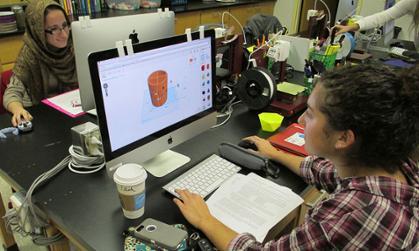
It seems like mathematics and 3D printing have a natural affinity, but how do you explain this? It also seems there are as many ways to explain this as there are 3D printed items, and one woman set out to understand this by attending a preconference session on 3D printing at the International Conference on Technology in Collegiate Mathematics (ICTCM) which was held in March 2015. Pearson Education, the corporate education giant, sent Caroline Miller to check this session out. This was one of the most highly attended sessions of the conference, and we are about to find out why.
T he explanations were quite varied but all mentioned the need for concrete application of abstract concepts (especially in calculus classrooms). Keith White, Associate Professor of Developmental Mathematics, Utah Valley University, explained his interest in 3D printing is helping students learn how to apply math in a real world environment with a tangible outcome. White reports that 3D printing motivates his students, piques their interests, and reinforces mathematical concepts as a major bonus.
“A lot of the math we teach is procedure and skill based. It doesn’t have a lot of application, and when it does the applications are usually contrived. Students know that. They see that. They get that, and anything that we can do to make it more real, and tie it to things that actually have meaning to them would be beneficial,” White said. “I am trying to figure out how 3D printing might give learning more meaning. I think students would find 3D printing interesting, but not necessarily meaningful. So I am exploring in order to see, in the context of a developmental math course or a general education math course, could you integrate 3D printing in a way that would reinforce mathematical concepts, while simultaneously increasing the motivation and interest level of students?”
San Jacinto College (Texas) Professor of Mathematics Sharon Sledge tells about how 3D printing helps associate the three-dimensional side when she teaches volumes of solids, or revolving them over some axis in calculus class. Students can actually see what these concepts looks like, and this excites them. Sledge reports that the math used in 3D printing is compatible with collegiate math and that she would definitely use 3D printers in her classroom if given the opportunity.
“In Calculus 3, when you go from a two-dimensional wor
ld to a three-dimensional world, it is perfect to help students see,” Sledge says. “Definitely in my calculus classes we would use 3D printers.”
Lila Roberts, the Academic Dean of Clayton State University, agrees that the technology is “rewarding” for visualizing calculus concepts.
Arunas Dagys, from Xavier University (Illinois) Department of Mathematics, sees how 3D printing can visualize 3-dimensional calculus concepts, but he isn’t so sure that educators should stop at 3D printing. In fact, he suggests that a holographic system would be a more natural way to proceeed in the classroon, and is “not so sure that burning plastic filaments…is the best route to go for 3D visualization.” His perspective is slightly different than his other colleagues covered here.
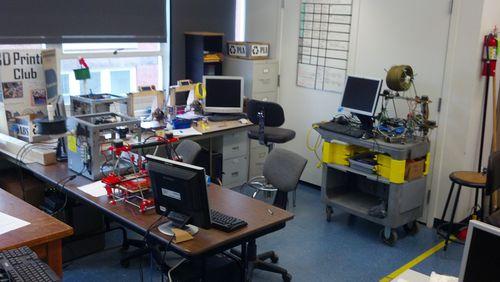
Bowen Brawner, Associate Professor in Tarleton State University’s Department of Mathematics, purchased a 3D printer for his classroom with a research grant. His students have set it up, uploaded code, and learned all the programs themselves.They also designed and built an improved extruder for their own printer, and Brawner has seen the real life applications of 3D printing in his classroom. He acknowledges the unlimited learning potential here: “So many problems within Calculus 1 to Calculus 3 can be turned into hands-on learning experiences.”
Finally, Jaque Davison from Anderson University (South Carolina) Department of Mathematics and Brian Jean, Taft Community College (California) Professor of Mathematics, both concur that having tangible 3-dimensional objects in the calculus classroom can significantly increase students’ learning potential and professors’ teaching options.
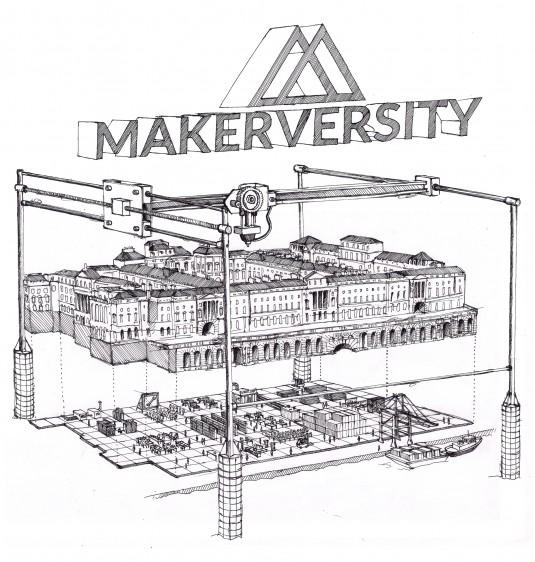 If you had any doubts about 3D printing relevance to college mathematics classrooms, you won’t after talking with these math professors. Miller reports that Pearson has partnered with Makerversity to support 3D printing in college classrooms with curricula to help teachers integrate this technology into their lesson plans and class projects. So, it looks like more 3D printing learning options may be coming to a college classroom near you!
Let us know your thoughts on 3D printing on the college level in the 3D Printing at the International Conference on Technology in Collegiate Mathematics forum thread at 3DPB.com.
Subscribe to Our Email Newsletter
Stay up-to-date on all the latest news from the 3D printing industry and receive information and offers from third party vendors.
Print Services
Upload your 3D Models and get them printed quickly and efficiently.











You May Also Like
3D Printing News Briefs, December 31, 2025: Frenzy Engine, Adaptive Slicing, & More
It’s the last 3D Printing News Briefs of the year! On this New Year’s Eve, we’re focusing on Beehive’s completed Frenzy Engine, adaptive slicing for binder jetting, medical 3D printing...
3D Printing News Briefs, October 1, 2025: Bambu Lab Store, Shape-Morphing Materials, & More
In today’s 3D Printing News Briefs, Bambu Lab has opened its first retail store, and Meltio is inaugurating its first international additive manufacturing reference site. A consortium has launched a...
Measuring Excellence: On the Ground at Hexagon Live in Fabulous Las Vegas
Two weeks ago, I drove approximately 66 miles from Dayton, Ohio to the Cincinnati airport in northern Kentucky. I then flew about 595 miles to Minneapolis, Minnesota, switched planes, and...
3D Printing News Briefs, April 23, 2025: Awards, Scalmalloy, & More
We’re starting with double awards for AMIS in today’s 3D Printing News Briefs, as the company was recently honored on both sides of the Atlantic! Moving on, BLT Europe announced...