3D Systems Unveils 3D Printed Bespoke Back Brace to Treat Chronic Scoliosis


One of the most important parts of growing up, from a child’s point of view, is blending in with their peers. I recall as a child, dreading having to get eyeglasses at such a young age, as I didn’t want to stand out, or be different  from the majority of those children around me. Children can be cruel, making jokes at other’s expenses, in the process lowering the target’s self-esteem. This could ultimately lead to long term problems with the child’s self worth.
In reality, my worry about having to get eyeglasses pales when compared to children who suffer from other physical conditions, such as severe scoliosis. These children are usually faced with having to wear a rigid, unattractive back brace for an average of 2-3 years. Nearly seven million Americans suffer from a condition known as idiopathic scoliosis, which is the rotational or lateral curvature of the spine. Although braces typically correct the issue, it is often difficult to convince children to wear the brace for many hours each day. Most kids are prone to taking them off when their parents are not around, making the treatment, many times, ineffective. This then leads to the need for relatively invasive surgery.
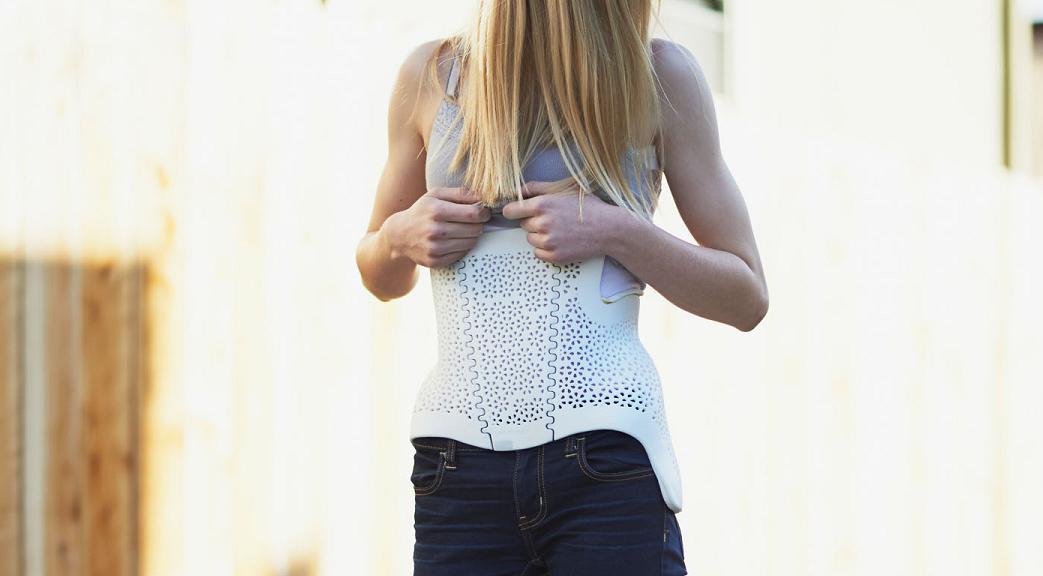
3D Systems is hoping to change this. Earlier today, they announced the completion of a pilot program for their new Bespoke™ Braces. The process used by 3D systems is quite innovative. They first fit a ‘check-socket’ brace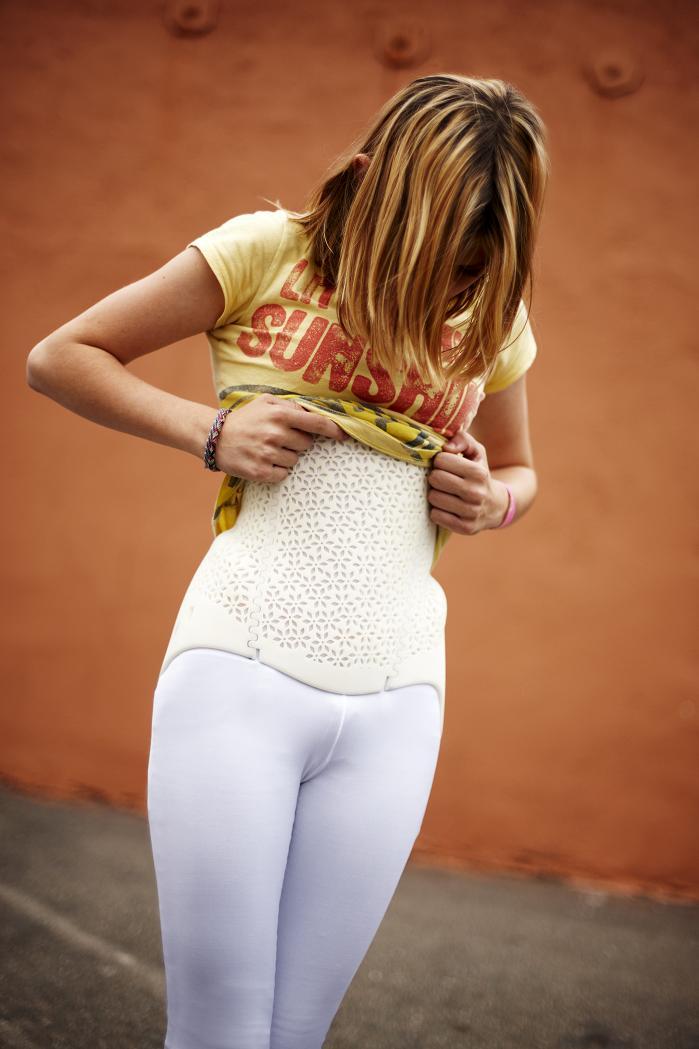 to a patient. Once the brace is correctly positioned, they then digitize it, creating a reference underlay. It is then adjusted further until they get a near perfect fit for the patient. They will then take that data and 3D print the brace on one of their selective laser sintering (SLS) 3D printers. They have worked diligently with Dr. James Policy, MD of Stanford University and Robert Jensen, CPO, to test the device on 22 patients at the Children’s Hospital of Oakland. The results, both in the brace’s ability to correct the scoliosis, as well as the feedback received by the children, were quite impressive.

Fits nicely under clothing
“All of our children wanted the Bespoke Brace,” said Dr. Policy. “We had a small 3D printed scale model of the brace on my desk. Once the children saw this, they all wanted one. I’ve never seen children respond so positively to a brace. It was so cool that once they were fitted, many were showing the brace off to their friends. It will take data to convince the insurers and medical community the value of this technology, but common sense dictates that if the children like their braces and are more comfortable wearing the devices, we will see higher compliance and greater success. The early data from our pilot study appears to support this. The Bespoke Brace promises to be an important advancement for these children.”
Unlike traditional braces, the Bespoke™ brace is flexible, as well as thin, making it easy to hide under a child’s shirt, and comfortable to wear all day long. The customization, via 3D printing, continues to leave its mark on the medical community. Earlier this year, 3D Systems made headlines when they showed off their amazing exoskeleton which allowed a paralyzed young woman to walk. This is just another amazing application for additive manufacturing within the field of medicine.
Discuss this story in the 3DPB.com forum thread for 3D System’s latest Bespoke back brace.
Subscribe to Our Email Newsletter
Stay up-to-date on all the latest news from the 3D printing industry and receive information and offers from third party vendors.
Print Services
Upload your 3D Models and get them printed quickly and efficiently.













You May Also Like
50,000 Orders and Counting: EPlus3D & Chinese AM Services Provider Are Scaling Liquid Cooling Solutions for AI Servers
An under-appreciated story driving the additive manufacturing (AM) industry this year has been the divergence between what’s driving the market in China and what’s driving it everywhere else. Let’s start...
Additive Manufacturing Has a Major Growth Opportunity; Trust Will Decide Who Captures It
After years of overpromising, the next phase of AM growth will be won by companies that consistently deliver what they say. When I entered additive manufacturing in 2014, after 15...
Seven Trends Reveal What’s Next for 3D Printing at TCT Shenzhen 2026
TCT Shenzhen 2026 opened on October 14 in Hall 15 of the Shenzhen World Exhibition & Convention Center in Bao’an, and ran through October 16. The event brought together equipment...
AM Investment Strategies 2026 Sets the Stage for AMS 2027
AM Investment Strategies 2026 Nov. 5 · 12 p.m. ET · Free online event RESERVE YOUR SPOT ↗ A one-hour online discussion featuring some of the biggest names in 3D...