First Ever Opposite Lung, Living Donor Lung Transplant Takes Place Thanks to 3D Printing

We all are aware that 3D printing has been helping advance several different types of surgeries. It’s doing this in two ways; first by giving surgeons the option of a variety of new types of 3D printed implants, and second  by allowing surgeons to print replica organs for a better understanding of the procedures that they are about to initiate.
A ground breaking new surgery was performed at Kyoto University Hospital in Japan. It was the world’s first ever living donor lung transplant in which the opposite lung of the donor was implanted into the recipient.
This groundbreaking surgery involved a woman in her 40’s who had suffered from interstitial pneumonia, causing her a great deal of respiratory distress. The pneumonia left her suffering from fibrosis of lung tissue, in which the lung tissue became scarred, stiff, and very thick. Her lung function declined so much, that a transplant was required.
Her husband immediately offered to become a donor, as it’s not easy to find someone who is willing to donate a part of their lung, who also has the same blood type as the patient. What doctors found however, was that the husband’s left lung was too small to be safely transplanted into the patient. Normally this would mean that the patient would have to wait and hope that another donor would come along. Instead, surgeons opted to perform a groundbreaking new surgery, where they would transplant the lower part of the husbands right lung, onto that of the 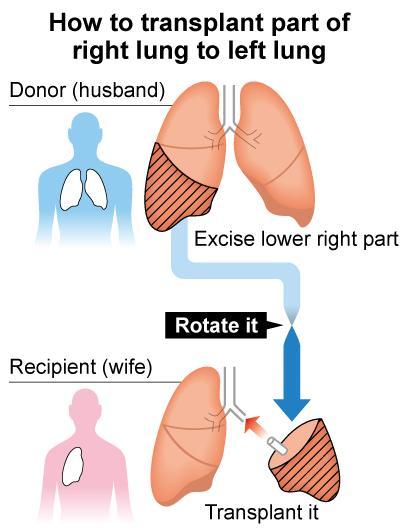 patient’s left lung.
Because of the fact that this surgery had never been performed before, doctors used a 3D printer to print out a model of the patient’s chest cavity, along with the piece of lung from the donor. They were then able to practice the very complicated surgery on the models. Typically during a lung transplant, the donor lung will match up nicely with that of the patient’s,. However, in this procedure, the fact that the lung was taken from the opposite side of the donor meant that it would have to be rotated. Unlike a typical lung transplant, blood vessels and arteries were in different areas for this procedure. The preparation and experience that the 3D printed model gave the surgeons was invaluable.
The surgery was a clear success. The patient has since been discharged from the hospital, and is doing very well, as is the donor.
“The existence of the option of implanting the right lung in the left lung will enable more patients to undergo transplantation,” said Hiroshi Date, a pulmonologist and professor at the hospital.
We may not have the technology yet to 3D print actual human lungs, but as we wait for such technology to become available, 3D printing has enabled a surgery which will hopefully increase the number of lung transplants that are able to take place each year. Discuss this amazing story at the lung transplant forum thread at 3DPB.com.
[Source: The Ashahi Shimbun]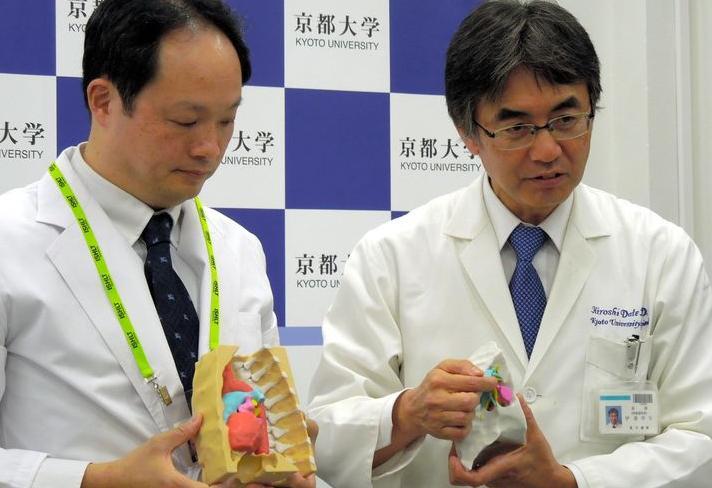
Hiroshi Date, on Right, a Pulmonologist at Kyoto University Hospital, Japan
Subscribe to Our Email Newsletter
Stay up-to-date on all the latest news from the 3D printing industry and receive information and offers from third party vendors.
Print Services
Upload your 3D Models and get them printed quickly and efficiently.











You May Also Like
ASTM International Works with UK MoD on America Makes Project
The UK Ministry of Defense (MoD) will work with ASTM International on a $1.1 million project to let it work in closer concert with the US Department of War (DoW)....
UK Government Funds Research to Develop 3D Printed Metal Alloys for Nuclear Fusion
The UK Atomic Energy Authority (UKAEA), a government-funded research organization, has demonstrated a persistent interest in developing metal additive manufacturing (AM) materials for nuclear fusion applications, including multiple phases of...
Top 10 3DPrint.com Stories of 2025: Kickstarter, Consumer Goods, Bankruptcy, & More
As Vanesa Listek wrote, last year was a major turning point for additive manufacturing (AM), as the industry is working to sort itself out. Customers want proven use cases and...
3D Printing Predictions 2026: Industrial Production & Polymer Additive Manufacturing
Polymer additive manufacturing is seeing less investment, attention, and disruption than metal additive manufacturing currently. Less crucial for defense needs, it has of late had far fewer new entrants. But,...