Style Your Desk and Increase Productivity with Colorful 3D Printed Statial Ergonomic Mouse

 3D printing and ergonomics tend to go together as they appeal to individuals with a more modernistic, high-tech style that is a natural match for digital design. Since most of us spend a lot of time in the office or in a chair of some sort using electronics, this is where the art of ergonomics seems to come in most handy.
Take your mouse, for instance. You might be very surprised at the amount of time you log in with that bad boy working, gaming — or both. For either venue, the everyday humdrum mouse may not be cutting it at all. You and your mouse may be ready to hit the big time with comfort, style, and just to make it even more cool — a little hacking business.
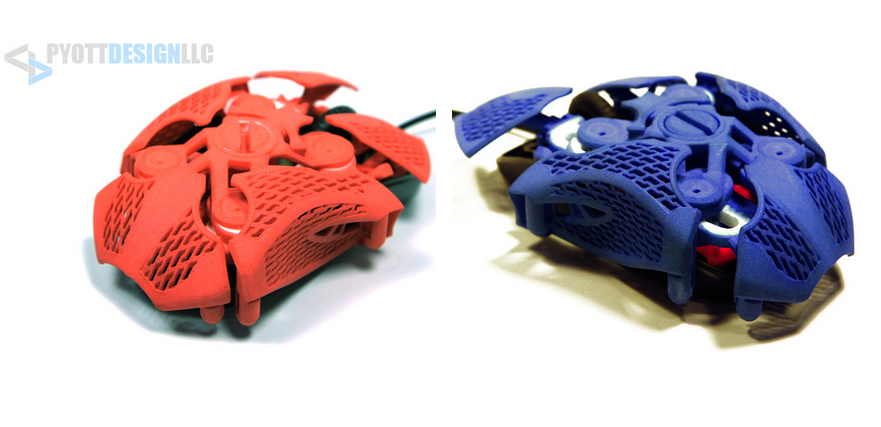
PyottDesign brings you a really fun and easy way to jazz up your mouse and put it to the test with everyday use. If you aren’t familiar with the Statial design, it’s an extremely customizable 3D printed mouse made for the modern user.
Made up of multiple parts, it allows for ambidextrous users, can be locked and unlocked easily, and is meant to be used in creating comfort and precision. If you can’t 3D print one, they can be easily ordered through 3D printing services in a variety of colors.
For making your own ergonomic mouse, you will need some supplies: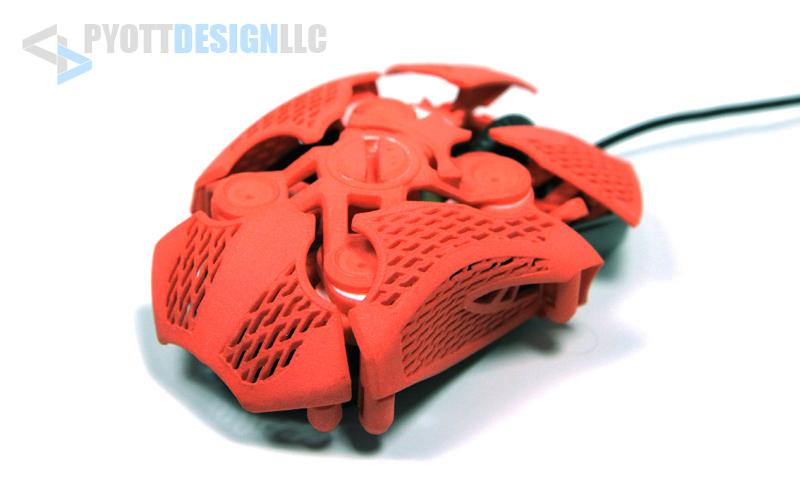
- A Statial 3D print
- A Logitech M100 mouse for complete dismantling
- Medium sized Phillips head screwdriver
- A coin
- Compressed air
In a fun and simple exercise, you’ll be up and running with your Statial mouse in no time. It’s important to note that this project will only work with the M100 mouse.
Since the Statial print will come to you in 18 interlocking parts, you’ll need to unlock it and free up the hinges so they can move easily. Use the coin to lock or unlock the parts. They recommend blasting the Statial print with compressed air just to make sure it’s completely clean and ready for assembly with the Logitech mouse.
Dismantling the Logitech mouse by unscrewing it and taking off the outer shell looks easy enough, but remember to save the hardware when you start taking it apart, for later use. Simply by pinching the Statial print from the back and launching it onto the area of the mouse now missing its conventional shell, you can align it and pop it right into place, putting the USB cord into the appropriate slot.
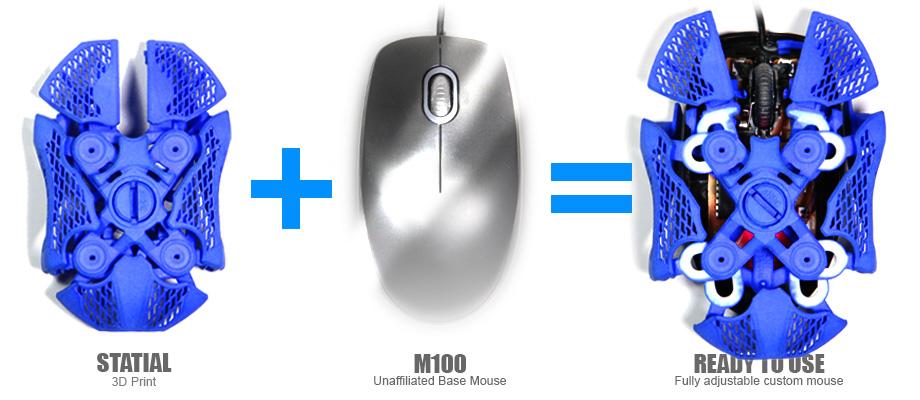 Use the coin to lock it back in place, and your ergonomic Statial mouse is ready to rock. If yiou need to make adjustments, just keep using the coin to lock and unlock it until you reach your comfort level.
I’m thinking this looks like a perfect weekend project — and what a great gift for a family member or friend at the office. It’s a good way to gain efficiency and add flair to your desk a la 3D printing.
Is this something you are interested in 3D printing? Have you 3D printed any items for your desk area or office? What about gaming equipment? Tell us your thoughts in the 3D Printed Statial Ergonomic Mouse forum over at 3DPB.com.
PyottDesign is a company completely dedicated to the exploration of 3D printing and helping to make it accessible to the public. They are very interested in studying the impact it will have on the world. PyottDesign offers various designs and products, as well as offering tools for 3D printing enthusiasts.
Subscribe to Our Email Newsletter
Stay up-to-date on all the latest news from the 3D printing industry and receive information and offers from third party vendors.
Print Services
Upload your 3D Models and get them printed quickly and efficiently.













You May Also Like
10 Years of Multi Jet Fusion: Onsite at HP’s Vancouver, Washington Facility
At this year’s RAPID event in Boston, HP Additive Manufacturing Solutions celebrated ten years in the additive manufacturing (AM) market. The company ushered in the milestone with several innovations, including...
These 3D Printed Lattices Can Sense Damage Before Failure
A new paper, “Full-Field Damage Monitoring in Architected Lattices Using In situ Electrical Impedance Tomography,” points to lattices being able to detect damage. This could really help composites in critical...
3D Printing News Briefs, October 3, 2026: Hypersonics, Hotends, & More
We’re starting off with defense in this weekend’s 3D Printing News Briefs, as Titomic was awarded a $5 million U.S. defense contract, and VulcanForms announced a partnership with Specter Aerospace...
3D Printing News Briefs, October 1, 2026: Defense, Enclosures, & More
In today’s 3D Printing News Briefs, we’re starting with defense news, first from Massivit and then from AML3D. Then we’ll move on to U.S. manufacturing of a new large-format LPBF...