Stratasys Reports Earnings, Beating Most Analysts’ Expectations


The 3D printing space has been a volatile one for investors as of late. We have seen shares of two of the major 3D printing companies, 3D Systems, and Stratasys, drop significantly over the last six months. The cause for the  drop in share prices has more to do with technical aspects than with the fundamentals of the companies.
Today Stratasys announced their first quarter earnings, prior to the opening bell. Overall their numbers were solid, better than many analysts had expected. The company generated 54% non-GAAP earnings growth, on a 61% gross margin. The reported net income for the quarter was $4.1 million, or $0.08 per share. This was a nice turnaround from last year when they reported a net loss of $0.40 per share.
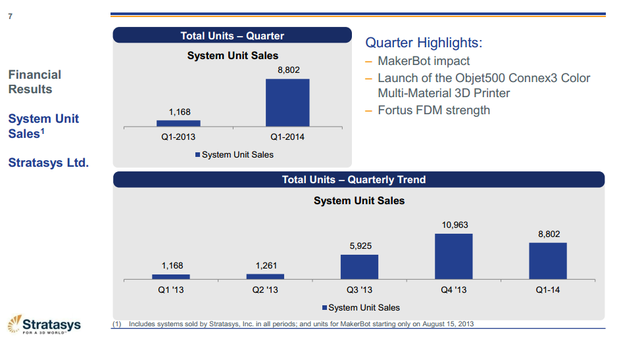
Helped by the acquisition of Makerbot, as well as the launch of their Objet500 Connex3 professional 3D printer, Stratasys sold a total of 8,802 printers, compared to last year’s first quarter where they sold just 1,168 printers.
The CEO of Stratasys, David Reis took part in an earnings call at 8:30 EST this morning, where he talked a little about the progress the company has made over the last three months.
“The rapid adoption of our higher-margin products and services remained impressive during the first quarter, which helped drive strong organic revenue growth of 33% during the period and contributed to a significant increase in our gross margin over last year,” said David Reis, “In addition, MakerBot products revenue remained strong, and we continued to invest aggressively in sales, marketing and product development initiatives that we believe will drive incremental growth over the coming periods. We are very pleased with our first quarter results and we remain on track to meet our financial projections for the year.”
Reis then went on to discuss their recent acquisitions and plans for possible acquisitions in the future.
“We believe the platform created by our pending acquisitions of Solid Concepts and Harvest Technologies will allow us to offer a comprehensive solution for our customers, and will help drive incremental growth opportunities. In addition, we continue to position Stratasys for future growth through enhancements to our organizational structure, and through strategic investments in channel, product and technology development. We believe these investments, combined with our ongoing acquisitions strategy, will support our growth objectives and position of market leadership going forward.”
The company has maintained their outlook for the full year, estimating a total earnings per share of $2.15 to $2.25 for 2014. The stock is down 6.8% on the day, as of the time this story was published. Let’s hear what your opinions of this quarter’s earnings are, at the Stratasys investor forum thread.
Subscribe to Our Email Newsletter
Stay up-to-date on all the latest news from the 3D printing industry and receive information and offers from third party vendors.
Print Services
Upload your 3D Models and get them printed quickly and efficiently.













You May Also Like
The Two Paths to AM Print Services Market Growth
AM Research New market research: AM Research is building its new Additive Manufacturing Services Market 2.0 model. Learn more about the report and preorder here → Things continue to heat...
Additive Manufacturing Has a Major Growth Opportunity; Trust Will Decide Who Captures It
After years of overpromising, the next phase of AM growth will be won by companies that consistently deliver what they say. When I entered additive manufacturing in 2014, after 15...
10 Years of Multi Jet Fusion: Onsite at HP’s Vancouver, Washington Facility
At this year’s RAPID event in Boston, HP Additive Manufacturing Solutions celebrated ten years in the additive manufacturing (AM) market. The company ushered in the milestone with several innovations, including...
ADDMAN to Buy Up to $10.8M in Nickel 718 Powder from 6K Additive Over 30 Months
After years of buildup, we’re finally starting to see what the US metal additive manufacturing (AM) market could look like at scale. To be sure, it’s still not quite there,...