AM Drilldown: the Beginning of 3D Printing’s Next Phase in the Energy Sector

For much of the last decade, many have pushed an unjustifiably optimistic view of global energy consumption, along the lines of, fossil fuels are “on their way out.” Sadly, this is still a delusion that stands very much in the way of the laudable goal of those pushing that line of thinking: addressing climate change by transitioning to clean energy.
Meanwhile, the Iran War is just the latest international development serving to remind everyone precisely how much we all still depend on fossil fuels. Before this, it was Israel’s war in Gaza, and before that, it was Russia’s invasion of Ukraine, which, after a nearly ten-year respite, reintroduced everyone to the idea that oil prices could trade above $100 a barrel.
Back in the early days of that last-mentioned conflict — likely to soon become the longest war on the European continent in centuries — I wrote a brief series titled “AM Drilldown”, aiming to contextualize the rise of additive manufacturing within the end of the era of cheap energy. However, because global powers, chiefly the US, responded so aggressively to what was, in retrospect, a rather brief period spent above the triple-digit threshold, the topic ultimately lost its prominence in the daily news cycle, and I put it aside.
The main premise the series was built on was that the decline in Energy Return on Energy Invested (ERoEI) associated with dwindling cheap oil supplies will, over the long run, play a principal role in catalyzing demand for AM. There is a multifaceted rationale for this, from my perspective, but first (even though it’s more or less self-explanatory), let’s just define ERoEI: it is the ratio of the usable energy obtained from an extraction process to the energy required to fuel that process. For a system whose purpose is to create electricity, the consensus is that the ratio should be at least 3:1 to reach an overall economic break-even point for all those reliant on that system.
One study argues that oil reached its highest ERoEI in 1931 and natural gas reached its highest point in 1945, at respective ratios of 73:1 and 200:1. An article from 2023 on “the plummeting [ERoEI] of oil liquids” puts the current numbers for oil ERoEI at somewhere between 4 and 30, depending on the source location and type of oil, and somewhere between 20 and 40 for natural gas.
The author of that 2023 article concludes by cautioning about the imminence of an era of “energy cannibalism” for oil liquids, where we’re actually just as much energy is used to extract oil as can be gotten in return, which is, in a petroleum context, the very definition of how at least one thinker frames societal collapse. The author, warning of energy cannibalism, notes, “The concept of energy cannibalism is becoming increasingly relevant, as mounting energy use in oil production means the very resources needed for the transition to renewable energy may be constrained, particularly when viewed from a net-energy perspective and in terms of economic growth.”
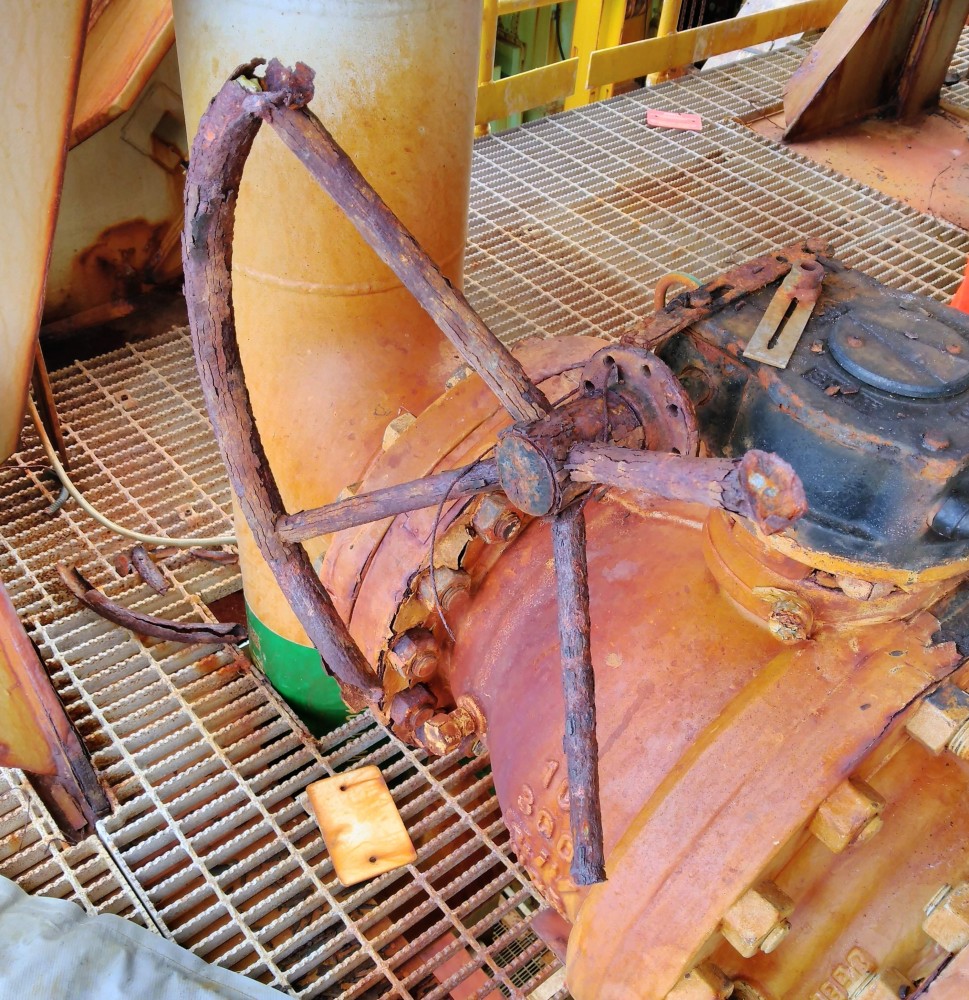
A corroded metal handwheel that Petrobras’ polymer spare replaced.
What that means is that, since fossil fuels are required to support the energy transition away from them, the global economy has to start being very careful — and strategic — about how it spends its fossil fuel reserves going forward.
AM is so relevant against this backdrop, for one thing, because, going forward, material waste will be the world’s least tolerable, and one of the clearest advantages of AM over conventional manufacturing is its ability to minimize it. Currently, however, our entire economy is essentially dependent on wastefulness. This is just another way of stating the same problem inherent in the energy transition: if we could simply conjure the desired scenario into existence, with a clean energy, low-waste economy replacing the prevailing order as seamlessly as one PowerPoint slide replaces the previous one, everything would be fine.
But a clean energy, low-waste economy can only be produced in an environment where dirty energy and maximum waste are the laws of the land. This is why those responsible for the energy sector status quo, just like those responsible for the defense sector status quo, are now in a position where they have to disrupt themselves. As is already the case with defense, AM will become an indispensable part of that process.
Precisely this background accounts for what’s so significant about what, on the surface, is a somewhat mundane story about Brazilian oil giant Petrobras using AM to produce a polymer handwheel at an offshore drilling site in Latin America. I say “mundane” because, at this point in the AM industry’s history, a polymer handwheel isn’t such a miraculous technological achievement, especially considering the innovations that emerge from the defense sector’s AM activities on a more or less daily basis.
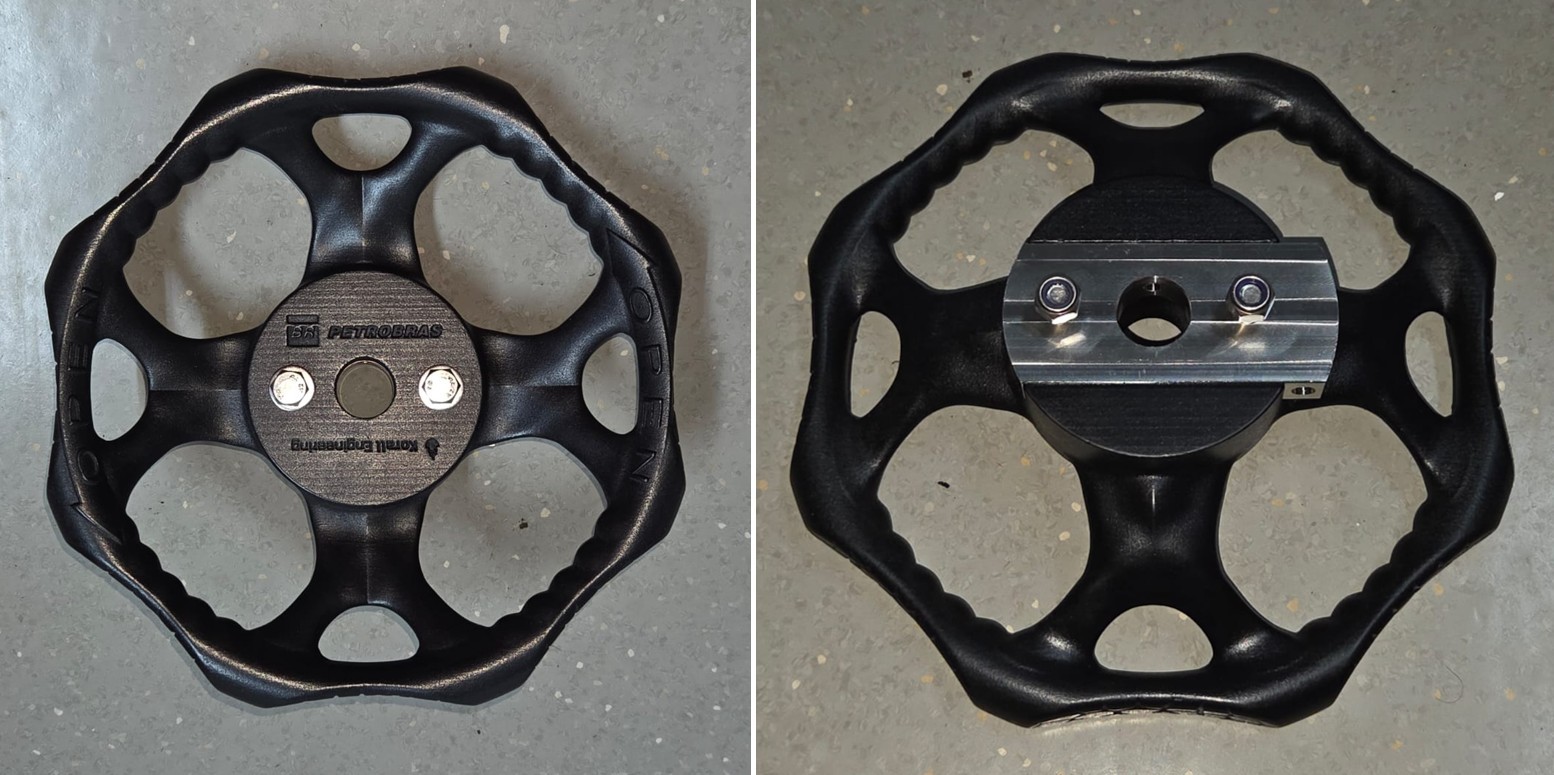
Non-metallic handwheel, 3D printed by Senai Cimatec using “state of the art” technology from Korall Engineering AS and HP machine.
However, this goes beyond the typical spare part, as it is the first DNV-qualified polymer component to be installed in the Latin American market. DNV, the world’s premier classification society for oil & gas and maritime, has been leading the effort to qualify spare parts for digital inventory platforms for years. Moreover, Latin America is now arguably the region that will be most significant to the oil & gas sector’s profitability for the foreseeable future.
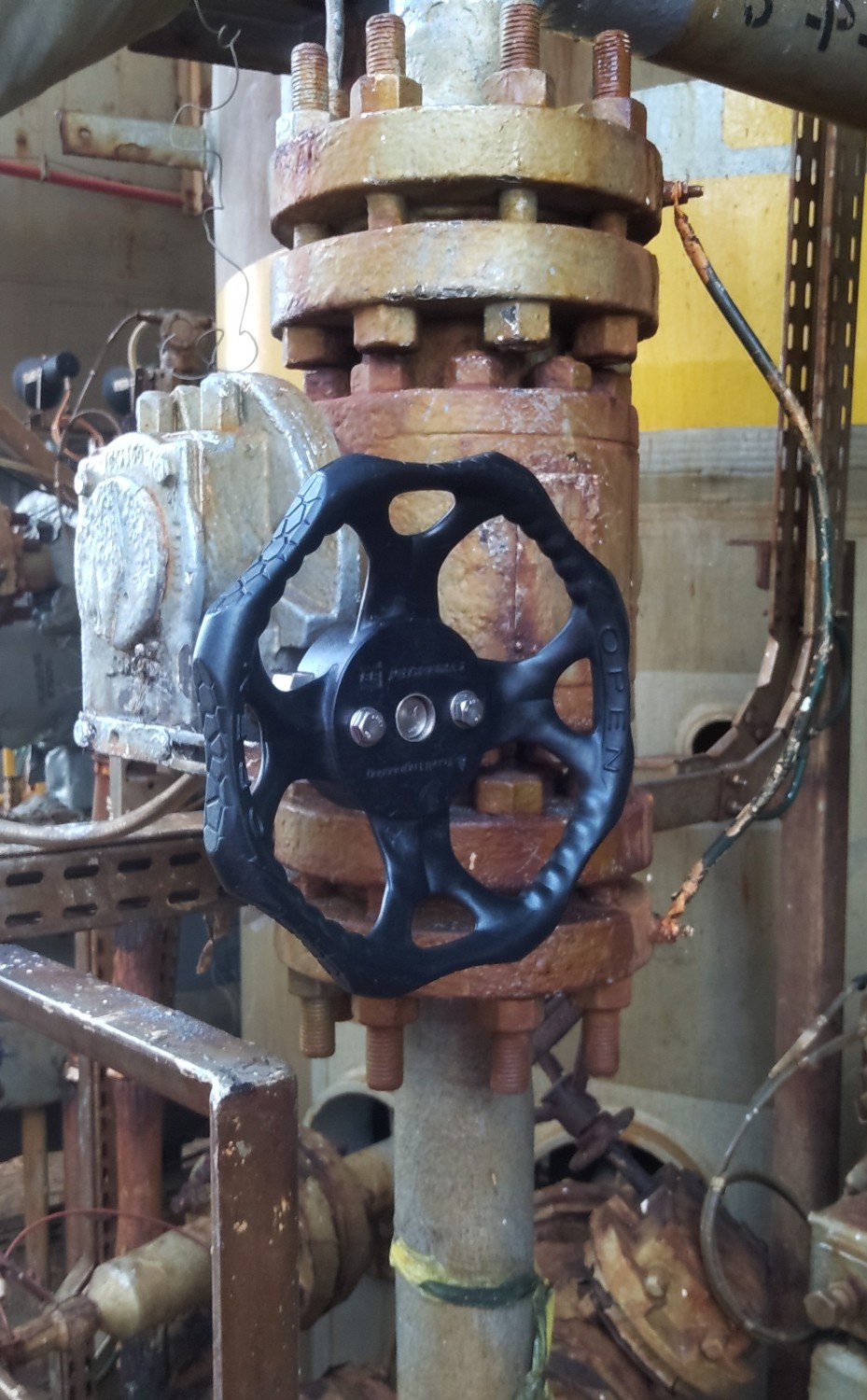
The high-performance 3D printed polymer solution.
The central paradox of the energy transition is that it has the greatest likelihood of succeeding — and I would argue, can only succeed — if it’s led in large part by the oil & gas sector. With that in mind, at some point it will no longer be enough for oil & gas producers to track their ERoEI purely in terms of the energy involved in drilling and distributing fossil fuels (which, from another perspective, counts as Scope 1 emissions). Before too long, any honest accounting of the oil & gas sector’s ERoEI will have to take Scope 2 and Scope 3 emissions into consideration, as well, which means all of the supply chains indirectly involved in the oil & gas sector’s activities.
To truly accomplish that in full is likely impossible, given that there is virtually no link in all of the supply chains that exist globally that is not tied to oil & gas. But we have to start somewhere, and the ideal place to start may be the oil & gas sector’s own spare parts. Every molecule of hydrocarbons that can be removed from the equation for spare parts like the Petrobras handwheel can improve the ERoEI of the relevant drilling operation, compared to what that would be without Petrobras’s ability to print spares on demand.
Again, while it’s merely one spare part, it’s also far more than that because of the involvement of DNV and the growth potential in Latin America. In that sense, it is like a foot in the door for AM-enabled digital inventory in a market likely to be disproportionately impactful on the oil & gas sector’s future global sourcing strategies. The same way that Ukraine is a laboratory for 3D printed drones, Latin America could become a laboratory for 3D printed oil & gas spares.
Won’t things just go back to how they were before the Iran War started, the same way they did after Russia invaded Ukraine? Two things about that: one, I would push back very forcefully on the idea that things did “go back to normal” after Russia invaded Ukraine, given that, in less than four years, the world saw the emergence of another major oil-related conflict, one much more consequential to global energy markets than Russia’s war in Ukraine.
Secondly, the Iran War and the war in Ukraine aren’t just connected thematically; they’re connected materially, from a diverse range of angles. Most pertinently to the present discussion, the CEO of Saudi Aramco warned in 2022 that the world was running out of spare oil capacity. He and others argued that the real problem, when it came to the impact of Russia’s occupation on global oil markets, wasn’t so much the state of oil supply in 2022 and 2023, but the fact that the world was responding to that near-term crisis by spending all its long-term spare capacity. In a future crisis, in other words, there would be no such cushion to rely on.
That warning now looks to have been quite prescient, so we should take heed to the CEO’s latest word of caution, that the oil market may not “normalize” until at least 2027. To me, that seems, if anything, very optimistic. While energy markets have become a nightmare to forecast, I don’t think it’s unreasonable to entertain the possibility that what the oil market looks like, currently, is the new state of “normal.”
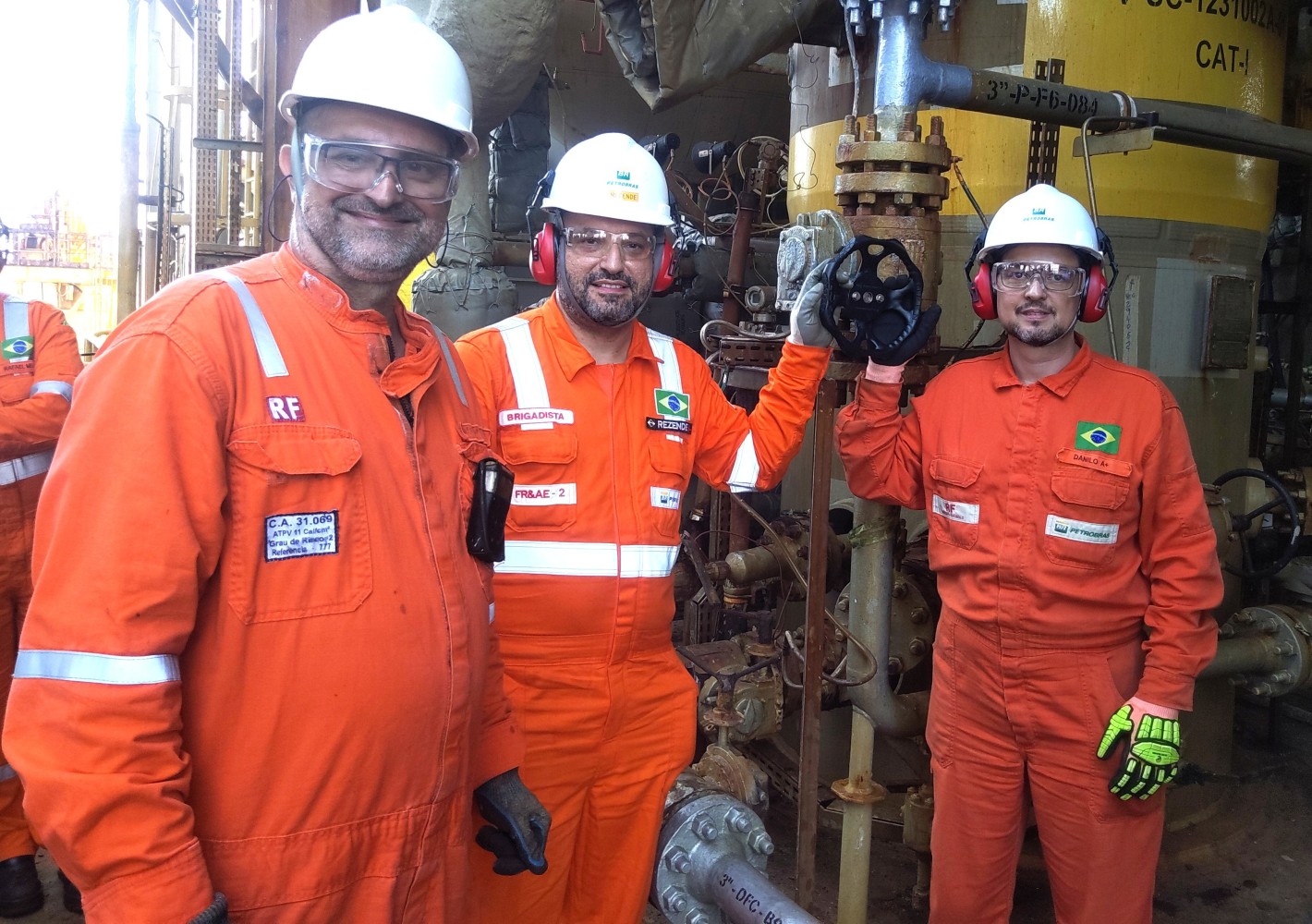
The team (Rafael Pacheco, Fabiano Rezende and Danilo Cunha) celebrating a giant leap for the Brazilian Oil & Gas industry.
Images courtesy of Petrobras
Subscribe to Our Email Newsletter
Stay up-to-date on all the latest news from the 3D printing industry and receive information and offers from third party vendors.
Print Services
Upload your 3D Models and get them printed quickly and efficiently.













You May Also Like
Additive Manufacturing Has a Major Growth Opportunity; Trust Will Decide Who Captures It
After years of overpromising, the next phase of AM growth will be won by companies that consistently deliver what they say. When I entered additive manufacturing in 2014, after 15...
Seven Trends Reveal What’s Next for 3D Printing at TCT Shenzhen 2026
TCT Shenzhen 2026 opened on October 14 in Hall 15 of the Shenzhen World Exhibition & Convention Center in Bao’an, and ran through October 16. The event brought together equipment...
Oerlikon Adds ATLIX’s xBUILD 5000, Plans More for 2027
Oerlikon has installed a new ATLIX xBUILD 5000 metal 3D printer at its facility in Huntersville, North Carolina, marking the first production deployment of the system worldwide. The machine will...
AM Demand Signals: Global Grid Resilience, Part 2
The nature of the AI boom seems no clearer despite its persistence, yet it persists. For one thing, as I’ve discussed before, people really seem to dislike data centers. American...