3D Printing Financials: Protolabs Hits Record Q3 Revenue, 3D Printing Rebounds


In Q3 2025, Protolabs‘ 3D printing revenue fell by around 6 percent year-over-year (YOY), and in Q2 2026, it declined another 2.6 percent to $20.7 million. In Q3 2026, however, the 3D printing segment experienced a decisive rebound, compared to both the same period a year prior, as well as quarter-to-quarter: revenue was $22.4 million, up 11.4 percent YOY and more than 8 percent sequentially.
These numbers become even more impressive when you consider them in context. First off, Protolabs set a new record for quarterly revenue in Q3 — $154.3 million — growing 14 percent YOY. While this might initially lead you to view the 3D printing growth as simply a knock-on effect of the company’s overall growth, it actually bucks a trend that had emerged over the last year. In Q2 2025 and the first two quarters of 2026, Protolabs also set a new revenue record each time, but in all those cases, the 3D printing division was either flat or slightly shrank.
Additionally, while 3D printing still technically saw the weakest growth amongst the company’s three main service lines, the other two being CNC machining and injection molding, the 3D printing division didn’t lag injection molding by much. That’s a big shift from Q3 2025, when, as mentioned, 3D printing revenue fell 6 percent while injection molding grew 2 percent, and an even bigger shift from Q2 of this year, when injection molding grew over 13 percent while 3D printing was flat.
One key takeaway is that while metal AM was the big driver for the company’s 3D printing growth, matching the strong performance that the company has seen in metals in recent quarters (even against a backdrop of weaker overall 3D printing performance), revenue from HP’s Multi Jet Fusion (MJF) line in Protolabs’ US factory business has also grown over 40 percent YTD. On the earnings call, the company’s President and CEO, Suresh Krishna, said they’re investing in more MJF capacity in response to heightened demand, implying Protolabs is optimistic about MJF’s potential to serve as a growth catalyst beyond 2026.
Finally, while this number isn’t directly related to 3D printing, it’s impressive nonetheless: Protolabs’ revenue per customer grew 17 percent YOY, which handily outpaced overall revenue growth. So Protolabs served fewer customer contacts than a year earlier, but revenue per contact increased by nearly 17 percent, and the ability to attract high-value customers was probably the main theme of the earnings call:
“Proto Labs is at the center of a major shift taking place in manufacturing, driven by four powerful macro trends,” Krishna noted. “First, reindustrialization: companies are bringing manufacturing closer to their customers and building more resilient regional and sovereign supply chains. Second, a wave of hardware innovation moving at the speed of software investment is accelerating across critical and emerging industries like space, drones, robotics, data centers, and other highly engineered hardware that ultimately needs to be designed, tested, and manufactured from prototype to production at faster speeds than ever before.
“Third, physical AI: AI is moving beyond software and into the physical world, driving a new generation of robotics, autonomous systems, intelligent machines, and other advanced products that require manufacturing to leverage physical AI. And fourth, supply chain agility and scalability: as innovation accelerates, companies need manufacturing partners that can invest and scale with them without the manpower and capital constraints of traditional supply chains.”
I quoted the CEO at length there because — while we don’t have a granular breakdown of how much revenue per customer grew in the 3D printing division, specifically — everything he said emphasizes how closely the company’s 3D printing capabilities align with its growth strategy. Take robotics, for instance, which, as the company recently announced, is becoming an increasing focal point for Protolabs and a key source of revenue growth. As I mentioned in my earlier post about that announcement, the company pointed to its diversity of 3D printing materials as a contributing factor in its success with robotics customers.
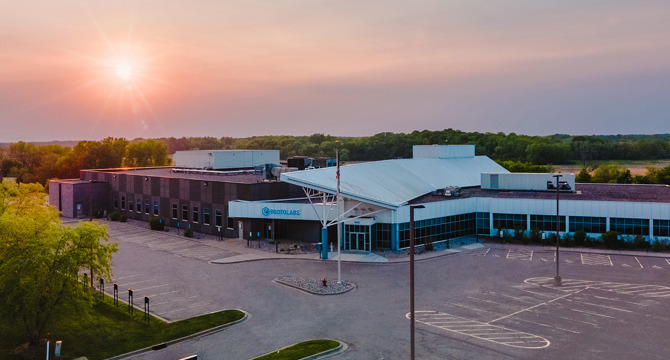
Protolabs headquarters. Image courtesy of Protolabs.
Meanwhile, the references to “reindustrialization,” “supply chain agility,” and “hardware innovation moving at the speed of software investment” are all obviously highly relevant to 3D printing. Along these lines, Krishna made another comment, in response to an analyst question about the per-customer revenue growth that’s worth highlighting:
“We are focused on a handful of industries that are high value for us, and those sales teams are building deep customer relationships and listening and turning it around to provide innovation that is specific to these customers. In the past, we may have innovated for the general customer base, which for us is tens of thousands of customers, to now being very focused on the customers where we see high value.”
Again, this is precisely the context in which 3D printing thrives. If Protolabs continues along this path, its 3D printing division could become a more consistent contributor to the company’s overall growth.
One other thing is noteworthy about Q3, which is the research grant that Protolabs announced back in August, in a new partnership with MIT and its new Industrial Performance Center (IPC). The goal of the grant is to develop a “manufacturing innovation index,” relevant to both the IPC and the university’s Initiative for New Manufacturing, which I wrote about last year. This is the kind of move forward-thinking companies make, and it’s exactly the sort of innovation partnership the US economy needs right now. It may not show up directly on a balance sheet, but it indicates a company on a path of sustainable long-term growth.
Subscribe to Our Email Newsletter
Stay up-to-date on all the latest news from the 3D printing industry and receive information and offers from third party vendors.
Print Services
Upload your 3D Models and get them printed quickly and efficiently.












You May Also Like
AMCRC’s Additive Manufacturing Forum: Australia’s Moment in the Sun?
The Additive Manufacturing CRC (Additive Manufacturing Cooperative Research Centre, or AMCRC) is a cooperative research and implementation organization dedicated to making additive happen in Australia. Headed by Simon Marriott, it...
Divergent Is Building a Factory Around 3D Printing
What started with a hypercar is now taking Divergent Technologies into aerospace and defense manufacturing. By combining software, metal 3D printing and robotic assembly, the California-based manufacturer is working to...
Russia’s 3D Printed Missiles & Can NATO Get Its Act Together?
For most of US history, however much the two major parties differed on domestic policy (in some cases a lot, overall less than you’d think), there was always essentially a...
Deals, Dollars and 3D Printing: What’s Moving in AM
There’s been plenty of business activity in additive manufacturing (AM) lately, with new deals, partnerships and investments in production. One of the bigger moves comes from Sweden, where investment firm...