
Onward for Velo3D with Optimistic Q1 Outlook, Gaining Momentum in Defense Sector

Just days after Velo3D (NYSE: VLD) revealed a brutal earnings report, the company is showing some signs of recovery, announcing bookings totaling $27 million since mid-December. What’s more, Velo3D shared the news that it is partnering with leading global contract manufacturer Mears Machine, which has acquired two Sapphire XC systems set to be dedicated to the defense and aerospace industries.
2023 proved to be a rollercoaster year for Velo3D, particularly marked by the departure of CEO and founder Benny Buller. After a tough year with declining revenue and a sharp increase in net losses, the company’s newly appointed CEO, Brad Kreger, faces significant challenges. The drop in annual revenue to $77.6 million from $80.8 million in 2022 and a net loss much larger than in previous years, soaring to $135 million, clearly signaled financial troubles.
However, Velo3D is moving forward. With the fresh influx of bookings worth $27 million and a backlog now totaling $23 million, the company shows potential for improvement. The orders for the Sapphire XC systems by Mears Machine mark a big shift and a new interest in the high-growth defense and aerospace sectors.
“These new orders reflect continued customer confidence in our technology and reinforce the success of our new go-to-market strategy, especially in the Defense and Space industries,” said Kreger. “We are also very encouraged to see that our renewed focus on system reliability and customer success is yielding results, as more than 50% of these orders are from existing customers. We are also pleased to welcome Mears Machine as a customer as they look to utilize our industry-leading capabilities to accelerate metal AM deployment in the aerospace and defense industries.”
Mears Machine, an Indiana-based business, has been around since 1966. First, as a small shop in the Mears family garage, it expanded into a 110,000-square-foot full-service supplier of precision machined components, complex fabrications, sheet metal weldments, and brazed assemblies. Catering to a wide range of industries, the company offers services from prototyping to full-scale production, working with clients globally on various projects, especially in the aerospace sector. Its facility is well-equipped with a series of manufacturing technologies, including CNC machines, electrical discharge machining (EDM), and capabilities for welding, laserjet, and waterjet cutting. Now, it adds metal additive manufacturing (AM) to its roster.

Brad Kreger speaking at the AMS 2024 CEO panel. Image courtesy of 3DPrint.com/Sarah Saunders.
Furthermore, Velo3D’s announcement also included preliminary estimates for the first quarter of 2024, with expected revenue from $6 to $11 million. This potential increase is significant compared to the last quarter of 2023, where Velo3D reported revenues of just $2 million. The expected rise in revenue for the first quarter of 2024 suggests a significant improvement from the previous quarter’s dip, attributed to lower system shipments and the transition period of its strategic realignment.
Building on this momentum, while most bookings occurred later in the quarter, the company anticipates shipping these orders in the early part of the second quarter of 2024. The expected gross margin ranges from a negative 25% to 10%, with a commitment to achieving roughly 30% gross margin by the fourth quarter of 2024. Also, operating expenses are expected to be between $13 million and $18 million.
Despite the troubling figures from the previous year, Velo3D’s strategic changes and the recent increase in bookings are optimistic. Focusing its energy on critical sectors like defense appears to be a good strategy likely to yield positive results for Velo3D.
It appears that the defense sector could indeed be a lifeline for the 3D printing industry, including Velo3D. A recent collaboration between Velo3D and Additive Manufacturing (AM) Research resulted in a white paper called “3D Printing and the Defense Sector: The Future is Now,” which highlights the growing importance of AM in defense. This document sheds light on the increasing reliance of defense contractors and militaries on AM technologies driven by strategic competition, particularly between the U.S. and China.
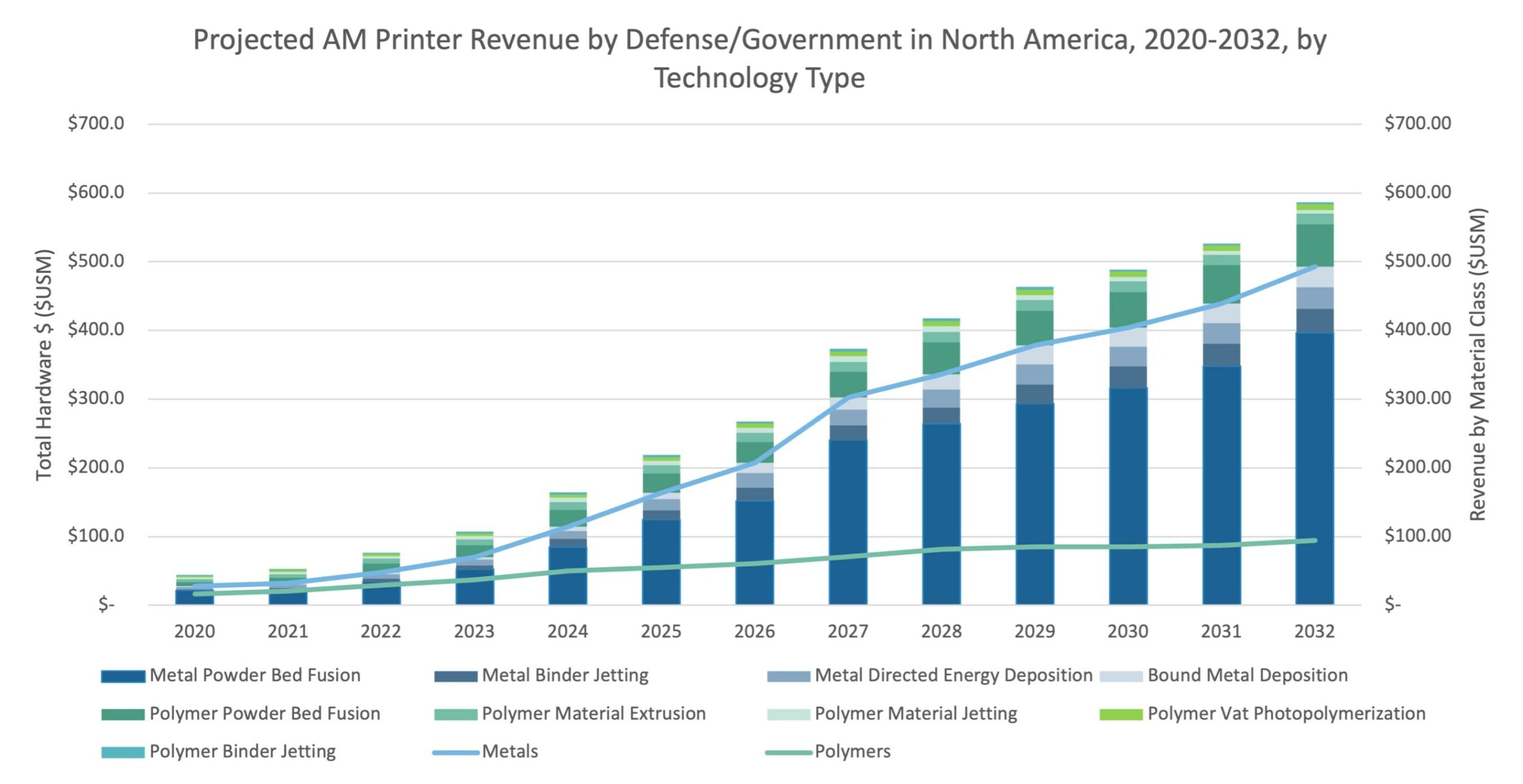
Projected AM Printer Revenue by Defense/Government in North America, 2020-2032, by Technology Type. Image courtesy of Additive Manufacturing Research.
The Department of Defense (DoD) is working hard to align U.S. manufacturing with its allies, pushing forward research and new technologies, especially in 3D printing. This is important for making supply chains more digital and quicker. Getting parts fast is vital for national security, showing how important the defense industry is for 3D printing’s growth. Furthermore, a recent AM Research report predicts that the DoD’s spending on AM will surge from $300 million in 2023 to $1.8 billion by 2032, making the sector a critical driver for the entire 3D printing industry’s future growth.
Efforts by the U.S. government to bring manufacturing back to the country show how vital the defense sector is to 3D printing firms. By working with the defense market, Velo3D is moving into an industry with great opportunities. Meanwhile, Velo3D is starting to see a change despite last year’s tough times. The contrast between the bleak financial report of 2023 and the promising start to 2024 highlights the unpredictability of the tech and manufacturing sectors. However, Velo3D’s resilience shows the company still has a clear vision for recovery, and this new lifeline is just what it needs to navigate its financial challenges and reclaim its position in the AM landscape.
Subscribe to Our Email Newsletter
Stay up-to-date on all the latest news from the 3D printing industry and receive information and offers from third party vendors.
Print Services
Upload your 3D Models and get them printed quickly and efficiently.













You May Also Like
Why the AM Industry Should Pay Attention to Schneider Electric’s $22.6B PTC Acquisition
By late 2024, there was already enough signaling of the additive manufacturing (AM) industry opportunity in the data center infrastructure market for AM Research to write a report on the...
How Does Nike’s 3D Printing Approach Fit Into Its Restructuring Plan?
Shares of Nike stock hit all-time highs in late 2021 but have cratered in the years following, with the company losing nearly 80 percent of its market cap since peaking....
3D Printing News Briefs, October 1, 2026: Defense, Enclosures, & More
In today’s 3D Printing News Briefs, we’re starting with defense news, first from Massivit and then from AML3D. Then we’ll move on to U.S. manufacturing of a new large-format LPBF...
South Korea’s Lincsolution Lands Hanwha Defense Deal as Hanwha Invests Billions in US
I recently wrote about how the South Korean additive manufacturing (AM) firm Lincsolution is building an aerospace and defense hub, part of the company’s construction of “the largest AM facility in...
























































